Strategic Fashion: Could the 20-Year-Rule Apply to Brand and Communication Planning?
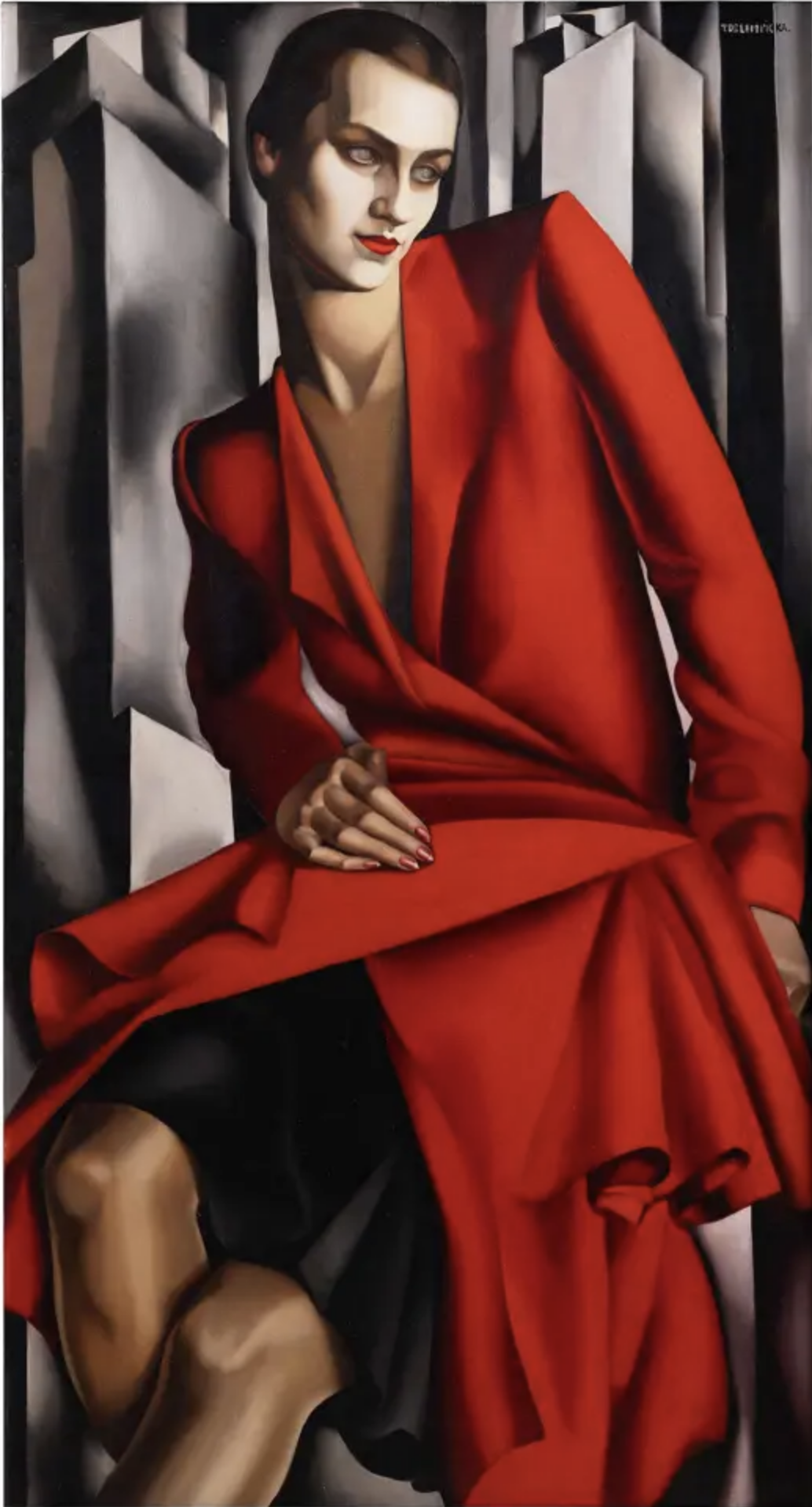
Tamara de Lempicka (1894-1980), Portrait of Mrs. Rufus Bush

I’m not fashionable, but I’m interested in fashion.

I like to read about skinny jeans, white jeans, barrel leg and baggy jeans; about rich neutrals, microbuns, bixies and man brooches. I like to consider bold pops, polka dots and pointelle fabric; French tuck collars, scelts and tomato red. I like to discover that they’re channelling Marie Antoinette and Diane Keaton, JFK Jnr and Carolyn Bessette; to learn that sandwich dressing is where you contrast a middle layer between two matching elements.

A while ago, I read in The Times (Rhys Blakely, 17 March 2026) that researchers have found evidence to substantiate the long-held fashion principle that trends follow a cycle of approximately two decades.

A study by mathematicians at Northwestern University in the United States examined nearly 160 years’ worth of women’s clothing records, scrutinizing databases of tens of thousands of garments, design drawings and archive images. In particular, it focused on the rise and fall of hemlines.

Employing a spectral analysis technique, the academics discovered repeating wave patterns of style, recurring on a timescale of roughly 20 years. For example, the shorter dresses of 1920s flappers gave way to longer hems in the 1930s, only for hems to rise again in the 1940s, and again in the 1960s with the miniskirt.

According to the research, designers’ and consumers’ desire to stand out – a little, but not too much - from popular conventions, creates a ‘cultural pendulum.’

‘Over time, this constant push to be different from the recent past causes styles to swing back and forth. The system intrinsically wants to oscillate, and we see those cycles in the data.’
Daniel Abrams, professor of engineering sciences and applied mathematics, Northwestern University 

We tend to regard the world of brand and communication planning as one of steady progress; of evolutionary learning; of gradual ascent towards superior practices and techniques.

But what if strategy is also subject to fashion? What if the 20-year-rule applies to planning?

I seem to recall that, two decades or so ago, deep in the mists of time, we were concerned with user values and usage occasions; with KPIs, USPs and SWOT analyses; with brand personification, cognitive dissonance and calls-to-action. There was some weird stuff about Greek gods. And we created temples, lighthouses, pyramids and stadia; eggs and onions; task-based briefs, chords, conveyer belts and yin yang charts. (Source: Mintel)

Are some of these approaches relevant now? Could they be revived and rebooted? Could they be the mullet of modern strategy, returning to centre stage in a blaze of glory? Or are they destined to remain forever out in the cold, like pleather chaps and platform trainers; sweatbands, leg warmers and fascinators?


'She's the face on the radio.
She's the body on the morning show.
She's there shaking it out on the scene.
She's the colour of a magazine.
And she's in fashion.
She's in fashion.
She's employed where the sun don't set.
And she's the shape of a cigarette.
And she's the shake of a tambourine.
And she's the colour of a magazine.
And she's in fashion
And she's in fashion.’
Suede, ‘
She’s in Fashion’ (B L Anderson, N J Codling)

No. 572

When Revolutionaries Become Reactionaries: Alfred Munnings and the Disenchantments of Age


‘My Wife, My Horse and Myself’ - Alfred Munnings

‘My Wife, My Horse and Myself’ - Alfred Munnings

The most radical revolutionary will become conservative the day after the revolution.’
Hannah Arendt, Philosopher and Political Theorist

I confess I’m partial to the art of Alfred Munnings. 

In the first half of the twentieth century Munnings painted East Anglian life in bold, bright colours: race meetings, horse fairs and hunting; farm hands, gentry and gypsies. Mostly he just painted horses, for whom he seemed to have a greater affection than he had for people. He titled one painting ‘My Wife, My Horse and Myself’ and the horse takes centre stage.

To modern eyes Munnings’ paintings are not particularly challenging or thought provoking. But in his youth he was part of the progressive art colony based on the south coast of Cornwall, the Newlyn School, and he served as a war artist during the First World War. His work is honest, open and true. It is rooted in the English countryside and English painting tradition. It is in its own way rather beautiful.

‘Every hero becomes a bore at last.’
Ralph Waldo Emerson, Essayist


Sadly Munnings’ reputation in the art world is tarnished. As he grew older he developed a passionate dislike of modernism. In his late sixties he served as President of the Royal Academy of Art and, in a speech broadcast live on the BBC in 1949, he drunkenly accused his fellow painters of ‘shilly shallying in this so called modern art.’ He suggested that Cezanne, Matisse and Henry Moore had corrupted art, and he joked that he’d like to join Churchill in kicking Picasso up the arse.

’The Start at Newmarket’ - Alfred Munnings

’The Start at Newmarket’ - Alfred Munnings

‘A great scientific truth does not triumph by convincing its opponents and making them see the light, but rather because its opponents eventually die.’
Max Planck, Nobel Prize-winning Physicist

I was prompted to think about Munnings by a piece I read in The Times (Rhys Blakely, 17 September 2019). A recent study by the Massachusetts Institute of Technology tracked the careers of 13,000 elite scientists, looking at their funding, published papers and citations. The research suggests that ‘superstar scientists,’ once they have achieved a position of authority, tend to suppress new ideas from other quarters. After their deaths their field of study is often invigorated by younger rivals, who suddenly publish research at a faster rate, and by scientists migrating from other adjacent subject areas. 

‘Our results suggest that, once in control of the commanding heights of their fields, star scientists tend to hold on to their exalted position – and to the power that comes with it – a bit too long.’ 
Pierre Azoulay, MIT

This conclusion may resonate with people working in business today. The senior ranks of industry are quite often filled with individuals who in their youthful prime were high-achieving radicals. However, with the passing of the years and the accrual of status, recognition and rewards, these same people can become increasingly conservative, set on defending their turf from new people and new ideas. They can’t help regarding the world through the prism of their own talents and beliefs. In time most revolutionaries become reactionaries.

’Morning Ride’ - Alfred Munnings

’Morning Ride’ - Alfred Munnings

Speaking from experience, as you get older you can feel marginalised. The world seems to be reinventing itself around the needs and tastes of new generations. It’s easy to resent change. And conservatism creeps over you like a comfortable blanket. We all occasionally suffer Luddite leanings.

‘All sorts of allowances are made for the illusions of youth; and none, or almost none, for the disenchantments of age.’
Robert Louis Stevenson, Writer

I’m not sure it’s wise to ‘rage against the dying of the light.’  At least not in the reactionary way that Munnings did. We may not want to run at the future, but we certainly shouldn’t run away from it. The grumpy old man or woman is rarely attractive, seldom makes for an effective leader, and should probably avoid the sauce when speaking in public.


'Old man, take a look at my life
I'm a lot like you.
I need someone to love me
The whole day through.
Ah, one look in my eyes
And you can tell that's true.’

Neil Young, ‘Old Man'


No. 259