Strategic Fashion: Could the 20-Year-Rule Apply to Brand and Communication Planning?
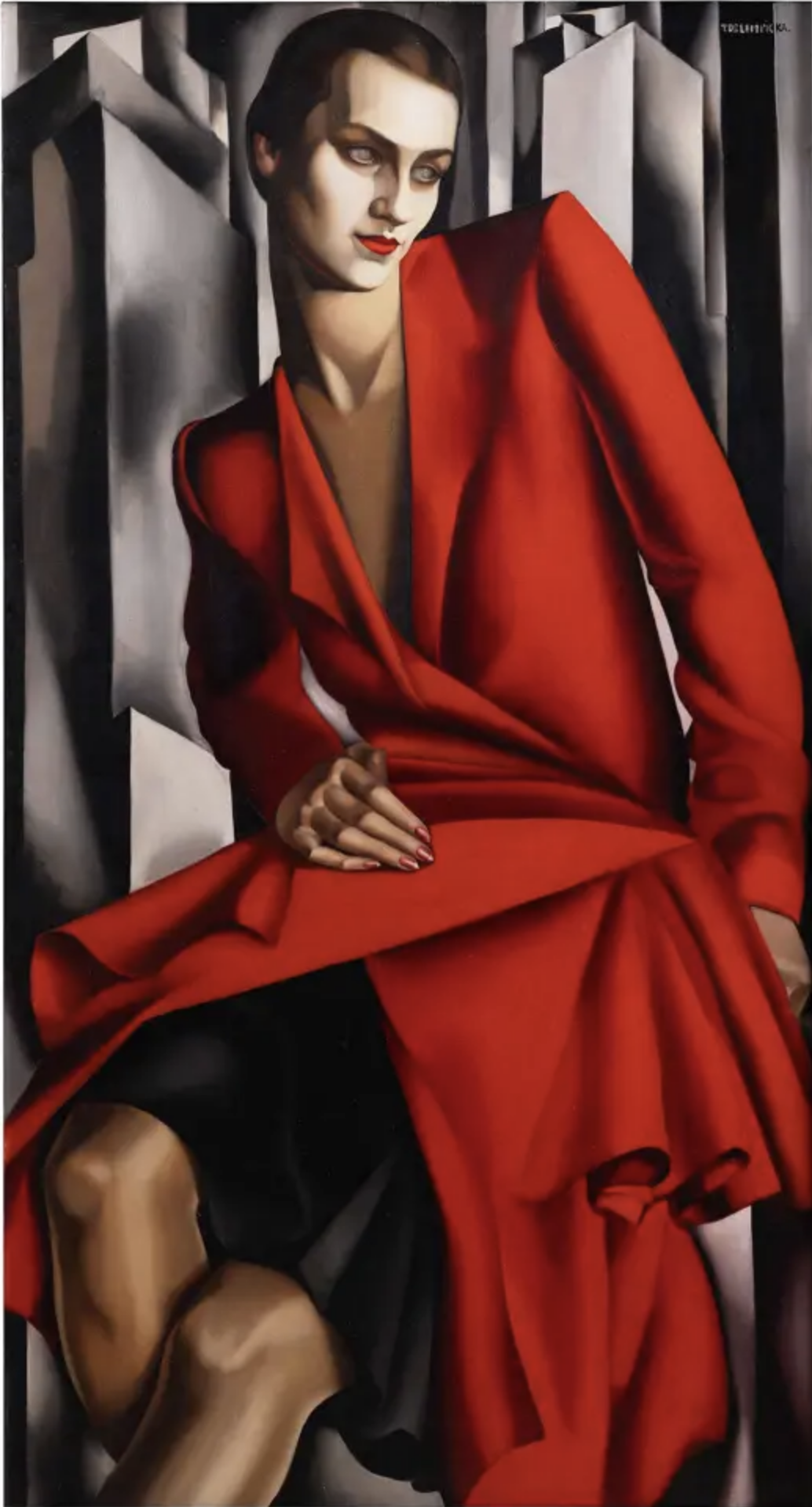
Tamara de Lempicka (1894-1980), Portrait of Mrs. Rufus Bush
I’m not fashionable, but I’m interested in fashion.
I like to read about skinny jeans, white jeans, barrel leg and baggy jeans; about rich neutrals, microbuns, bixies and man brooches. I like to consider bold pops, polka dots and pointelle fabric; French tuck collars, scelts and tomato red. I like to discover that they’re channelling Marie Antoinette and Diane Keaton, JFK Jnr and Carolyn Bessette; to learn that sandwich dressing is where you contrast a middle layer between two matching elements.
A while ago, I read in The Times (Rhys Blakely, 17 March 2026) that researchers have found evidence to substantiate the long-held fashion principle that trends follow a cycle of approximately two decades.
A study by mathematicians at Northwestern University in the United States examined nearly 160 years’ worth of women’s clothing records, scrutinizing databases of tens of thousands of garments, design drawings and archive images. In particular, it focused on the rise and fall of hemlines.
Employing a spectral analysis technique, the academics discovered repeating wave patterns of style, recurring on a timescale of roughly 20 years. For example, the shorter dresses of 1920s flappers gave way to longer hems in the 1930s, only for hems to rise again in the 1940s, and again in the 1960s with the miniskirt.
According to the research, designers’ and consumers’ desire to stand out – a little, but not too much - from popular conventions, creates a ‘cultural pendulum.’
‘Over time, this constant push to be different from the recent past causes styles to swing back and forth. The system intrinsically wants to oscillate, and we see those cycles in the data.’
Daniel Abrams, professor of engineering sciences and applied mathematics, Northwestern University
We tend to regard the world of brand and communication planning as one of steady progress; of evolutionary learning; of gradual ascent towards superior practices and techniques.
But what if strategy is also subject to fashion? What if the 20-year-rule applies to planning?
I seem to recall that, two decades or so ago, deep in the mists of time, we were concerned with user values and usage occasions; with KPIs, USPs and SWOT analyses; with brand personification, cognitive dissonance and calls-to-action. There was some weird stuff about Greek gods. And we created temples, lighthouses, pyramids and stadia; eggs and onions; task-based briefs, chords, conveyer belts and yin yang charts. (Source: Mintel)
Are some of these approaches relevant now? Could they be revived and rebooted? Could they be the mullet of modern strategy, returning to centre stage in a blaze of glory? Or are they destined to remain forever out in the cold, like pleather chaps and platform trainers; sweatbands, leg warmers and fascinators?
'She's the face on the radio.
She's the body on the morning show.
She's there shaking it out on the scene.
She's the colour of a magazine.
And she's in fashion.
She's in fashion.
She's employed where the sun don't set.
And she's the shape of a cigarette.
And she's the shake of a tambourine.
And she's the colour of a magazine.
And she's in fashion
And she's in fashion.’
Suede, ‘She’s in Fashion’ (B L Anderson, N J Codling)
No. 572
