Figures in Extinction: ‘If Separation is the Question, Then Connection is Surely the Answer’
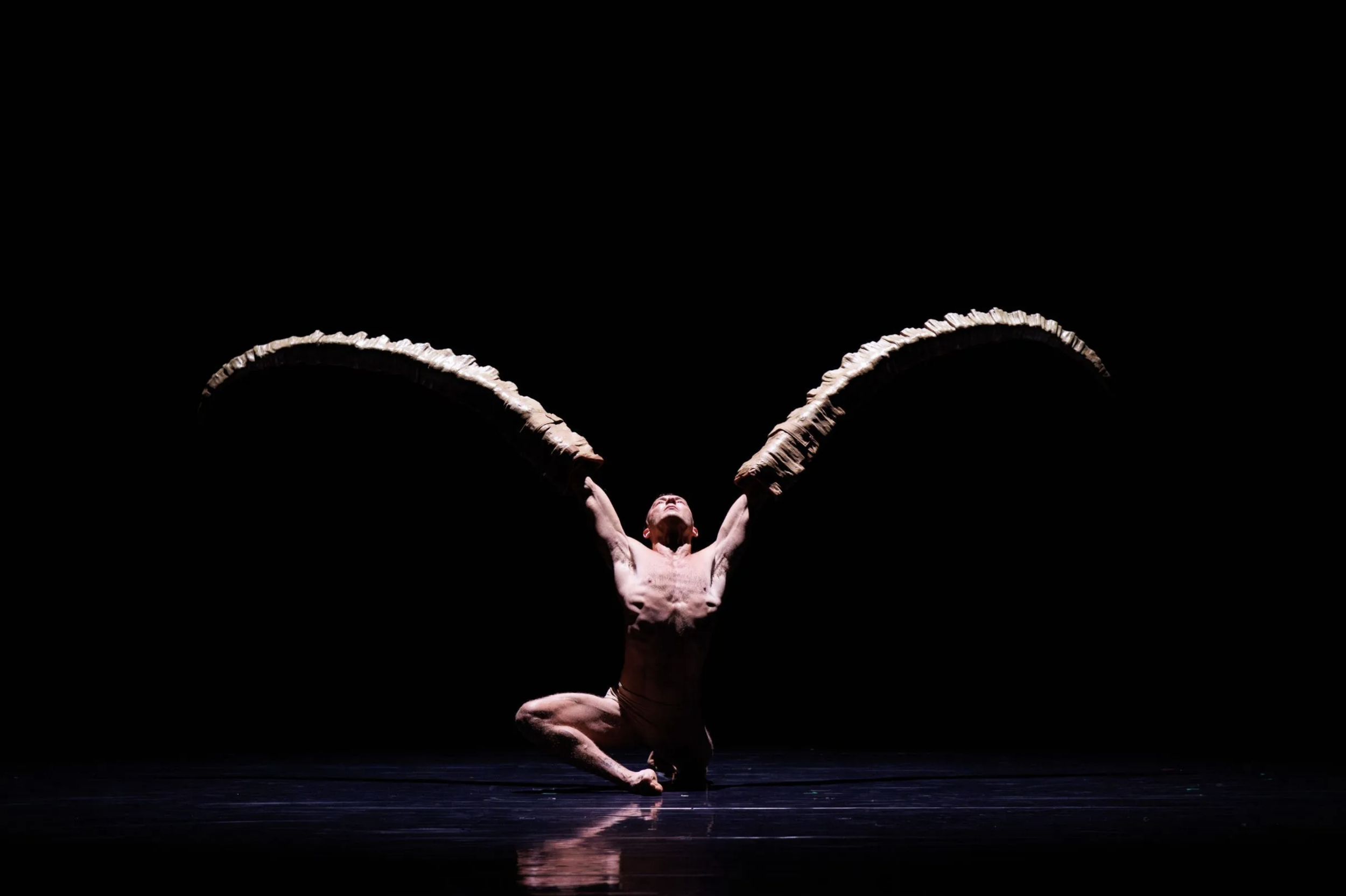
Still from Figures On Extinction © Andrew Perry

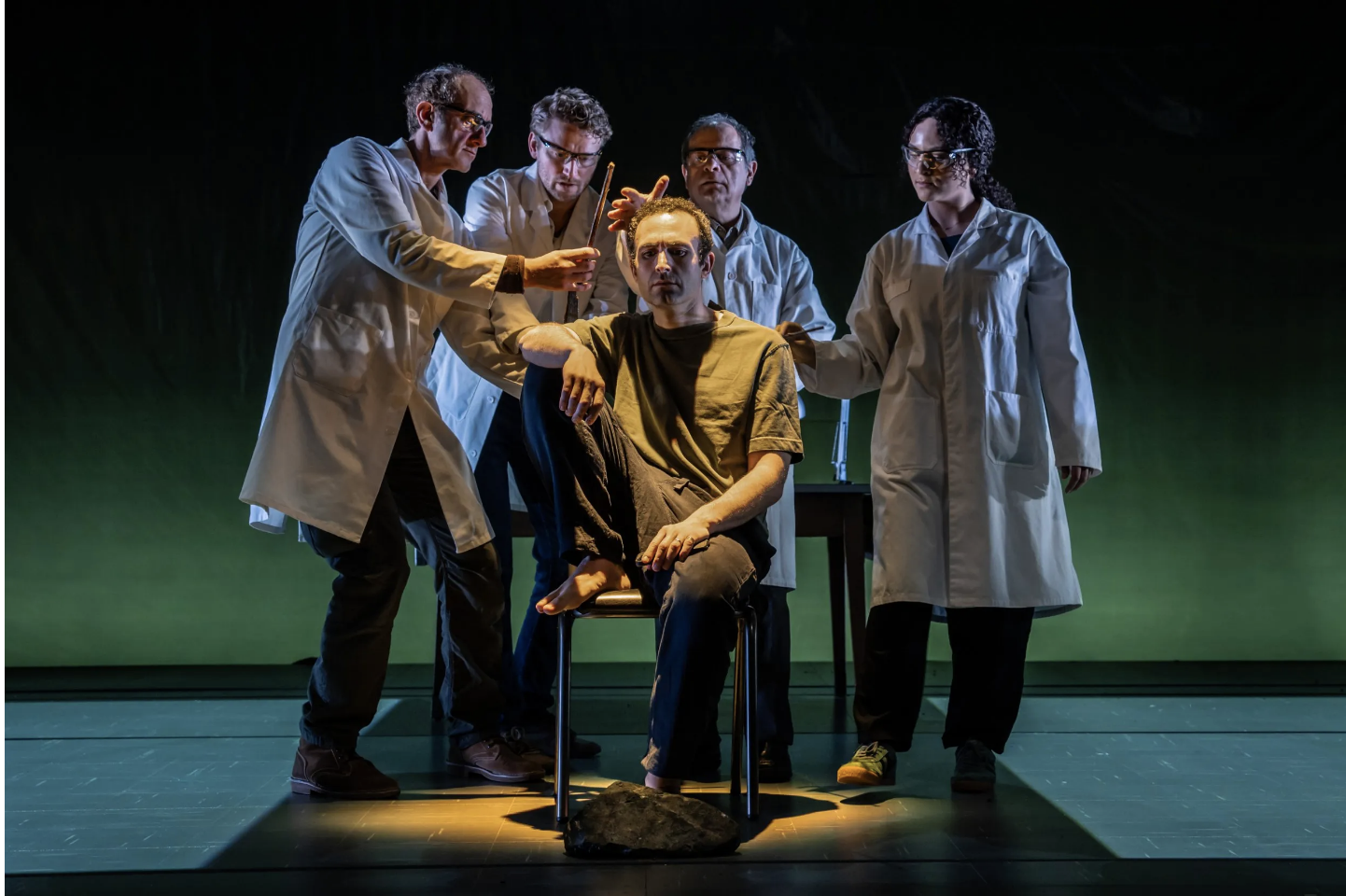
‘Figures in Extinction’ is a three-act dance work that considers the climate crisis, the segmentation of the brain, and society’s attitudes towards death. It is at the same time thought provoking and deeply moving. (Sadler’s Wells, London, 5-8 November 2025. I’m afraid it’s over now. Let’s hope it returns some time soon.)

‘The way you treat the outer world reflects what is happening in your inner world.’
Simon McBurney

The piece is a collaboration, between the choreographer Crystal Pite and the theatre-maker Simon McBurney; between Nederlands Dans Theater and Complicité. The plan was for Pite to lead the first part, for McBurney to lead the second, and for the third segment to be composed jointly. In practice, the co-creators found that sharing responsibility was more productive.

I choreographed all sorts of things, and Crystal wrote scenes and shaped stories. We didn’t stay on our patch because we never felt we had a patch.’
Simon McBurney

In fluid, restless motion, the dancers congregate and scatter, circle each other and separate, coil and uncoil. With sweeping gestures and sinuous lines, arms arch, bodies quiver and hands flicker. The mood is dark and sombre, as a voiceover takes us on a philosophical journey.

Figures In Extinction -  Nederlands Dans Theater and Complicité

Section one catalogues the animals, plants and places that have become extinct in the last century. The dancers’ subtle movements suggest the Pyrenean ibex, the Asiatic cheetah and the passenger pigeon; a warbler and a macaw, a herd of caribou and a shoal of hand-fish; poisonous frogs, blossoming irises and melting glaciers.

‘That’s what we do, as humans: we label and list, like in a museum.’
Crystal Pite

We hear an innocent child struggling to understand the absences. Meanwhile, a suited climate change denier stalks the stage, spouting false claims and flawed logic. 

In the second part, humanity itself comes under the microscope. We listen to a lecture on brain science by psychiatrist and neuroscientist Iain McGilchrist, the words dramatized by the dancers

‘The left hemisphere yields clarity and power to manipulate things that are known, fixed, static, isolated, decontextualised, explicit, general in nature, but ultimately lifeless. The right hemisphere by contrast yields a world of individual, changing, evolving, interconnected, implicit, incarnate living beings within the context of the lived world.’
Iain McGilchrist

McGilchrist contends that, in our hyperactive contemporary culture, the left brain has become dominant, creating a tendency to rules, control, bureaucracy, and a loss of freedom.

As Albert Einstein is reputed to have said:

'The intuitive mind is a sacred gift and the rational mind is a faithful servant. We have created a society that honours the servant and has forgotten the gift.’
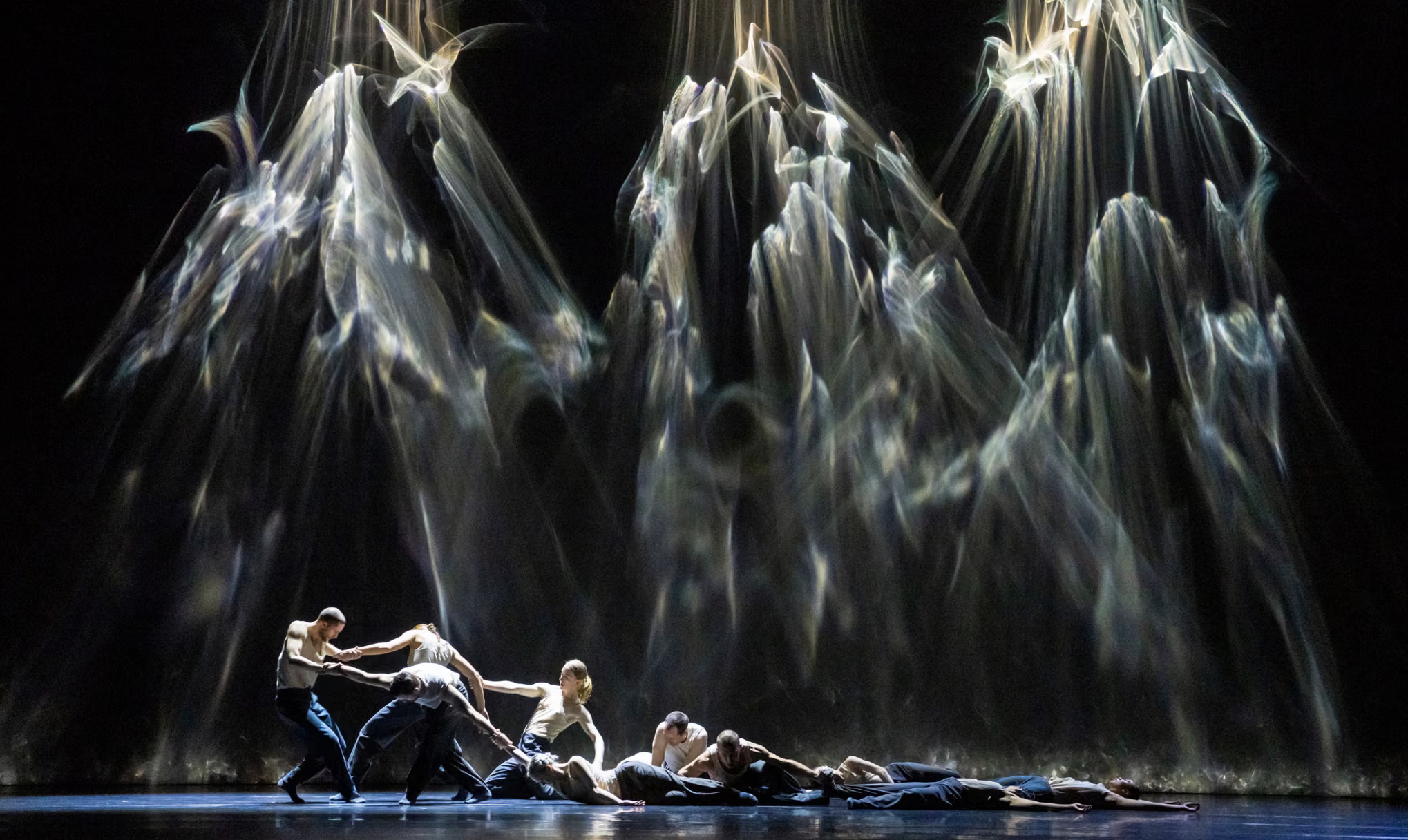
Figures In Extinction -  Nederlands Dans Theater and Complicité. Photograph: Tristram Kenton/The Guardian

McGilchrist concludes that we are increasingly confined in a ‘hall of mirrors.’

‘There’s a hall of mirrors effect; the more we get trapped into this, the more we undercut and ironise things that might have led us out of it. We just get reflected back into more of what we know about what we know.’
Iain McGilchrist

The third act considers mortality. Families gather round a death bed. A body decomposes. The Doomsday Clock ticks towards midnight. And yet still we turn away from accepting these stark truths.

Whilst in awe of the choreography and touched by the grand themes, I confess I found myself struggling to understand how the three parts of ‘Figures in Extinction’ linked together. And then, in the programme notes, I read an interview with Pite and McBurney conducted by Sanjoy Roy. The work, it transpires, is fundamentally concerned with separation and connection.

‘We began with the desire to approach the climate crisis, but as we dug deeper, we felt it boiled down to separation: our perceived separation from the living world, our separation from the intuitive mind, our separation from the dead. And if separation is the question, then connection is surely the answer. You can feel a yearning for connection running like a luminous thread through the whole show.’
Crystal Pite

I found this rather a compelling thought. It’s true: as technology professes to draw us closer together, we find ourselves drifting further apart. Separated by screens, shepherded by algorithms, isolated by doomscrolling, our information is edited and moderated; our thinking is processed and packaged; our experience is filtered and abstracted. We yearn for intimacy, authenticity, real feeling. We need to re-learn connection.

'Only connect! That was the whole of her sermon. Only connect the prose and the passion, and both will be exalted, and human love will be seen at its height. Live in fragments no longer.'
EM Forster, 'Howards End'

'Hold my hand.
I am afraid.
Please pray for me,
When I am away.
Comfort the girl,
Help her understand.
No memory,
No matter how sad,
And no violence,
No matter how bad,
Can darken the heart,
Or tear it apart.
Take my hand,
When you are scared,
And I will pray,
If you go back out there.
Comfort the man.
Help him understand,
That no floating sheet,
No matter how haunting,
And no secret,
No matter how nasty,
Can poison your voice,
Or keep you from joy.'

Perfume Genius, ’
Normal Song’ (Michael Hadreas)

No. 546

SUBSCRIBE

The Amnesiac Industry: If We Have No Memory of the Past, We Can Have No Vision for the Future

‘Mnemonic’ at the National Theatre Photo: Johan Persson 

Mnemonic’ is a play about memory and migration, ancestry and storytelling. (The National Theatre, London, until 10 August).

The body of a man has been discovered under Tyrolean ice. It turns out to have been preserved for over 5,000 years. How did the Iceman get there? Where did he come from? Was he a shaman or a shepherd, a victim of a patriarchal challenge, or of a pogrom?  

A woman disappears on the morning of her mother’s funeral. She has set off on an odyssey across Europe, in search of the father she never knew.

Her partner, left behind in London, desperately tries to make sense of it all.

A 1999 work by the Complicité theatre company, ‘Mnemonic’ was conceived and is directed by Simon McBurney. This imaginative, layered production uses props and visual effects to take us on a speeding train, into bars and bedrooms, and up to an Alpine ridge. We are invited to don a mask and feel a dead leaf. We meet migrants living in London suburbs. And an articulated chair plays a starring role. We are prompted to reflect on the interconnectivity of our pasts and futures; on the fundamental human need for narratives.

In particular, the play asks us to consider memory.

‘Memory is a pattern. Of electrical synaptic connections. Each time you remember, your brain has to re-make this pattern. It is a creative act, and it happens at a speed no computer can match. But the memory is different each time. And because the pattern can never be exactly the same, so it is… an imaginative act. Remembering is about discarding and choosing, forgetting and creating, losing and finding, dismantling and simultaneously re-making.’

Simon McBurney

‘Mnemonic’ begins with a discussion of a celebrated neuroscience case. (Also outlined in the Programme Notes by Daphna Shohamy, Professor of Brain Science at Colombia University.) In the 1950s a man underwent surgery for a severe condition of epilepsy. The surgeon removed his hippocampus, a seahorse-shaped structure behind each ear. The patient recovered well - his past memories, language, reasoning and sense of self remaining intact. But he lost the ability to create new memories.

‘[Subsequent research has established that] Patients with hippocampal damage struggle not just with new memories, but also with imagining the future. When asked to envision future events – such as plans for next weekend, or their next birthday party – their minds draw a blank.’
Daphna Shohamy

I was struck with this thought that our memories determine our capacity to imagine the future.

The communications industry proudly proclaims its talent for predicting, managing and creating change. It positions itself firmly in the future, always looking forward to the next horizon; to tomorrow’s world.

But it tends not to be so expert in the past, rarely reflecting on historic models, case studies and thinking; seldom studying the learnings of previous generations.  

It is an amnesiac industry. And as such it is constrained in its ability to progress at pace, and cursed continually to re-make past mistakes.

I’d advise young strategists to be historians as much as forecasters. I’d encourage them to read Paul Feldwick’s analysis of how different eras have understood advertising effectiveness (‘The Anatomy of Humbug’); to consider old D&AD, APG and IPA Effectiveness annuals; to talk to veteran practitioners; to visit the History of Advertising Trust.

Because if we have no memory of the past, we can have no vision for the future.

'Did we give up too soon?
Maybe we needed just a little room.
Wondering how it all happened,
Maybe we just need a little time.
Though we did end as friends,
Given the chance we could love again.
She'll always love you forever,
It's not hard to believe.
I want you and I need you so I’m...
Sending you forget me nots,
To help me to remember.
Baby please forget me not,
I want you to remember.’
Patrice Rushen, ‘
Forget Me Nots’ (P Rushen, T McFaddin, F Washington)

No. 480

SUBSCRIBE

NOTES FROM THE HINTERLAND 15

The Space Between Our Ears

At The Barbican recently I attended an extraordinary performance by Simon McBurney of the Complicité theatre company.

The Encounter considers issues of environmentalism, materialism, communication and time. In the play McBurney relates the story of Loren McIntyre, an American photographer who in 1969 was dropped into the Amazon rainforest on an assignment for National Geographic. McIntyre soon locates the nomadic Mayoruna tribe that he had been hoping to shoot, but soon loses the camera he had been hoping to shoot them with. Nonetheless, he follows the Mayoruna deep into the jungle, to the brink of starvation, tripping on their mystical herbs, joining them in their quest to find ‘the beginning.’ McIntyre is convinced that the tribe’s shaman is communicating with him telepathically. ‘Some of us are friends’, he seems, rather cryptically, to be suggesting, over and over again.

McBurney enacts this compelling story without costumes, or set, or other actors. In fact the stage resembles a radio-recording studio as McBurney, surrounded by props, circles a ‘binaural’ microphone that records in a kind of 3D.

We the audience listen through headphones. We hear voices, sounds, noises in the dark; we hear McBurney creating beautiful birdsong, the buzz of mosquitoes, the growl of airplane engines. He blows into the microphone and we feel the heat of his breath on our ears.

We are together in the theatre, but alone in our private soundscapes. We close our eyes and follow McIntyre into the heart of darkness.

Overall it’s a disarming experience. It made me think of the phenomenal power of sound, of storytelling and of the imagination. It took me back to the power cuts of 1974’s Three-Day Week, when we listened with mother in the candle light, to Radio 4 plays and Dr Finlay’s Casebook…

In the communications industry we spend so much time and money these days on location shoots, on CGI and special effects. We seek to recreate the past, to simulate the future, to bring distant lands to our doorsteps. But we leave little room for the imagination. It’s as if we’ve lost our faith in the phenomenal human capacity to dream, invent, envisage.

In his book Hegarty on Advertising Sir John Hegarty urges us to think beyond platforms, technologies, channels and media space. He encourages creatives to concentrate on ideas, and on communication’s ultimate destination, the mind.

‘The only space worth occupying is the space between someone’s ears.’

It’s a healthy reminder. Ideas engage the brain more effectively than any cunning creative device, canny media strategy or quirky technology. Ideas are comfortable unadorned, in the nude so to speak. And the best ideas have a life of their own. They are suggestive, seductive, conspiratorial. They linger.

As I left The Barbican that night, inspired but also confused somewhat by what I had experienced, I could not help hearing a voice whispering quietly at the back of my brain:

‘Some of us are friends.’

(The Encounter is on tour across the UK and the rest of Europe until 25 June)


Appetite

‘I’ve weathered the storms. I’ve fallen down and I’ve gotten back up.’

The recently released documentary film Mavis! tells the story of Mavis Staples, singer with The Staple Singers throughout the ‘50s, ‘60s and ‘70s, and even on into the ‘90s. She has now been performing for 60 years and still sings her heart and soul out at the age of 76.

Mavis grew up on the South Side of Chicago, the neighbourhood that spawned soul legends Sam Cooke, Curtis Mayfield and Jerry Butler. Her father Roebuck ‘Pops’ Staples organised his children into The Staple Singers, combining his own country blues heritage with a vibrant gospel sound. Pops sang with a sweet, thoughtful voice, young Mavis sang with raw, deep emotion.  As Bonnie Raitt observes in the documentary, she was ‘sensual without being salacious.’

Initially The Staple Singers’ material addressed purely gospel themes. Then one day, while on tour in the South, Pops took the family to see Dr Martin Luther King speak at a local church. He was deeply moved by the encounter.

‘I like this man’s message. If he can preach it, we can sing it.’

The group took to singing Freedom Songs in support of the civil rights movement. Songs such as ‘Why? (Am I Treated So Bad)’ and ‘Long Walk to DC’ had conviction, courage, clarity of purpose. They signed to Stax and had huge hits with ‘I’ll Take You There,' ‘Respect Yourself' and many more besides. They created anthems of authority, yearning and pride.

Mavis comes across as a luminous, forthright, humble soul who can laugh in the face of ageing:

‘That’s the best time I’ve had since I got my new knees.’

Her speech is intercut with the rich vocabulary of the church and the civil rights struggle.

‘I’m a living witness….I’ll stop singing when I’ve got nothing left to say.’

It’s this appetite that most impressed me. The appetite to ‘keep on keepin’ on.’ Appetite is an elusive quality. One minute you have it and the next it has completely deserted you. Mavis illustrates very powerfully that the key to sustaining appetite over the long term is a sense of purpose, a sense of mission.

In the marketing community we’ve been talking a good deal about Purpose over recent years. Purpose defines a brand’s broader social responsibility and contribution. It galvanises colleagues, partners and stakeholders around a higher order goal.  But critically Purpose ensures that appetite endures, that it is persistent, permanent; through thick and thin, good times and bad.

‘I’ve come too far to turn back now. I’m determined to go all the way.’
Mavis Staples, Mavis!

  
Speak Like a Child

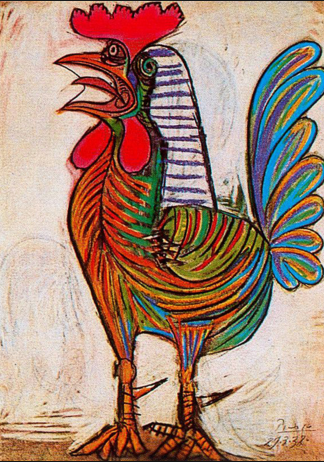
‘It took me four years to paint like Raphael, but a lifetime to paint like a child.’
Pablo Picasso

Pablo Picasso Le Coq

When I was younger I well recall being told that The Jam derived their sound from The Who and The Kinks; that Echo and the Bunnymen owed their sonic style to The Doors; that first generation Dexy’s were channelling Sam & Dave. I cared not a jot. These were our bands. They were our team. No sarcastic snipe or world-weary remark from the older generation could tarnish their integrity.

Now I’m the one that can hear every young band’s influences. I can’t ignore the shadow of a Beatles chord progression, the echo of Marvin’s rhythm section, the replication of Morrissey’s wordplay. And so I struggle to enthuse.

The Curse of Middle Age is familiarity, recognition, experience, discernment. Your palate, once refined, can become jaded; your enthusiasm qualified. You can’t see the originality.

And I suspect this Curse of Middle Age is at play in the workplace too.

One of the keys to sustaining interest and value in professional life, particularly in the creative industry, is to shed this corrosive cynicism; to dismiss the instinct to say ‘I’ve heard it, seen it, done it before’; to refrain from rose-tinted nostalgia; to retain a wide-eyed optimism; to be childlike, not childish; to learn to speak like a child.

‘I really like it when you speak like a child.
The way you hate the homely rank and file
The way you’re so proud to be oh so free and so wild.’
 

Paul Weller/The Style Council/Speak Like a Child

No. 70

Subscribe