In the Final Reckoning, Kindness Trumps Success
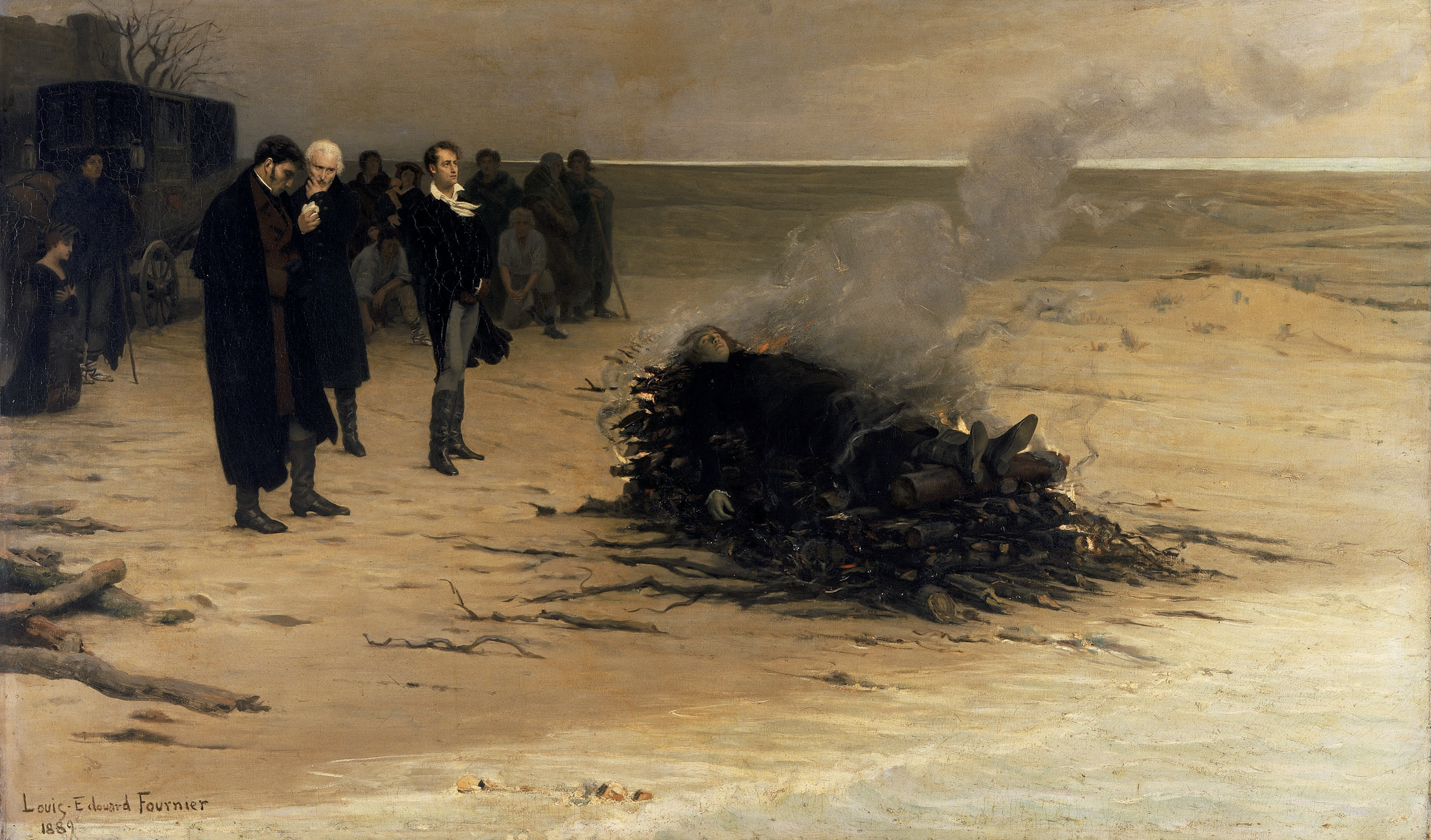
The Funeral of Shelley by Louis Édouard Fournier. Walker Art Gallery Liverpool

I read recently in The Times (12 January, Rhys Blakely) about a study into the language used in obituaries.

A team of academics, led by David Marcowitz of Michigan State University, has analysed 38 million US memorials that appeared between 1998 and 2024 on the Legacy. com platform. 

As Markowitz observes, death notices illuminate what we hold dear:

‘Obituaries serve as a unique source of information about how societies value different kinds of lives. They reveal broader patterns of remembrance by showing who is remembered, for what contributions, and how cultural values are expressed through these acts of memory.’

The research, published in the journal The Proceedings of the National Academy of Sciences, found that the most prevalent personal value in obituaries was tradition (religious participation and enduring customs etc) which was represented in about 80% of cases. Next came benevolence (caring for the welfare of others) with 76%. Words relating to ‘achievement’ and ‘power’ featured far less often – in fewer than 25% of cases.

We may note that, in the final reckoning, kindness consistently trumps success.

This may give us pause for thought in the world of work, when we reach those forks in the road that require us to make difficult decisions.

There is a business tradition that encourages toughness, aggression and hostility: commerce is competitive; it’s dog-eat-dog out there; the end justifies the means.

‘You’ve got to look after number 1 to survive.’

Sobering to reflect that, in the long run, in the court of community opinion, we will be judged by our consideration for others. 

Concepts like courtesy and concern, tenderness and tolerance have not conventionally been regarded as essential to business performance. They are too soft. But perhaps these qualities are critical. Perhaps they represent the basis for an enduring legacy. 

'Let me know,
Have you started to lose your love for me?
And if so,
Will you still continue to be on my side?
Tell me if you still care about me.
I was so insecure with you,
Did you still want me?
So I let go of the feeling that you
Were still all mine.
Tell me if you still care about me.
(Show me that you care)
Tell me if you still care about me.’
The SOS Band, '
Tell Me If You Still Care’ ( J Harris III, T Lewis)

No. 553

If You Want to Survive the Rat Race, You Need to Learn to Enjoy the Ride

Researchers have discovered that rats can be trained to drive a car, and that they enjoy the experience. With practice, and the incentive of some Froot Loop breakfast cereal, a sample of laboratory rats steered a vehicle constructed from a plastic container, by grasping at a wire that propelled it forward. (Kaya Burgess, The Times, 19 November, 2024)

Writing on The Conversation website, Kelly Lambert, a professor of behavioural neuroscience at the University of Richmond, Virginia observed:

‘Unexpectedly, we found that the rats had an intense motivation for their driving training, often jumping into the car and revving the ‘lever engine’ before their vehicle hit the road.’ 

The scientists then set about establishing whether the rats’ eager anticipation was for the Froot Loops or the driving. And so, they offered the rats a choice: they could either access the Froot Loop by making a short journey on foot, or they could climb into the car and drive the long way round to the treat.

‘Surprisingly, two of the three rats chose to take the less efficient path of turning away from the reward and running to the car to drive to their Froot Loop destination. This response suggests that the rats enjoy both the journey and the rewarding destination.’

Perhaps the lab rats can teach us a lesson. 

Work shouldn’t just be about ends, goals and objectives. If we enjoy the process as well as the prize, we can be more fulfilled; we can make better teammates; and, over time, we can become more resilient.

'It’s not the destination, it's the journey.’
Ralph Waldo Emerson

My fondest recollections of advertising are not just of pitch wins and finished commercials. They are of deconstructing briefs and developing hypotheses; of sharing thoughts and shaping executions. The synergies of multi-disciplinary teams and the camaraderie under pressure. The diplomacy of client engagement and the theatre of presentation. The daft situations, wise aphorisms and witty observations. 

I found the journey as satisfying as the arrival.

As Lambert concludes:

‘Anticipating positive experiences helps drive a persistence to keep searching for life’s rewards. Planning, anticipating and enjoying the ride may be key to a healthy brain.’

Useful advice if you want to survive the rat race.

'You're working at your leisure to learn the things you'll need.
The promises you make tomorrow will carry no guarantee.
I've seen your qualifications, you've got a PhD
I've got one art O level, it did nothing for me.
Working for the rat race,
You know you're wasting your time.
Working for the rat race,
You're no friend of mine.
You plan your conversation to impress the college bar,
Just talking about your Mother and Daddy's Jaguar.
Wear your political T-shirt and sacred college scarf,
Discussing the worlds situation but just for a laugh.
You'll be working for the rat race,
You know you're wasting your time.
Working for the rat race,
You're no friend of mine.’
The Specials, ‘
Rat Race’ (R J Byers)

No. 506