Phaedra: A Life of Surprises
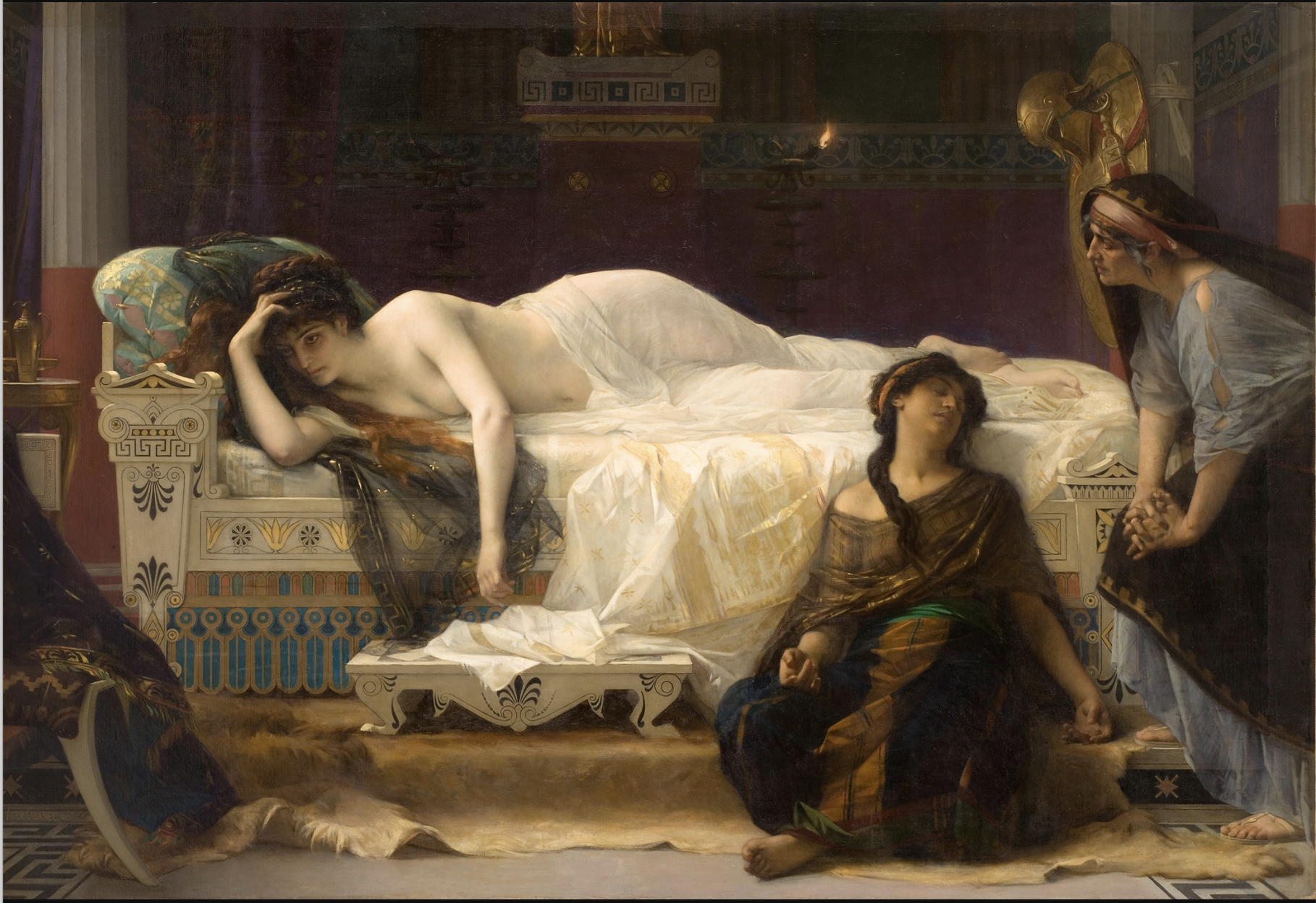
Alexandre Cabanel - Phaedra, 1880. Oil on canvas. Musée Fabre, Montpellier

As I took my seat at the National Theatre, I was surprised to see a stylish young couple settling in next to me. 

We had bought tickets to see the classical work Phaedra. This would typically be the domain of quarter-zips and blazers, the floral midi-dress and white trainers; of fleece, grey hair and walking-sticks.

I was concerned that the stylish young couple would find this ancient Greek tragedy about a woman who falls in love with her stepson hard going.

Nonetheless, as the lights went down, I hoped for the best.

The production was a modern ‘re-imagining’ of the Phaedra story by Simon Stone, drawing on versions by Euripides, Seneca and Racine. (This was 2023. It’s not on-stage now, I’m afraid.)

Helen (Phaedra), a charismatic politician, convenes a meal with her husband, teenage son and married daughter. They are visited by Sofiane, the son of Helen’s former, now dead, lover.  

Sofiane blames Helen for stealing his father away from his mother, and believes their affair led to his death. He has fantasised about Helen since childhood, and she, dissatisfied with her marriage, falls for him, recognising a strong resemblance to her lost partner.

I sensed at the interval that the drama had engaged the couple next to me. It was complex, psychologically nuanced, unpredictable. Would Helen turn out to be a hero, villain or victim?

But then the plot took a further twist. Sofiane embarks on another affair – this time with Helen’s daughter.

At this point the young woman next to me was startled. She extended her hands in front of her and audibly exclaimed: ‘What the actual f**k!’

I would not normally approve of audience participation of this sort. But it was such a natural, spontaneous response. She was genuinely shocked.

'There are two kinds of taste, the taste for emotions of surprise and the taste for emotions of recognition.'
Henry James

I was pleased that a classical play, albeit a modern version, could provoke such a reaction. But of course. Greek tragedy concerns itself with fate and free will; with pride and desire, violence and vengeance; with flawed heroes coming to terms with their weaknesses and mistakes. The plots would comfortably adapt to contemporary Netflix dramas.

‘The element of surprise is the most important thing and what keeps me interested in writing.’ 
Phoebe Waller-Bridge

We imagine that it’s difficult to disarm and unsettle contemporary generations. That they’re too knowing, cynical and worldly wise. That they’ve seen it all before. 

But if you set the right context for an audience; if you manipulate their assumptions, suggest the plot is going one way and then take it another, then it’s still possible to jolt people out of their seats.

And surprise remains one of the most potent tools in the storyteller’s armoury.

‘What the actual f**k!’

'Never let your conscience be harmful to your health.
Let no neurotic impulse turn inward on itself.
Just say that you were happy, as happy would allow.
And tell yourself that that will have to do for now.
Darling, it's a life of surprises.
It's no help growing older or wiser.
You don't have to pretend you're not crying,
When it's even in the way that you're walking.’

Prefab Sprout, ‘A Life of Surprises’ (P Mcaloon)

No. 550

SUBSCRIBE

Swimming In The Shallow End

Portrait of an artist, by David Hockney

Portrait of an artist, by David Hockney

My father worked for a time at a gasket factory in Romford. One Christmas he presented me with a corporate diary he had been given by an industrial felt supplier. Inside they’d printed their slogan: ‘You need the felt. We felt the need.’ I loved that line. I thought it was so funny, clever and beautiful at the same time.

I was at school studying for my A Levels: Latin, Greek, Ancient History. It was a robustly academic diet. I found that, having immersed myself in Homer, Horace and Herodotus, I was increasingly distracted by Essex fashion and soul music, pub banter and puns. I was drawn to the facile, frivolous and foolish. I guess it was a kind of mental displacement.

In the early ’80s, pop was revered anew in the UK. In the wake of the ponderous rock and precocious punk of the ’70s, we embraced ABC, Haircut 100 and Dollar with gusto. We believed in the beauty of the three minute pop song: shiny lyrics, shallow sentiments, shimmering production. We believed that there was an integrity in pop that raised it above the pretentious posturing of the indie crowd; that there was a kind of perfection in its brevity and wit. We believed that love itself was fragile, funny and transient.

Around about that time I determined that I’d one day like to work in advertising.

‘And all my friends just might ask me.
They say,”Martin, maybe one day you’ll find true love.”
I say,”Maybe. There must be a solution
To the one thing, the one thing, we can’t find”’

The Look of Love, ABC

In my 20s I noticed my social circle was narrowing and deepening. I was spending more and more time with a tight knit bunch of close friends. Although I greatly enjoyed their company, I became concerned that my conversation was increasingly predictable, that I was reinforcing my own prejudices and opinions. And so I set myself the task of developing a broad but shallow social set. I endeavoured to ensure that I saw a lot of friends infrequently. (I wouldn’t necessarily recommend this particular game plan. It was frankly rather exhausting).

Nigel Bogle once complained that Planning had a nack of digging down to Australia to discover the meaning of a paper clip. In my brief, and I have to say less than successful, tenure as Head of Planning at BBH, I endeavoured to address this. I transposed my ‘broad and shallow’ strategy to Planning: I encouraged the department to experience more things less profoundly; to work on more projects less intensively. Broad and Shallow Planning was to be my legacy to the strategic community. Strangely it was never widely adopted…

I guess I have always felt a little uncomfortable with the elevated status we afford brands nowadays. We talk of trust and love and ideals. Loyalty, passion, faith. Visions, missions, purposes. It sometimes strikes me as faintly bombastic. Brands as Wagnerian heroes. The Emerson, Lake and Palmers of consumption. The high concept action movies of marketing. Roll the credits. Lighters in the air. Cue the helicopters. Cue the smoke machines. Cue Coldplay. Cue Ghandi…

Surely not all soft drinks can save the babies, not all toothpastes can launch a thousand ships. Surely many brands have more modest roles to play in people’s lives. The fleeting glance, the quiet companion, the casual acquaintance. Shouldn’t we of all people be celebrating the inconsequential, the insignificant, the incidental? For these foolish things are truly the stuff of life.

‘A cigarette that bears a lipstick’s traces,
An airline ticket to romantic places.
A tinkling piano in the next apartment,
Those stumbling words that told me what your heart meant.
These foolish things remind me of you’

These Foolish Things, Eric Maschwitz & Jack Strachey


The fall of Icarus, Baglione

The fall of Icarus, Baglione

Finally, a word of caution. We have all learned to ladder up to higher order concepts and social goods. Ordinary, everyday brands get to leave behind base functionality, to sup with sages and kings. And often it serves a brand well to give it a higher purpose and social resonance. But beware the Icarus Effect. You may be playing with the Pomp Rock of Planning. In a Creds meeting once, I told a High Street optical retailer that his brand gave consumers the gift of sight. He excused himself and said he was due back on Planet Earth.

So don’t get me wrong. I love a big, ambitious, high ground, universal idea as much as the next man. I love brands with vision, confidence and courage. I’ve even nodded along to Coldplay occasionally.

But, just for once, let’s raise a glass to the little guys, to the not-so-crazy ones. Here’s to the inconsequential, the incidental and frivolous. Here’s to the modest, the momentary and fleeting. Here’s to swimming in the shallow end.

First published: BBH Labs 25/09

No.16