Wright of Derby: Don’t Let Me Be Misunderstood
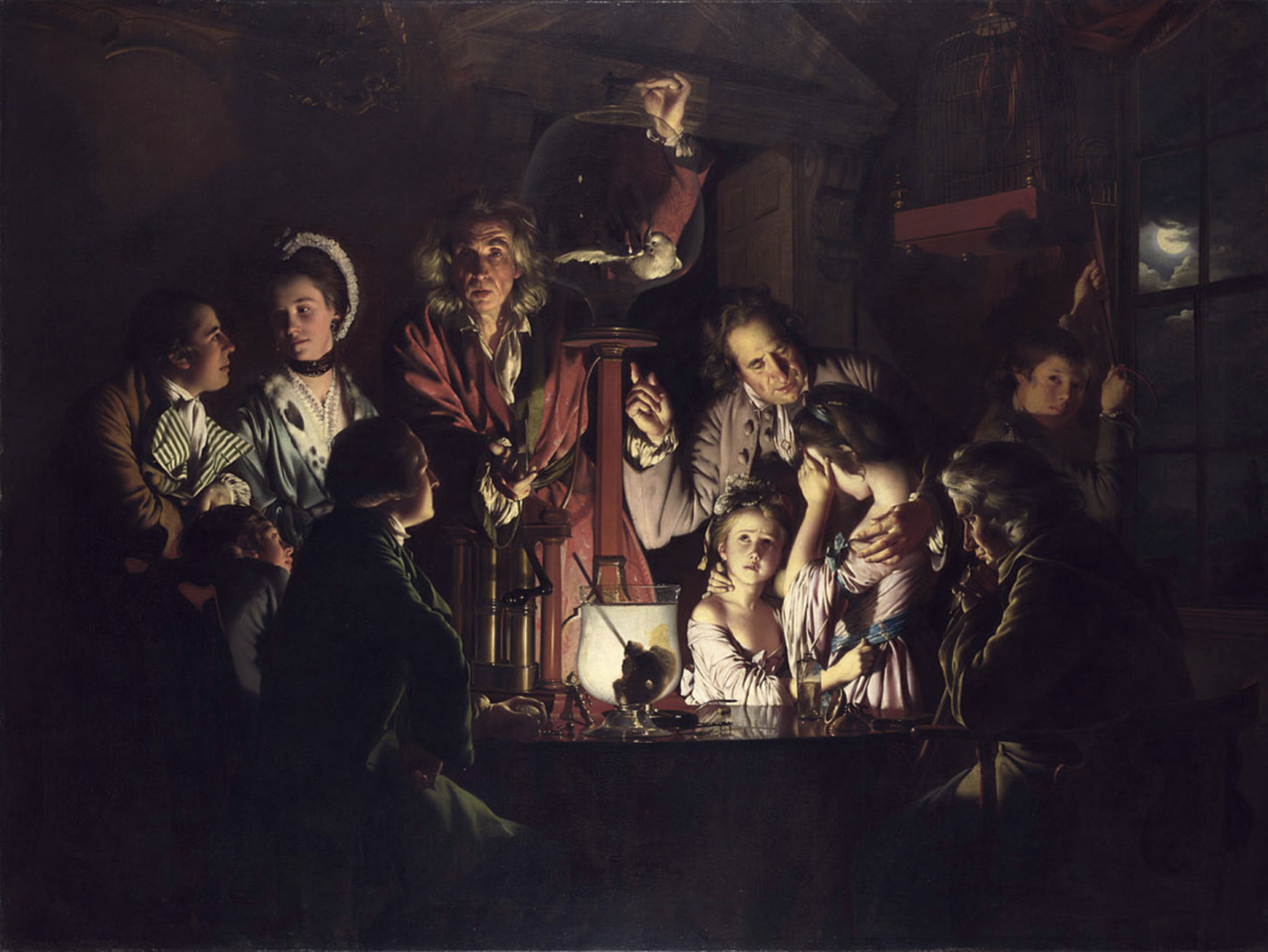
Joseph Wright 'of Derby' - An Experiment on a Bird in the Air Pump. Oil on canvas

I recently enjoyed a visit to a small exhibition of the art of Joseph Wright of Derby. (‘From the Shadows’ is at the National Gallery, London, until 10 May.)

Working at a time of extraordinary scientific breakthroughs, combining vivid realism with dramatic contrasts of light and shadow, Wright was the first painter to capture the spirit of the Industrial Revolution.

Joseph Wright was born in 1797, in Irongate, Derby, into a respectable family of lawyers. Having studied in London, he established himself as a portraitist in Liverpool, Italy and Bath, before eventually settling back in Derby. There he mixed with the pioneering industrialists and scientists of the Lunar Society, a club that met in Birmingham, during the full moon, for intellectual discussion and experimentation. His patrons included Josiah Wedgwood, the entrepreneurial potter, and Richard Arkwright, the creator of the modern factory system.
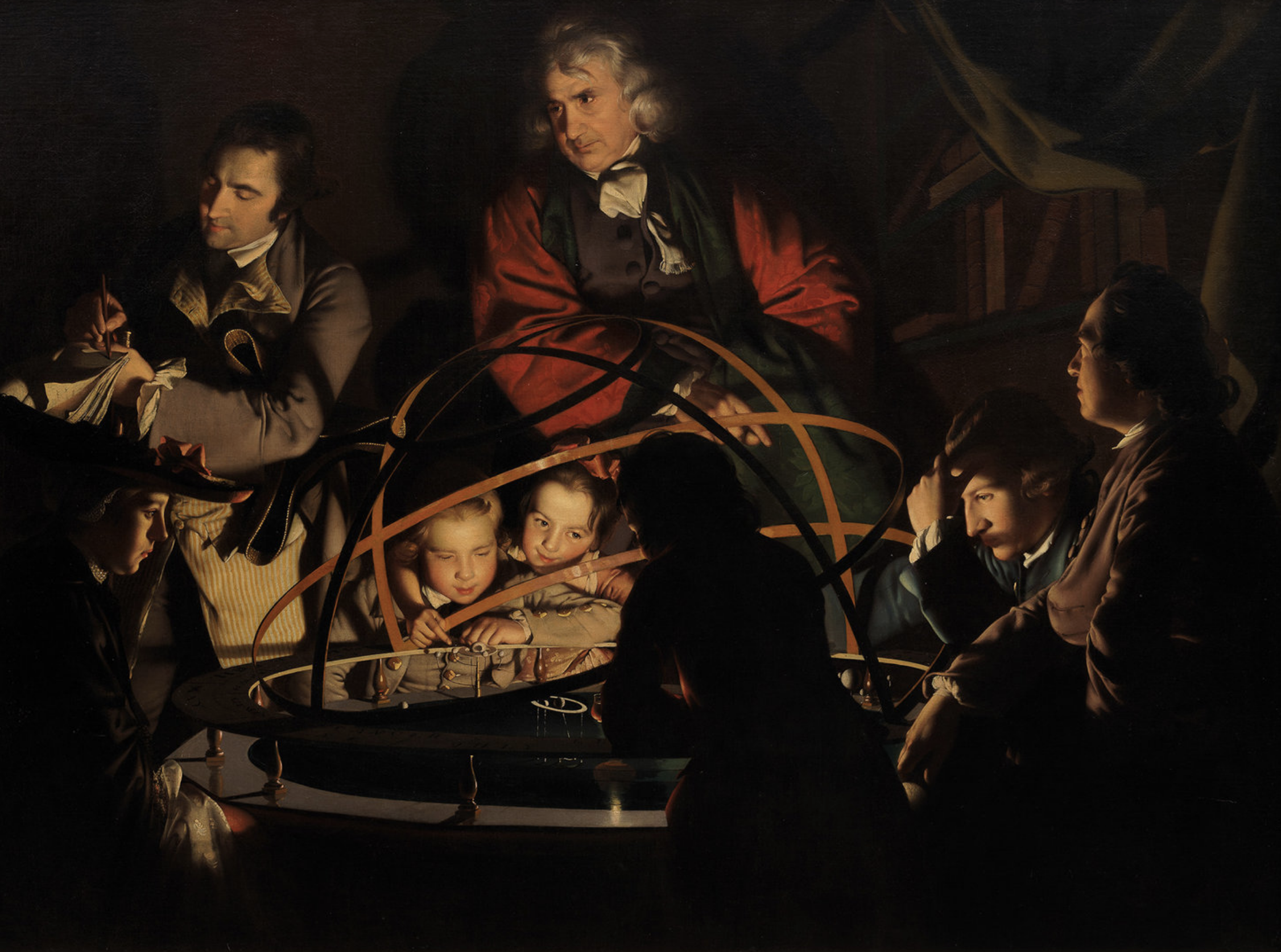
Joseph Wright 'of Derby' - 'A Philosopher giving That Lecture on the Orrery in Which a Lamp Is Put in the Place of the Sun. Oil on canvas

The show focuses on Wright’s ‘tenebrist’ works – atmospheric scenes with extreme contrasts of light and dark, in the tradition of Caravaggio - that were painted between 1765 and 1773. 

Ironmongers toil in a murky forge. Late at night an alchemist takes to one knee as he discovers glowing phosphorus. By lamplight, an elderly philosopher contemplates a human skeleton. By candlelight, three academics examine a plaster cast of a gladiator. In a darkened room, a travelling teacher explains the movement of planets, using an ‘orrery’, a clockwork model of the solar system. 

These paintings capture the excitement of science, the thrill of progress, the shock of the new.

Consider ‘An Experiment on a Bird in the Air Pump.’ A long-haired lecturer draws air from a glass flask to demonstrate the effect on a grey cockatoo trapped inside. It is night, and the room is lit by a single candle. Two men dispassionately examine the panicked bird, one of them timing the trial. Two girls cling to each other in distress. The older is unable to watch, but her father, placing a consoling hand on her shoulder, encourages her to pay attention. Two lovers only have eyes for each other. An elderly gentleman stares mournfully, not at the bird, but at a glass bowl containing a human skull. 

Joseph Wright 'of Derby' - Three Persons Viewing the Gladiator by Candlelight. Oil on canvas

I was particularly struck by this complex web of gazes and glances. We all tend to go through life and work with one particular point of view – our own. But often it is only when we reflect on other people’s perspectives, that we can truly understand a dilemma. And it is only when we consider how others see a problem, that we are able to solve it.

Perhaps the most haunting perspective in ‘An Experiment on a Bird in the Air Pump’ is that of the lecturer. He looks directly out at us, the viewers, as if to ask: What do we make of this scene? Is it science or sadism? Is this progress or regress?

'Baby, you understand me now,
If sometimes you see that I'm mad?
Don't you know no one alive can always be an angel,
When everything goes wrong, you see some bad?
But I'm just a soul whose intentions are good,
Oh Lord, please don't let me be misunderstood.
You know sometimes, baby, I'm so carefree,
With a joy that's hard to hide.
And then sometimes again it seems that all I have is worry,
And then you're bound to see my other side.
But I'm just a soul whose intentions are good,
Oh Lord, please don't let me be misunderstood.’
Nina Simone, '
Don't Let Me Be Misunderstood’ (B Benjamin, H Ott, S Marcus)

No 558

Caravaggio’s Flashbulb Memories: Have We Forgotten How to Create Intense, Enduring Impressions?

The Taking of Christ

I recently attended an exhibition, at The National Gallery in London, of works by Caravaggio and the artists that followed immediately after him. (Beyond Caravaggio runs until 15 January.)

Michelangelo Merisi da Caravaggio was born in Milan around 1571. He moved to Rome when he was about 20 and it was here that he made his name. Caravaggio painted heavenly themes with low-life models; he told spiritual stories with earthy naturalism. We are drawn to the moral ambiguity, the proximity of the sacred and the profane. His characters are pensive, uncertain, intensely human. We see the brooding adolescent in the wilderness, the saint coming to terms with his calling, the artist complicit in the crime. Sometimes the subjects reach out and beckon us in. We are present, engaged, involved.

Caravaggio’s paintings also seem to be in suspended animation. He arrests time at the precise moment when the boy is bitten by a lizard; when the cardsharp considers his hand; when the deceiver realises her guilt. We witness the painful fall, the sudden recognition, the treacherous kiss.

These vivid effects are achieved in large part by lighting. The actors in Caravaggio’s dramas loom out at us from the darkness. They are spot-lit from above. It’s as if critical events have been illuminated by a flashbulb. Freeze-framed, they fix themselves in our consciousness.

“He invented a black world that had not existed before, certainly not in Florence or Rome. Caravaggio invented Hollywood lighting.”
David Hockney

In 1977 the psychologists Brown and Kulik posited the theory of Flashbulb Memory: that at certain moments of surprise or significance the brain captures vivid, detailed memories; and that these memories are more enduring, more consistent and more easily recalled than our usual, everyday recollections. We are prompted to record Flashbulb Memories at highly emotional or traumatic events. Like witnessing the death of JFK or participating in a car crash. Some have suggested that at these moments of crisis the brain records every last possible piece of stimulus because the smallest detail may be essential to survival.

You might imagine that in the world of marketing and communication, where we are engaged in the business of creating vivid and enduring recollections, we would be students of this kind of suspended animation, proponents of Flashbulb Memories. But our brand experiences are seldom heightened, our brand expressions rarely intense.

In the Content Era we seem more concerned with quantity than quality of engagement; more interested in frequency than depth of impression. Our brands are chatty, conversational, casual. We suffer from verbal prolixity and conceptual poverty. Our communication is always on, but our selectivity is often off. Why concentrate on a single moment when a hundred will do? Why focus on a single image when a thousand will do?

Perhaps we are not aware that in sacrificing selection, we may also be forfeiting intensity, and potentially therefore memorability. We do not realise that fewer, more precise, more emotionally acute images, can create deeper, more enduring, more personally meaningful recollections. Editing, selection and curation should be primary skills in the modern brand’s armory. But they seem woefully undervalued.

Saint John The Baptist in the Wilderness

‘Made some bad choices, then worse choices, then ran out of choices.’
Anna Nicole

Poor Caravaggio. His character was quarrelsome and cantankerous; his life was violent and turbulent. He drank too much, brawled too often and thought too little. He was a prototype of the impetuous artist, ‘mad, bad and dangerous to know.’

In 1606 he killed a man after an argument over a tennis match and he had to flee Rome. He settled briefly in Naples, then Malta and Sicily, and then Naples again, all the time communicating with Rome in the quest for a pardon. When he painted Salome with the Head of John the Baptist, he put his own head on the platter. It was a plea for forgiveness. Or a portent of death.

In 1610 Caravaggio set out for Rome in anticipation of his long sought pardon. But he died on the journey, possibly from a fever. Some say he was, in fact, murdered by one of his many enemies; or poisoned from the lead that was commonly used in the paint of the time. Death by art, perhaps.

Michelangelo Merisi da Caravaggio had a luminous talent and his life was intensely lived. And perhaps that’s one reason why his fame has spread so wide and his reputation will endure so long. Caravaggio’s was a flashbulb life.

No. 108