Barbara Hepworth: Searching for ‘Forms and Rhythms and Curvatures for My Own Satisfaction’
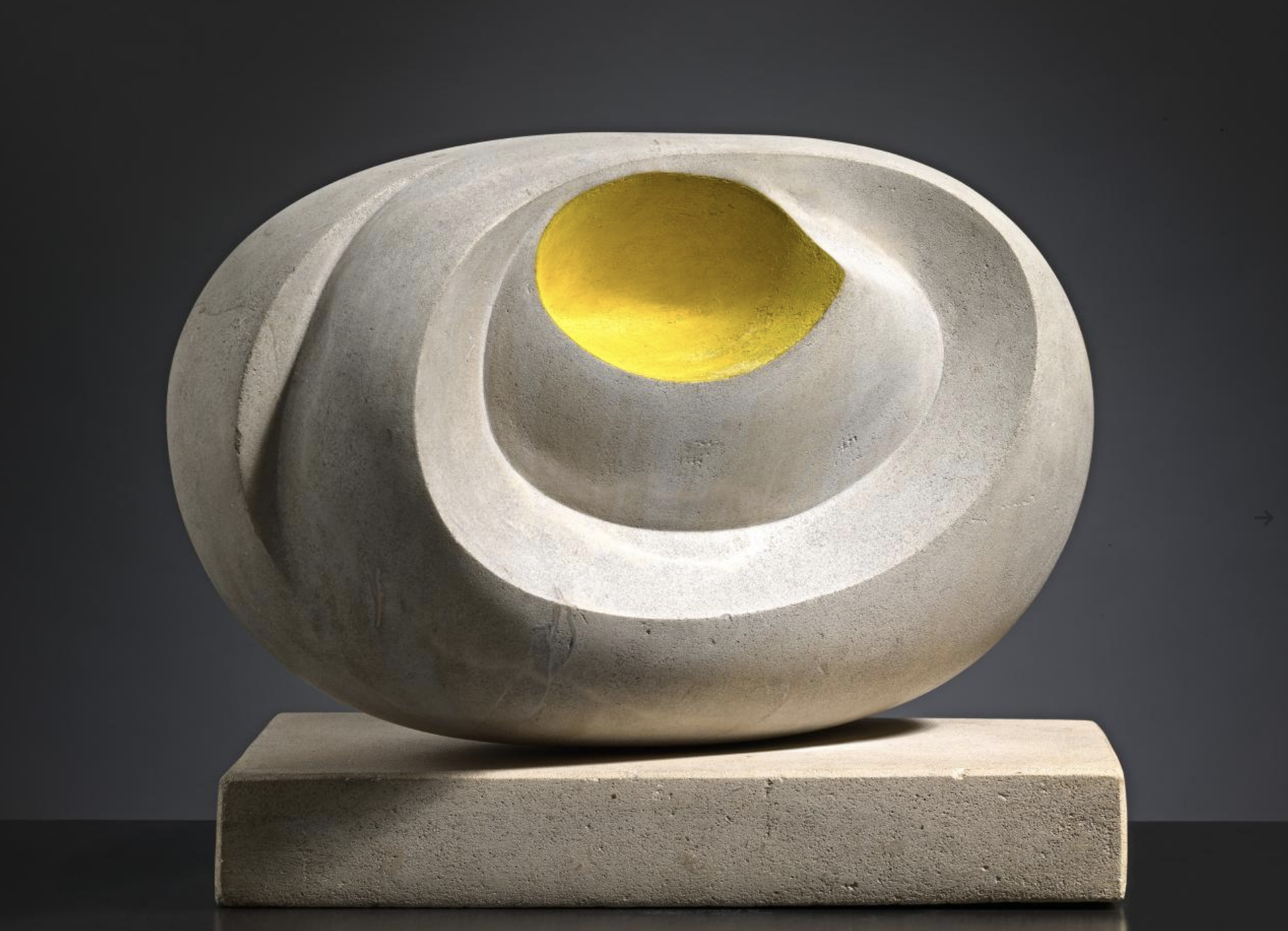
Barbara Hepworth (1903-1975), Eidos, 1947, National Gallery of Victoria, Melbourne. Photo: Predrag Cancar / NGV. Image courtesy National Gallery of Victoria, Melbourne

I enjoyed a small exhibition of the work of sculptor Barbara Hepworth at the Courtauld Gallery, London. (‘Hepworth in Colour’ runs until 6 September.)

'My works are an imitation of my own past and present.'
Barbara Hepworth

Born in Wakefield in 1903, Hepworth studied at the Royal College of Art, and afterwards in Florence and Rome, learning the Italian tradition of direct stone carving. Just before the outbreak of the Second World War, she and her husband, the artist Ben Nicholson, left London with their young children, for St Ives in Cornwall. It was here that she properly explored what she called ‘the particular tensions and relationships of form and colour.’

‘I actually think I have discovered how to use both [colour and form] together to achieve a new power and experience, and I have discovered certain laws. I don’t think anybody has done it before.’
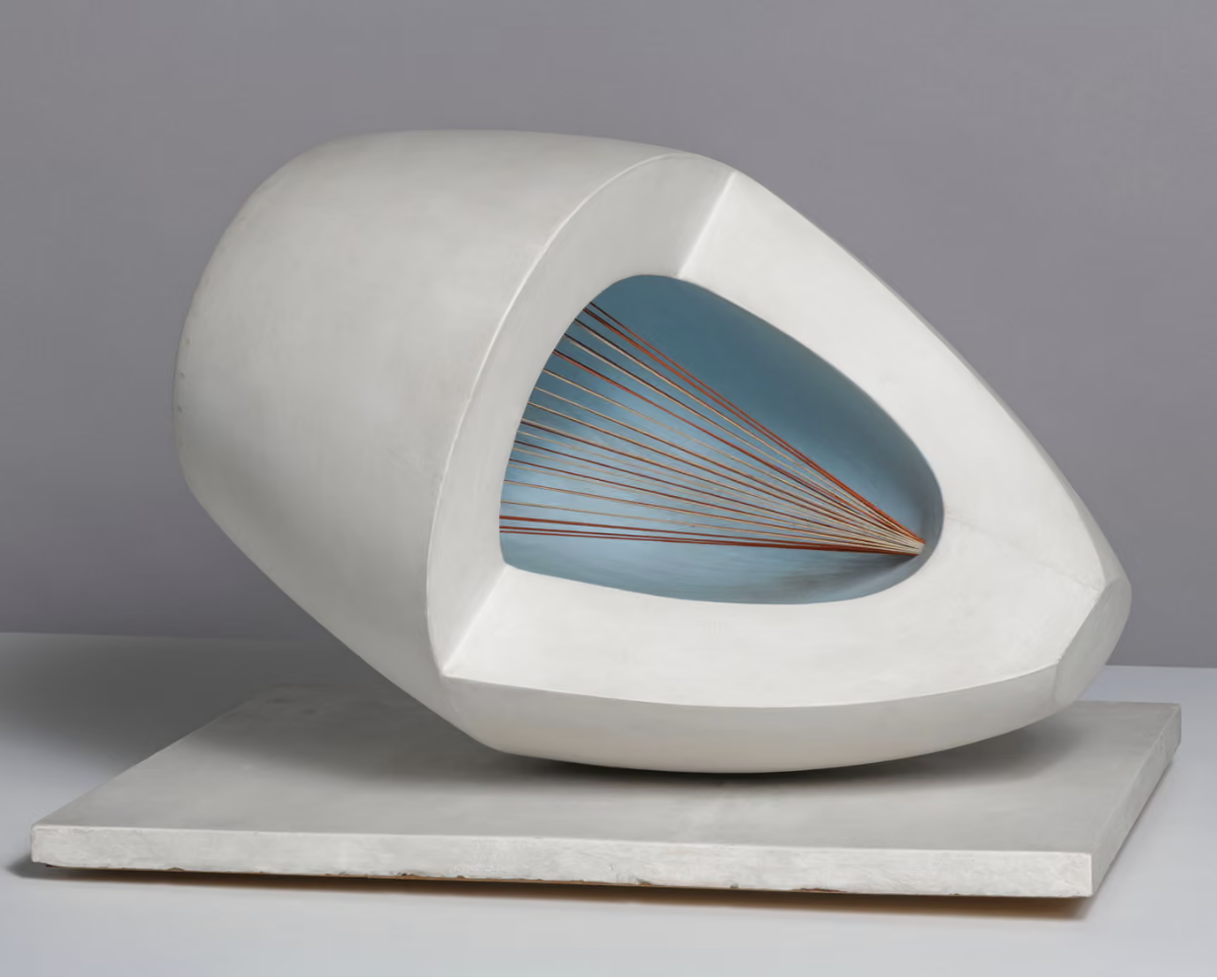
Barbara Hepworth, Sculpture With Colour (Oval Form) Pale Blue and Red, 1943.

Working in plaster, wood and stone, Hepworth experimented with geometric shapes - spheres, cylinders and cones; arcs and axes; lozenges, ovals and parabolas. She polished her pieces to a sheen, pierced and hollowed them, revealing inner surfaces that - inspired by the sea and sky, the light and atmosphere of the Cornish coast - she painted deep and pale blue, intense sunny yellow and vibrant grassy green. Occasionally she added taut strings in different colours as accents.

‘The colour in the concavities plunged me into the depths of water, caves, or shallows deeper than the carved concavities themselves.’

Pure forms, with refined surfaces and enfolding curves, Hepworth’s sculptures perhaps suggest cells, seeds and acorns; wombs; planetary and crystalline shapes. They create what she described as ‘the sense of being curled up in the shelter of sunlit cliffs.’ They have a serene beauty.
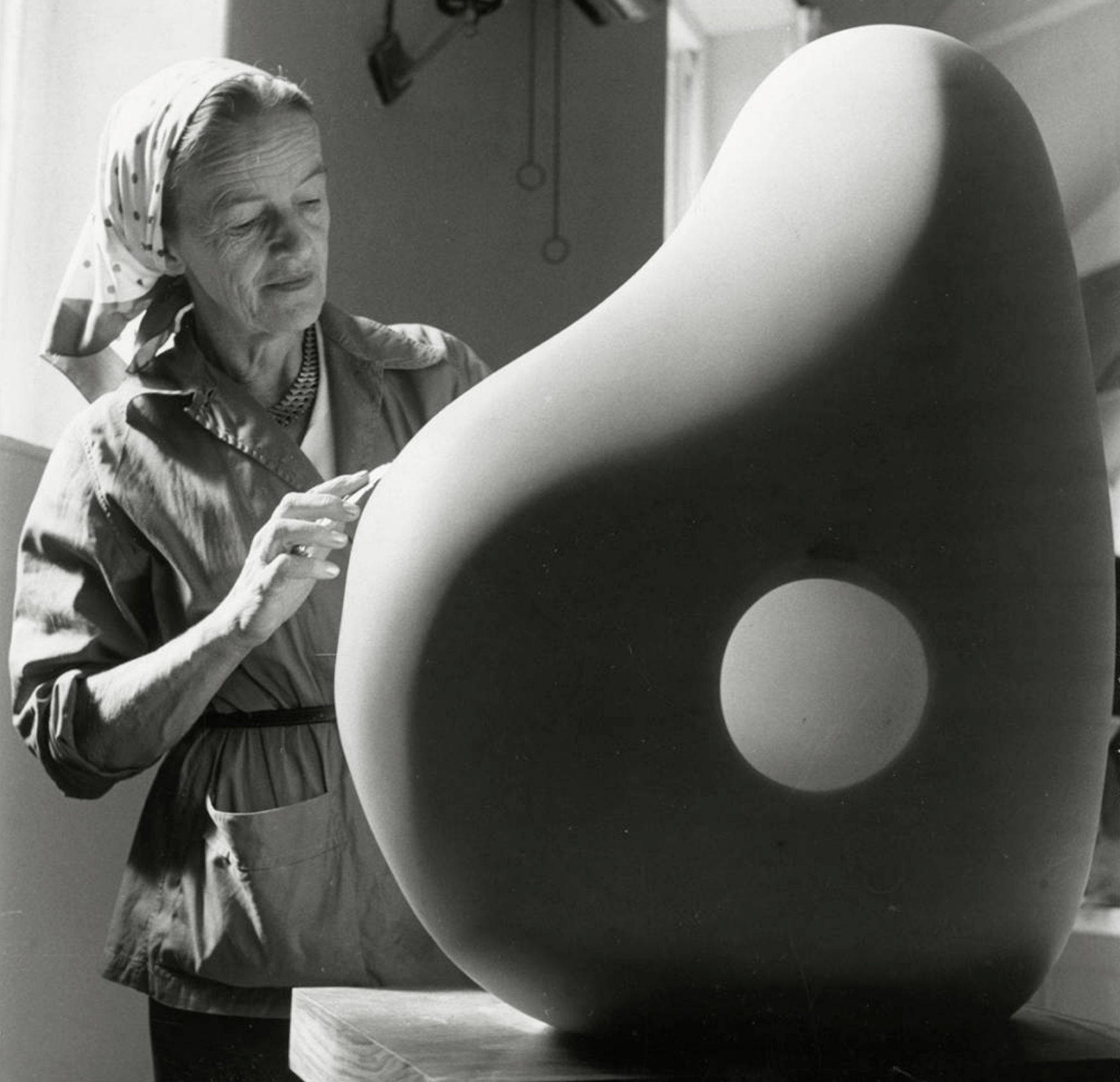
Barbara Hepworth

At the show, you can see 18 of Hepworth’s sculptures, and also 26 drawings and paintings - what she termed ‘sculptures in disguise’ - where she worked through her ideas.

‘I spend whole periods of time entirely in drawing (or painting as I use colour) when I search for forms and rhythms and curvatures for my own satisfaction.’
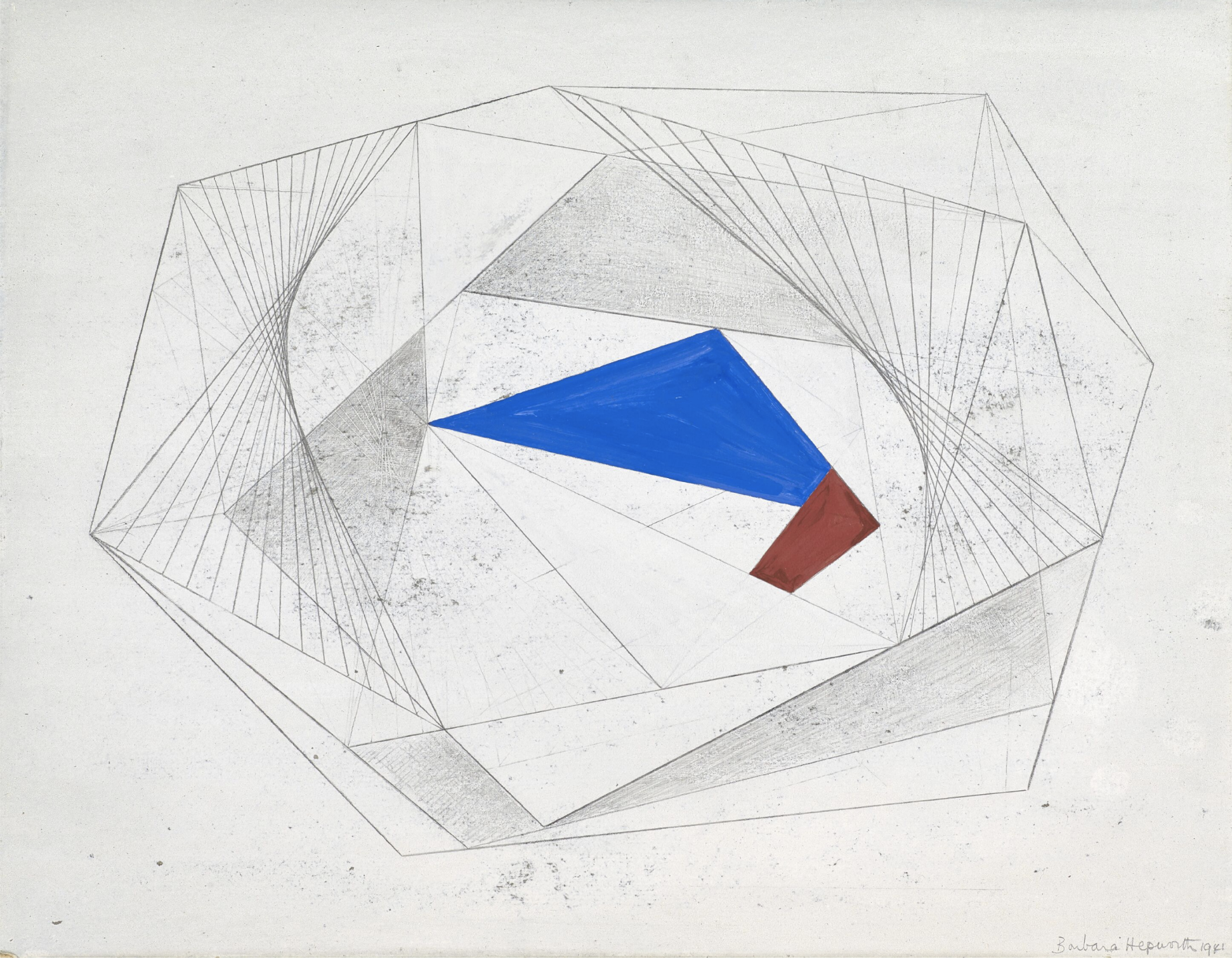
Barbara Hepworth (1903-1975), Drawing for Sculpture with Colour (Forms with Red and Blue), 1941, pencil and gouache on paper-covered board.

This language prompted me to reflect on the world of marketing. Whilst we are often offered martial and mechanical metaphors to articulate brand building, I have found it helpful to think of our core task as something more organic and emotive: creating meaningful patterns; setting a seductive beat; designing a compelling cadence that swings and tilts and cascades. Indeed, one could say ‘searching for forms and rhythms and curvatures.’ Brand building is not a science, rigid and fixed. It is a natural, fluid, creative endeavour, requiring fundamentally human qualities of instinct, taste and judgement.

Hepworth was not given to self-promotion and she was often misinterpreted. Critics sometimes felt her work was too cool, and credited her innovations to Henry Moore. While recognising her mastery of form, they seldom celebrated her use of colour. 

‘My colour has been accepted, but never understood.’

This exhibition goes some way to rectifying that error.


'Walking in rhythm,
Moving in sound.
Humming to the music,
Trying to move on.
I'm walking in rhythm,
Singing my song,
Thinking about my baby,
Trying to get home.’
The Blackbyrds, '
Walking in Rhythm’ (B Perry) 

No. 579

NOTES FROM THE HINTERLAND 2

Thinking Inside the Box

This week I visited the excellent Joseph Cornell exhibition at The Royal Academy. Cornell spent most of his life in New York State and never left America. But through his art he voyaged across continents and through time. In a week in which Pixar launches a film exploring the brain of an 11 year old child, the Cornell exhibition is a jouney into the mechanics of a creative mind.

Although Cornell didn’t travel, he read extensively and compiled dossiers on subjects that interested him, whether that be astronomy, ornithology, circuses, childhood games or nineteenth century France. Drawing on the contents of these dossiers and combining them in imaginative ways, Cornell painstakingly constructed collages, mechanicals and glass fronted ‘shadow boxes.’ His boxes contained fantasy hotels, tropical birds, celestial maps. He created fictional lives, shooting galleries, slot machines and an interactive Museum of Sound (including ‘the sound of silence’ which I guess belongs in a museum nowadays…).

It’s often been said that travel narrows the mind. Cornell demonstrated that a creative imagination can take us to exotic places without setting foot outside one’s home town.

What can we in the creative professions learn from Cornell?

Could we do more to capture and collate experiences and thoughts that would otherwise pass unexpressed and unremembered?

Are we misleading ourselves when we imagine that our exotic holidays are fuelling our imagination? Would we be better off just reading more?

In the age of consumer insight and user experience, do we give proper weight to the pure transformative power of dreams?

Cornell loved poetry and he dedicated his piece Toward the Blue Peninsula to the similarly private Emily Dickinson. The work refers to a Dickinson poem that considers the choice of an imagined, over an experienced, life.

‘It might be easier
To fail - with Land in Sight-
Than gain – my Blue Peninsula -
To perish - of Delight -’

Emily Dickinson/ It Might Be Lonelier
 

Carving, Not Casting; Making Not Managing

I also attended the splendid retrospective of the sculptor Barbara Hepworth at Tate Britain. Beautiful contemplations in form and space, surface and light. Hollowed out solids, wires casting shadows. Polished and painted, curved and scooped. Lovely.

In her early career Hepworth participated in the ‘direct carving’ movement: artists carving directly into wood and stone, respecting the truth of the materials; rather than casting sculpture into a mould or employing skilled craftsmen to execute a model. Initially the direct carvers’ works were a little cruder, a little more rudimentary, than those produced by the incumbent methods, as the artists learned the craft skills themselves. But there was a compelling simplicity and honesty about the results.

I wonder what would a rededication to direct carving look like in the communication arts?
What if all our creatives shot their own film, designed their own posters, wrote their own code, built their own applications?
What if we rejected our fragmented, demarcated world and rededicated our selves to ‘making not managing’?
 

Wasted Talent

On Friday afternoon I sat on my own in a cinema weeping to the Amy Winehouse documentary. It was like watching a car crash in slow motion. From the start you could see the ending, but there was nothing you could do to stop it.

There seem to have been many contributors to poor Amy’s demise; not least her determination to ‘sabotage her own life’. And I couldn’t escape a sense of complicity. I’d read those papers, consumed those news stories; I was watching the film.

But the abiding impression I took from Amy was of waste: wasted talent, wasted love, wasted life. In our disposable culture we imagine that talent, like everything else, is readily replaceable. But it isn’t.  And we’ll not see the like of Amy again in our lifetimes.

I wonder, are creative businesses wasting the very talent that sustains them?
Shouldn’t we be protecting talent as our most precious commodity?
Should our new-found commitment to sustainability extend to people, not just resources?

And, by the way, the film wasn’t entirely depressing. Tony Bennett emerged as a wise, gentle, luminous star. If only there were more like him…

Advice to My 17 Year Old Self

Work hard, but not at the expense of your cultural life.
Study hard, but not at the expense of your social life.
Play hard, but not at the expense of your health.

N0. 39