The ‘Subtle Simplicity’ of William Nicholson
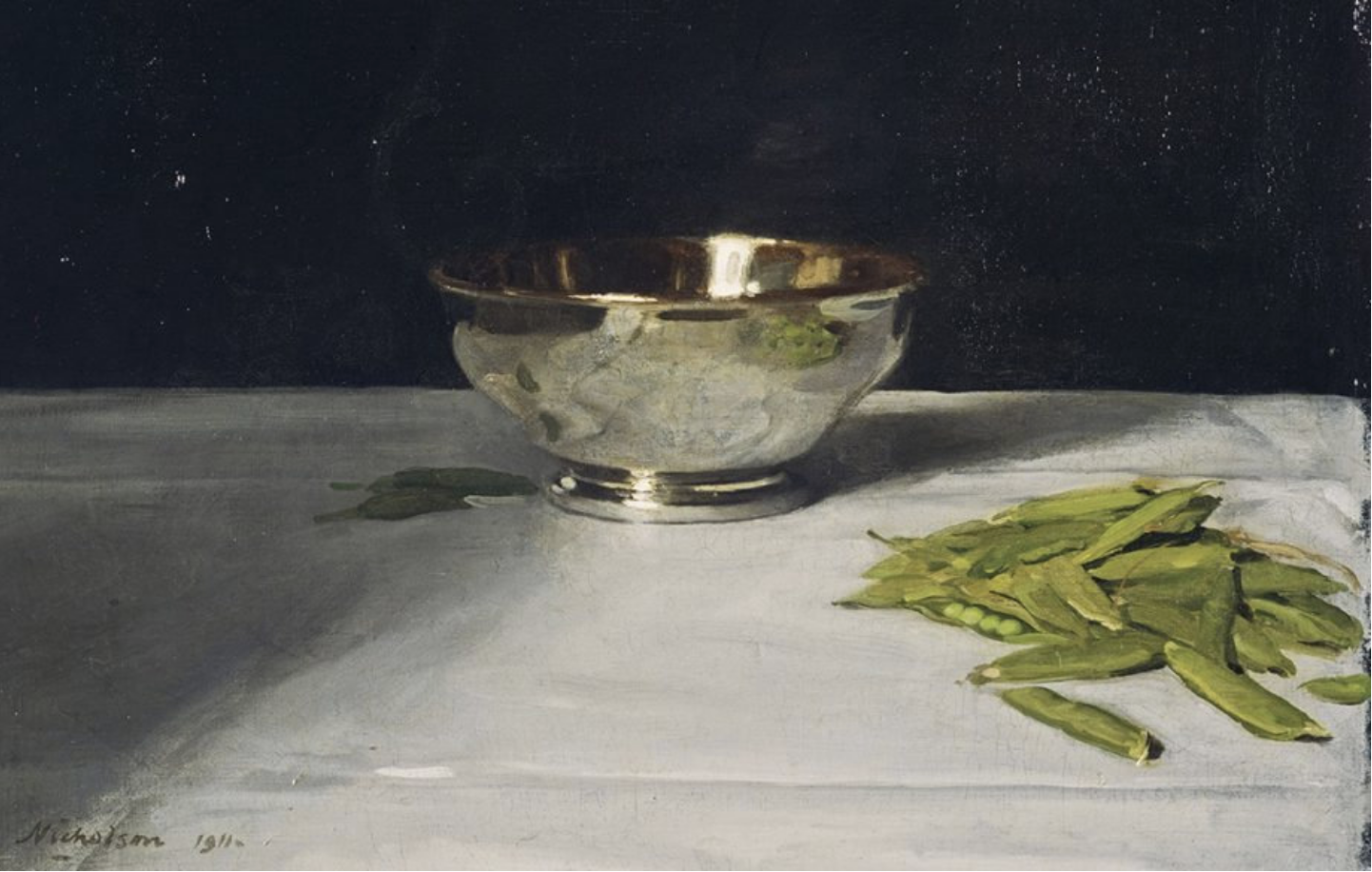
William Nicholson - The Lustre Bowl with Green Peas

I recently enjoyed a trip down to Chichester to see an exhibition of the work of William Nicholson. (Pallant House until 10 May)

Nicholson was incredibly versatile. A printmaker, illustrator and designer, he also painted portraits, landscapes and still lifes. He had a gift for elegant clarity and quiet understatement, for keen-eyed observation.

‘’Must learn to observe.’ This maxim is as perfect for a painter as for a scientist.’

William Nicholson, quoting the scientist Michael Farraday

Nicholson was born in Newark-on-Trent in 1872, the youngest son of an industrialist and Conservative MP. Having trained in art in London and Paris, he collaborated with his brother-in-law James Pryde, under the name Beggarstaffs. Together they designed posters for Kassama Corn Flour and Rowntree’s Elect Coffee; for theatre productions of Hamlet, Cinderella and Don Quixote. 
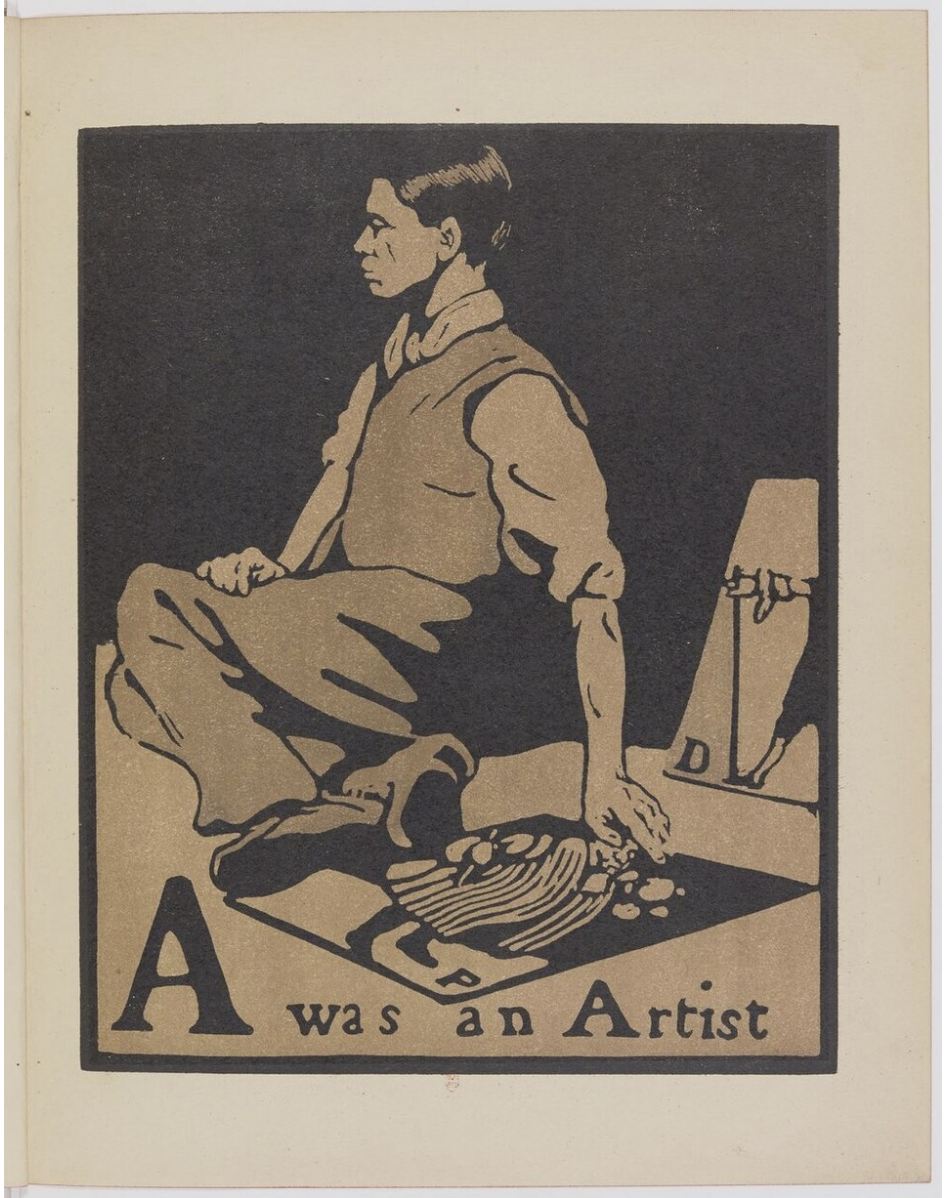
William Nicholson - A was an Artist

From the outset, Nicholson’s work was characterised by wit and sophistication; simplicity and restraint. He went on to produce illustrations for The Square Book of Animals, The Velveteen Rabbit, The Book of Blokes, and many more besides. He created woodcuts for a collection of London types - barmaid, guardsman, sandwich man, newsboy - and a pictorial alphabet - A is for Artist, B is for Beggar, C is for Countess… 

And D is for Dandy. Nicholson was something of a dapper dresser. In ‘A Bloomsbury Family’, William Orpen painted him in starched collar and yellow waistcoat, wrapped in his favourite black and white polka-dot dressing gown, a black slipper dangling from one foot. His children, gathered round the table, look bored. His wife Mabel Pryde, in smart Edwardian attire, stands at the back and reaches for the door.
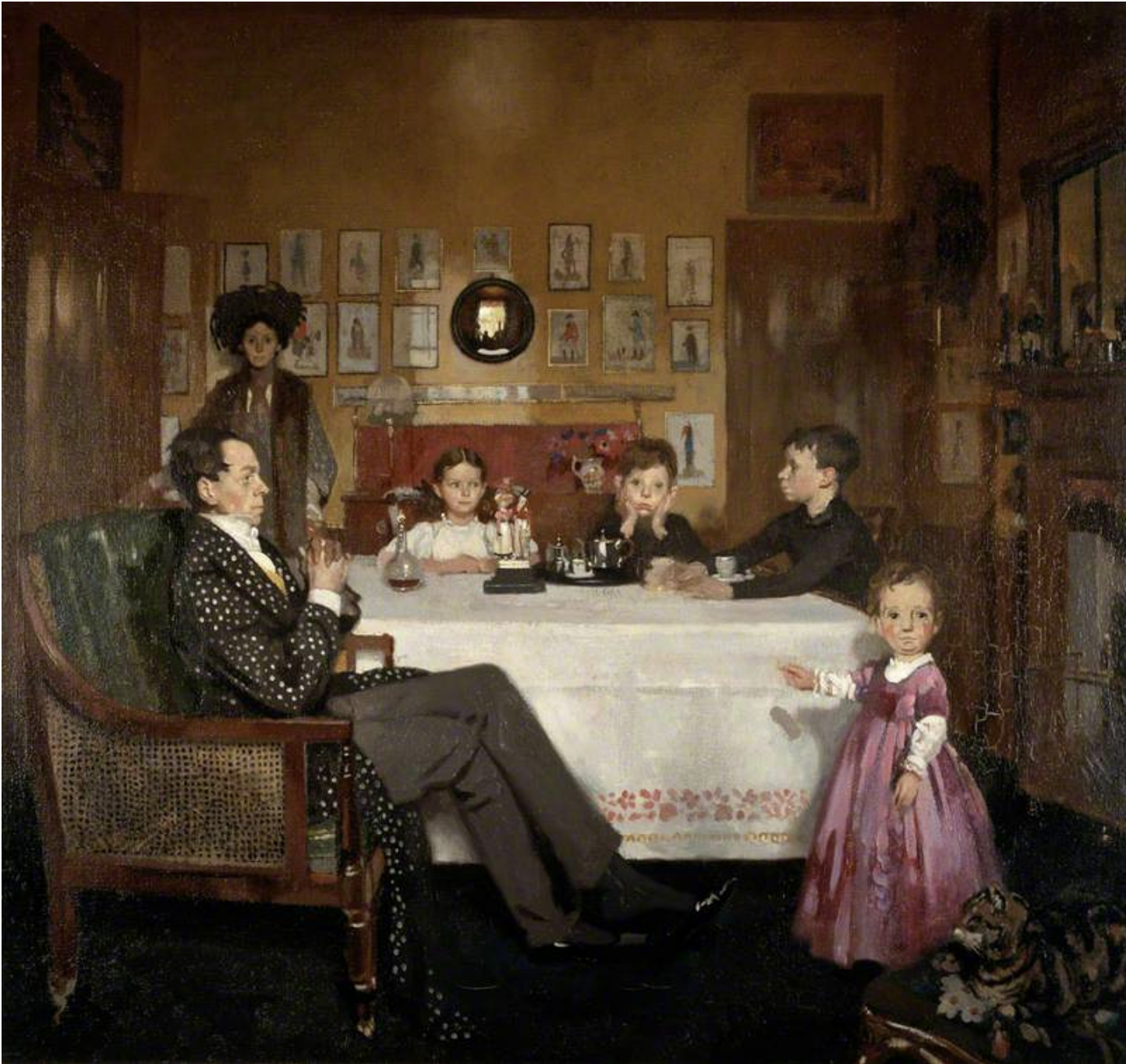
William Orpen -  ‘A Bloomsbury Family’

Gradually Nicholson turned to portraiture as a reliable source of income. Essayist Max Beerbohm is rather solemn, his top hat and stick casting a shadow against a bare wall. Social reformers Sidney and Beatrice Webb warm themselves by the fire, a terrier at their feet. Actress Wish Wynne, wearing a maid’s outfit for a performance, turns her back. And blonde-bobbed artist Diana Low, set against a primrose curtain, looks confidently straight out at us.

 It is thought that Nicholson used his son Tony as the model for his 1917 portrait of a First World War soldier in goatskin jerkin, peering over the lip of a trench. The following year, Tony died from wounds received in action, and Mabel fell victim to the Spanish flu.

‘It is difficult to rebuild in words what one records in paint.’
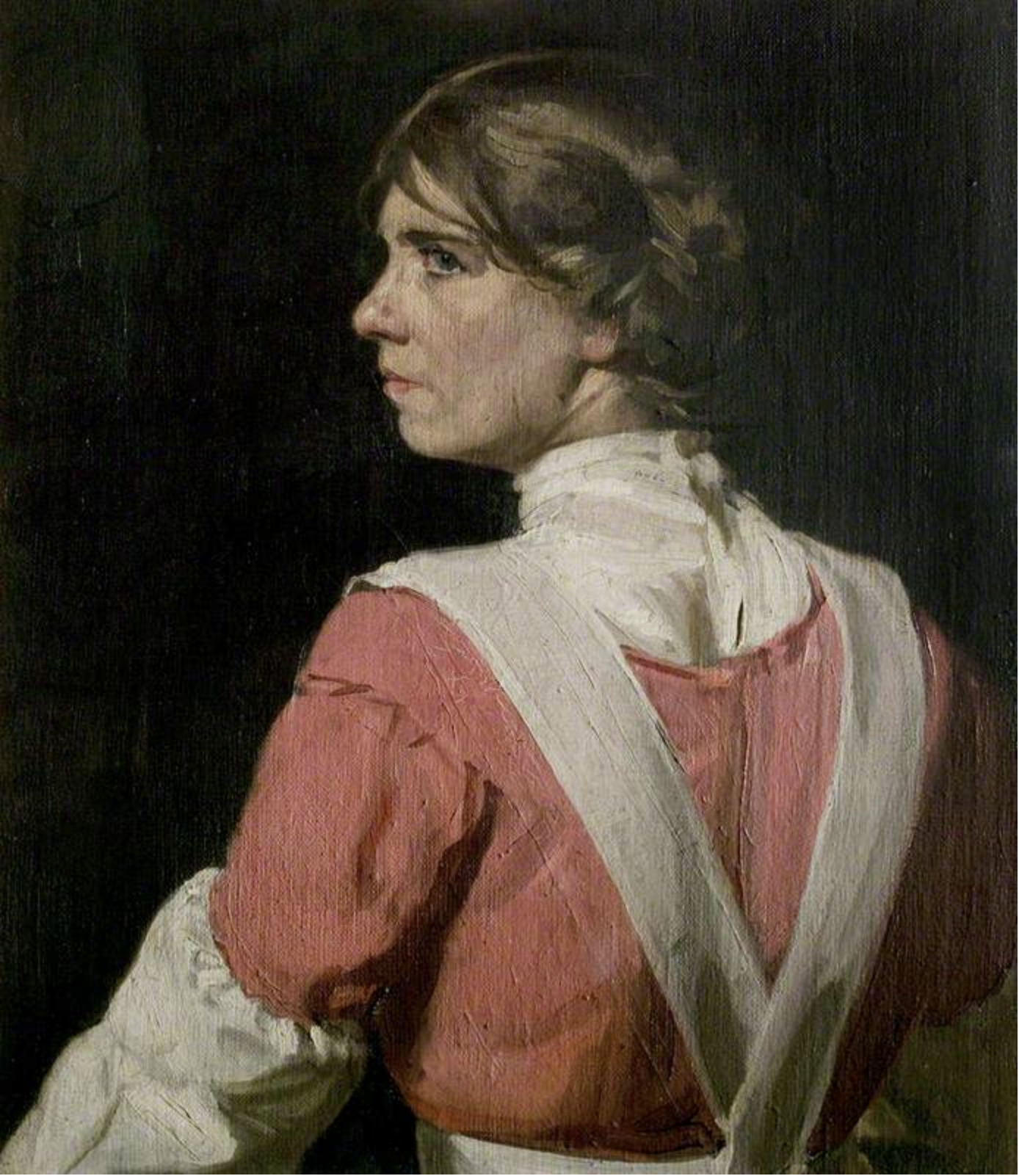
William Nicholson - Miss Wish Wynne, Actress, in the Character of Janet Cannot for the Play 'The Great Adventure''

Nicholson expanded his artistic repertoire further still. He painted the landscapes of Sussex and the Downs: rolling hills and luminous skies, verging on abstraction. He painted still lifes that explored the relationship between light and dark. Affectionate depictions of treasured objects, they dazzle and enchant. 

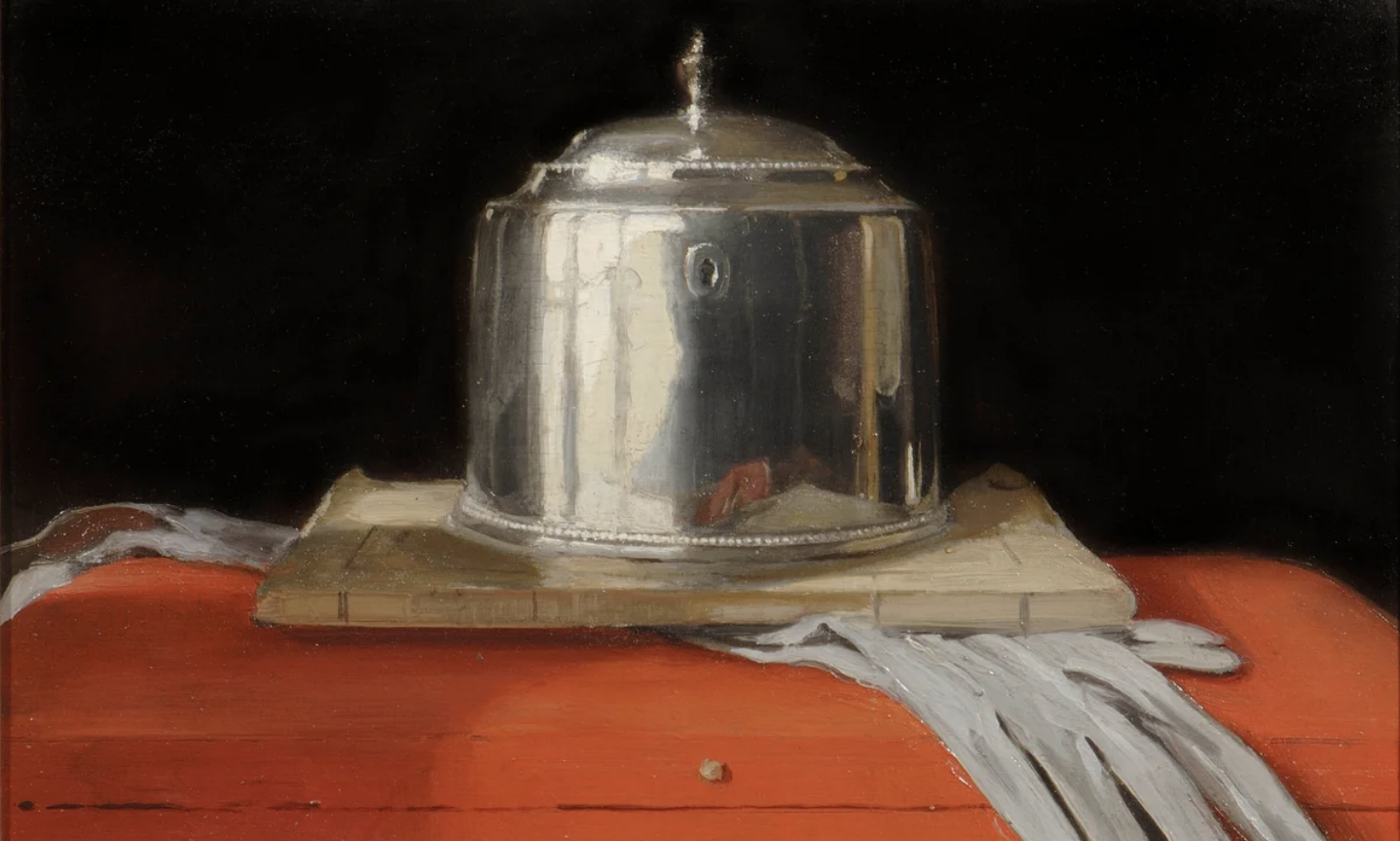
Some flowers in a mug rest on top of a pile of books. A Lowestoft bowl stands beside some cut tulips and one melancholic fallen petal. There is a silver bowl on a white tablecloth, another accompanied by a fan and tassel; a lustre bowl with green peapods; a brass canister with a quill and some journals; a ruby glass with a necklace, a gold jug. A silver casket is carefully placed on a vibrant red leather box, a pair of white gloves to one side.

These are modest, understated images. In their stillness, they prompt the viewer to pause, to reflect in silent wonder. The metal objects shimmer in the light, catching reflections. If you stand up close, you can see that Nicholson has achieved a luminous effect with just a flick of a brush loaded with white paint.
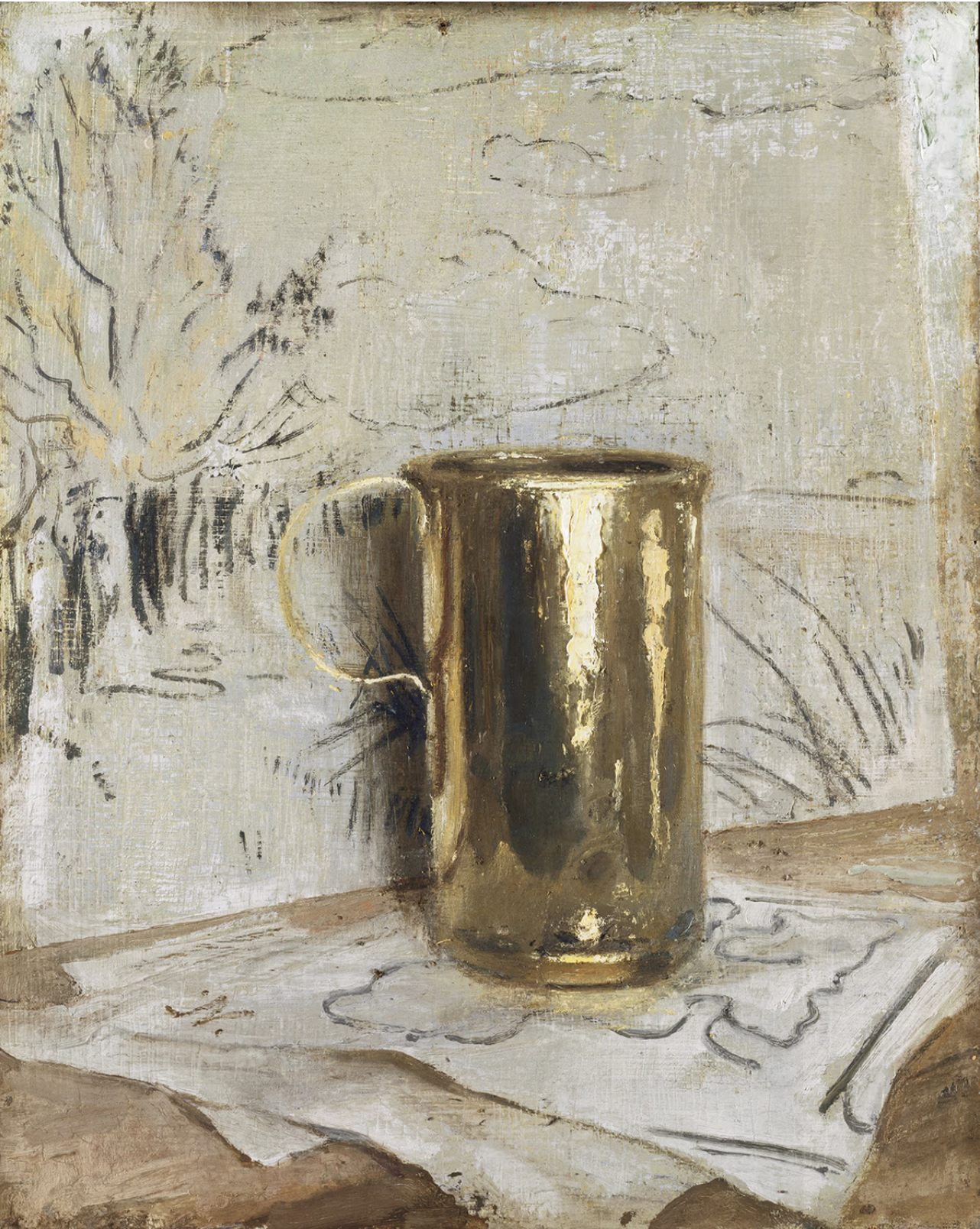
William Nicholson - Gold Jug

Though Nicholson’s art celebrated simplicity, he had a complex family life. He had a long-running affair with his housekeeper, and, after Mabel’s death, he married a family friend who had also been close to his son Ben. Somehow, they navigated the situation. His children went on to form a creative dynasty, with Ben becoming an artist, Nancy a designer, and Kit an architect. 

Nicholson picked up the pots, jugs and other ceramics that featured in his still lifes in the Caledonian Road market, second hand shops and pubs. He also collected silver, and was a particular fan of the work of 18th century silversmith Hesther Bateman. He wrote to a friend: 

‘Hesther Bateman… was a wonderful artist. I have four or five of her silver masterpieces. Subtle simplicity is her ‘note.’’ 

 The phrase could equally be applied to Nicholson’s work.  

Simplicity is hard to attain. It requires focus and sacrifice; moderation and restraint. It demands that we make deliberate choices, that we learn to say ‘no’. Ultimately, as Leonardo observed, ‘simplicity is the ultimate sophistication.’


'I don't believe in fretting and grieving,
Why mess around with strife?
I never was cut out to step and strut out,
Give me the simple life.

Some find it pleasant dining on pheasant,
Those things roll off of my knife.
Just serve me tomatoes and mashed potatoes,
Give me the simple life.

A cottage small is all I'm after,
Not one that's spacious and wide.
A house that rings with joy and laughter,
And the ones you love inside.

Some like the high road, I like the low road,
Free from the care and strife.
Sounds corny and seedy, but yes, indeed,

Give me the simple life.'
Etta Jones, '
Give Me the Simple Life’ (R Bloom, H Ruby)

No. 551
SUBSCRIBE

Still Life: Finding Beauty in Plainness

William Nicholson’s The Silver Casket and Red Leather Box, 1920. Photograph: Private collection

I recently attended an excellent exhibition examining the story of still life in Britain. (‘The Shape of Things: Still Life in Britain’ is at the Pallant House Gallery, Chichester until 20 October.)

‘Those two words [still life] imply an undercurrent of meaning at once poignant and vital, suggesting objects curiously related to each other, silent, composed, in tranquil, even ominous, association.’
Michael Ayrton


Historically considered to be a lesser form of painting, still life first became popular in Britain in the 17th and 18th centuries, following the import of Dutch work in the genre. (The English term still life derives from the Dutch word stilleven.)  

Early still life paintings sought to convey the transience of human existence through arrangements of meaningful objects, such as clocks and skulls. They were known as ‘vanitas’ (a reminder of the futility of pursuing material wealth) and ‘memento mori’ (a reminder of our mortality). 

Edwaert Collier’s vanitas of 1694 presents books, a globe and an engraved portrait of Caesar Augustus, alongside a recorder, lute and oboe. The message is that earthly knowledge and power are fleeting. Once an instrument is put down, the music stops.

Symbolism abounds in these works. Playing cards connote pleasure, chance and fate. Grapes, peaches and plums represent fertility and romance. Roses suggest love and the Virgin Mary, and carnations imply resurrection and eternal life.  If you look closely, you’ll notice that some of the rose petals are wilting; the plant's leaves are brown at the edges; and a grape has fallen from the bunch. Beauty, like life itself, does not endure.

In modern times still life has offered artists the opportunity to explore colour, form and materials. Breaking free from a more naturalistic approach, everyday objects could be reduced to abstract blocks of pure pigment. Ben Nicholson painted the striped and spotted jugs, mugs and glassware that he had in his studio, interpreting their forms and patterns in varying degrees of representation and abstraction. 

‘Furniture such as couches, chairs, bookcases and tables… involve planes, horizontal, vertical and inclined, angles, right, acute and obtuse, directions, divisions, dimensions and recessions; contrasts of masses, light and shade, in fact, the basic material for creating the structural harmony.’
Paul Nash

Meredith Frampton, Trial and Error

In the 1920s and ‘30s surrealist artists revealed the strangeness in the ordinary, making arresting arrangements of familiar objects to expose the subconscious. Meredith Frampton precisely painted an artist’s model of a head and placed it on an open sketchbook. There is a pear sitting on a funeral urn; a white carnation in a tea pot; a queen of spades playing card.

Subsequently pop artists blurred the boundaries between ‘high’ and ‘low’ art, drawing our attention to the proliferation of marketing imagery. In Eduardo Paolozzi’s brightly coloured collages, American salespeople jostle with Mickey and Minnie Mouse, White Star Tuna, Coca-Cola and Kool-Aid.  

Over the years still life has evolved into many different forms of expression. But perhaps its enduring appeal resides in its invitation to close observation and contemplation.  

‘There is a place in our lives for small pictures… Looked at in stillness, hidden forms take shape; and forms, like words, have their references, haunted by experience, extending into a half-conscious dream world.’
Valentine Dobrée

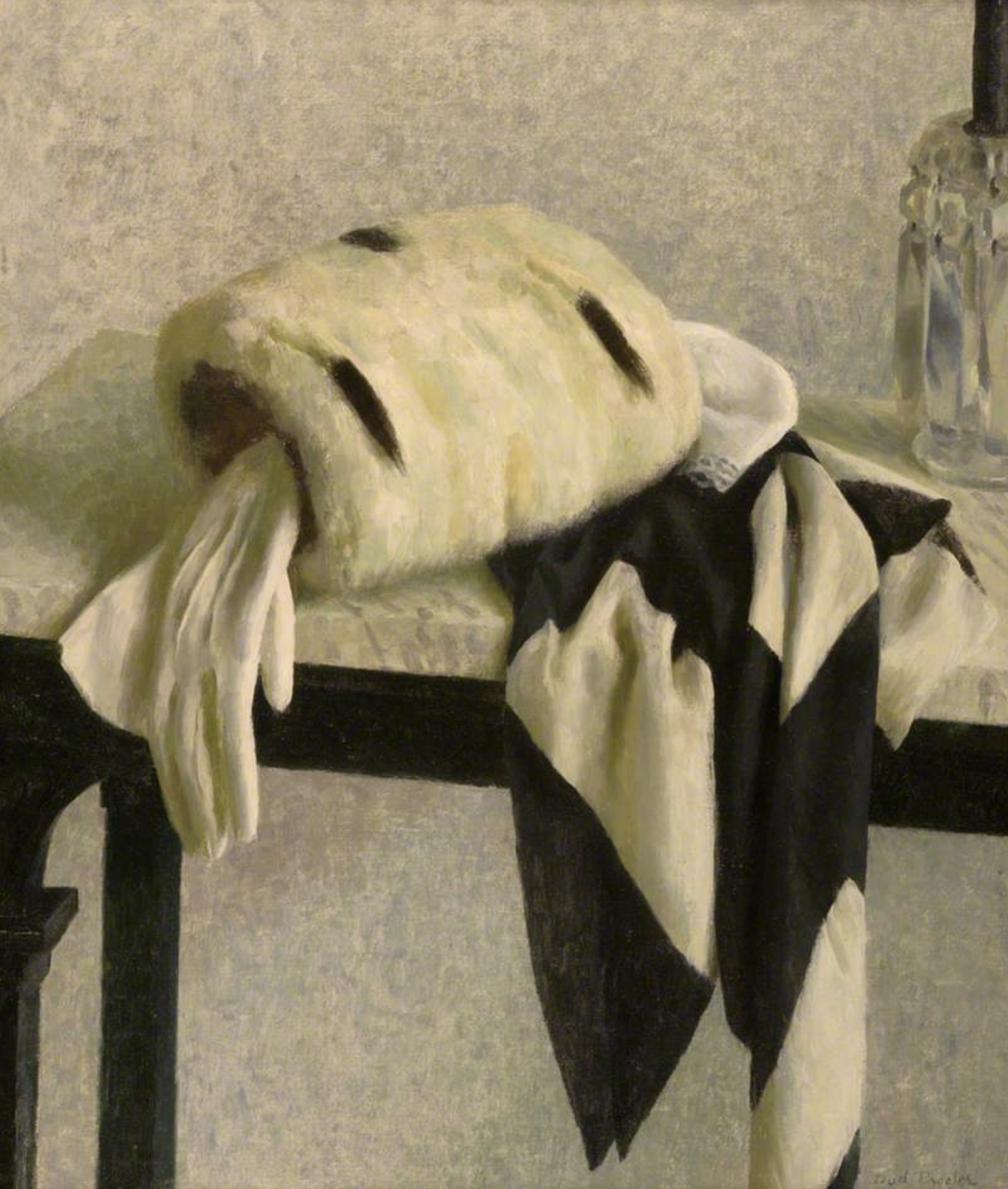
Dod Procter (1892–1972)-Black and White. Southampton City Art Gallery

William Nicholson asks us to consider an elegant silver casket sitting on top of a red leather box, the light shimmering on the metal, reflecting the unseen room. Dod Procter paints her shawl, gloves and ermine wrap, perhaps deposited on the hall table after a night on the town. Eric Ravilious depicts a forlorn jug of bracken fronds and cow parsley, casting a melancholy shadow on the tabletop.  

More recently Rachel Whiteread has explored the negative spaces between objects. A white plaster imprint of three bookshelves suggests a lifetime of thought and ideas; of private moments and quiet introspection.  

‘I find beauty in plainness.’ 
William Scott


The themes at the heart of this exhibition may resonate with those of us that work in the world of marketing and communications. Many of us sell ordinary objects, performing modest roles in everyday lives. Too often we exaggerate the value and significance of our brands. We are prone to hyperbole.  

Untitled (For Frank) (1999), Rachel Whiteread. Pallant House Gallery, Chichester. © the artist

Perhaps we would do well to seek instead the beauty in their plainness.

Still life asks us to pause, look and reflect, in the unbroken silence; to find meaning in the mundane. Life may be fragile and fleeting, but it is also beautiful.

'I can hardly bear the sight of lipstick
On the cigarettes there in the ashtray,
Lying cold the way you left them,
But at least your lips caressed them while you packed.
And a lip print on a half-filled cup of coffee
That you poured and didn't drink.
But at least you thought you wanted it.
That's so much more than I can say for me.
It's been a good year for the roses,
Many blooms still linger there.
The lawn could stand another mowing,
Funny, I don't even care.
When you turned and walked away,
And as the door behind you closes,
The only thing I know to say,
It's been a good year for the roses.’
George Jones, '
A Good Year for the Roses’ (J Chesnut)

No. 486

SUBSCRIBE