Golden Boy: ‘Where a Man is Glad to Be Himself’
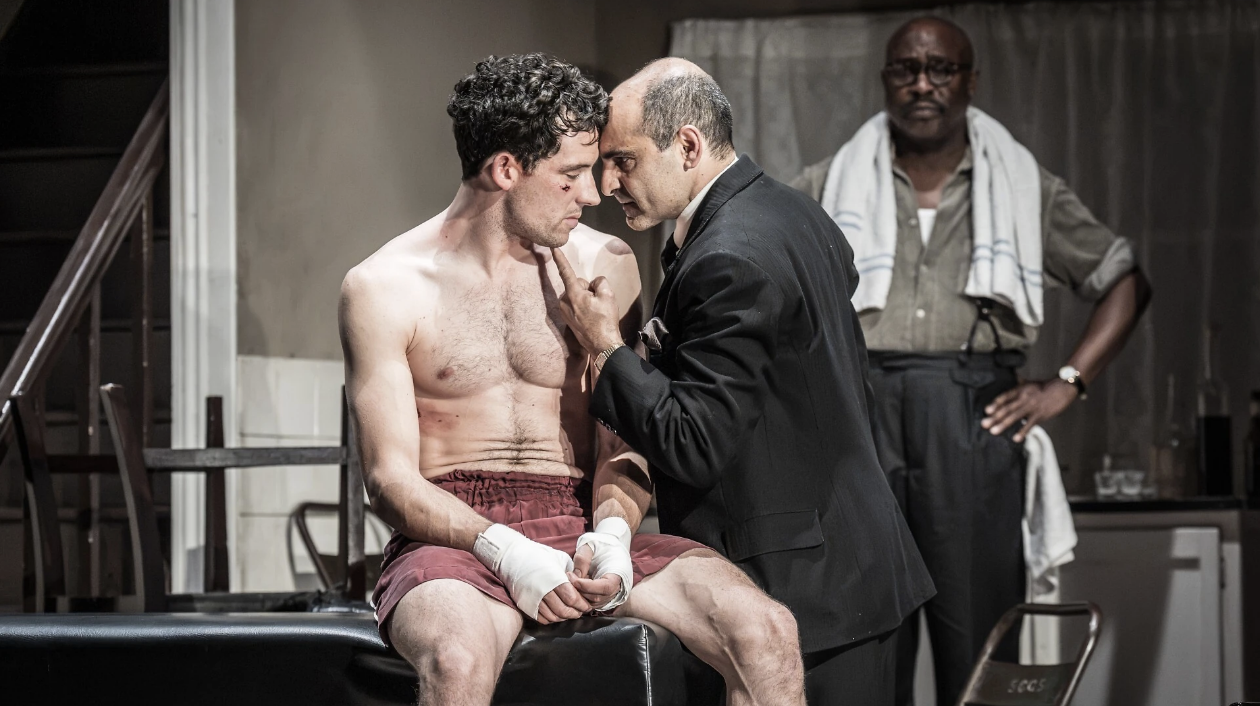
Photo: Marc Brenner | Josh O'Connor (Joe) and Zubin Varla (Eddie)

Clifford Odets’ 1937 play ‘Golden Boy’ tells the story of Joe Bonaparte, a gifted violinist who chooses to pursue a career in boxing. (There’s a fine production at the Almeida Theatre, Islington until 31 October. Let’s hope it receives a West End transfer.)
 
Joe: Poppa, I have to fight, no matter what you say or think! This is my profession! I’m out for fame and fortune, not to be different or artistic! I don’t intend to be ashamed of my life!
 
When we first encounter young Italian American Joe, in the small Broadway office of fight manager Tom Moody, he is self-contained, a callow, ‘cock-eyed’ youth, desperate to be given a chance to prove himself in the ring.
 
Joe: There are forty-three thousand minutes in a month - can’t you give me five?
 
Joe has determined that his pugilistic talents offer a more propitious route to material wealth than music.
 
Joe: Do you know there are men who have wonderful things from life? Do you think they’re better than me? Do you think I like this feeling of no possessions? Of learning about the world from Carp’s encyclopaedia?
 
And so, Joe has no use for the concert violin that his father has bought him for his 21st birthday.
 
Mr. Bonaparte: Music is the great cheer-up in the language of all countries.
Joe: I take a vacation – the notes won’t run away!
 
Joe is successful in his first bouts under Moody’s management, but Moody is concerned that he’s not a slugger. He seems to be holding back. Trainer Tokio argues that Joe should be allowed to fight his own way.

Tokio: Don’t ask him to change his style. A style is best when it’s individual, when it comes out of the inner personality and the lay of the muscles and the set of the bones.
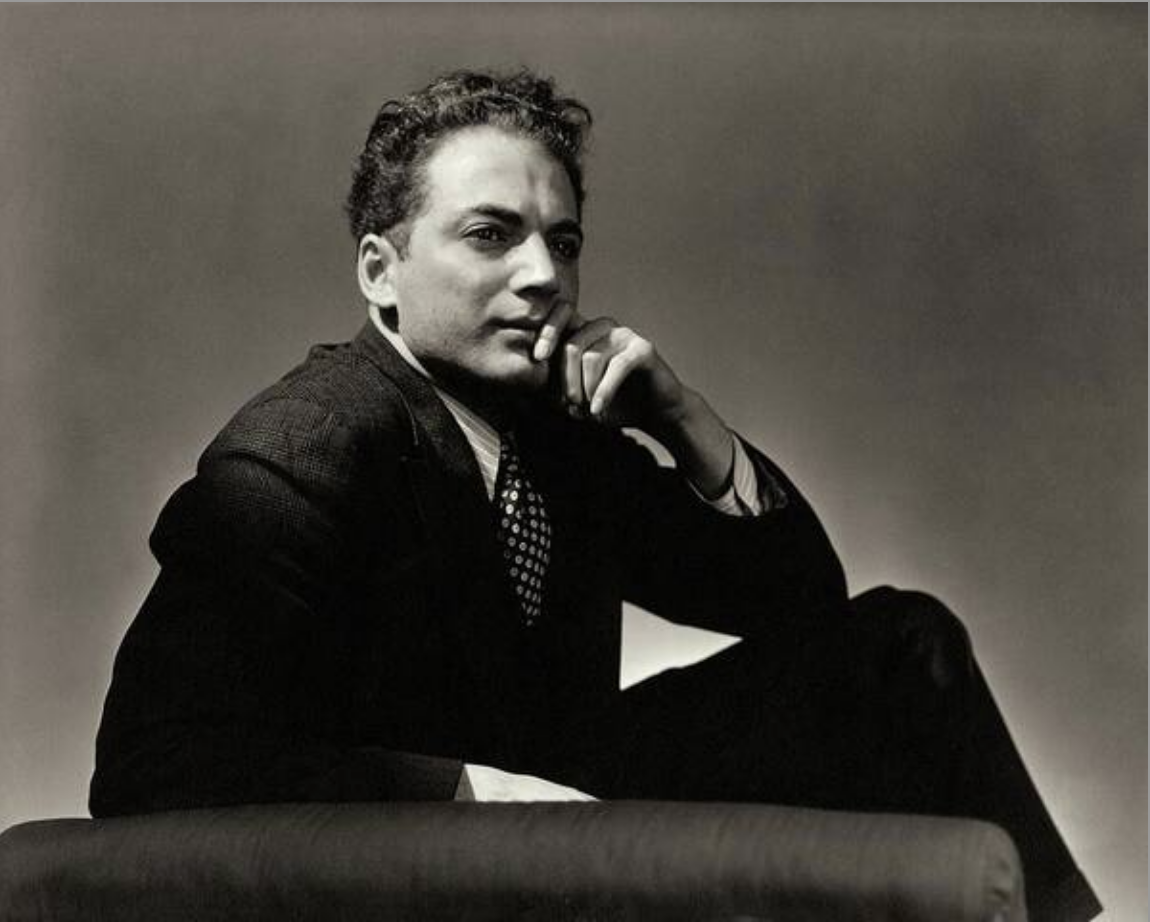
Portrait Of Clifford Odets by Lusha Nelson

It transpires that Joe has been pulling his punches to protect his hands, and with them his future violin playing. Promoter Roxy Gottlieb is dismissive of Joe’s musical pretensions.
 
Roxy: You shoulda seen that bunch of musicians on 48th Street before. Fiddlers, drummers, cornetists – not a dime in a car-load. Bums in the park!
 
Moody’s girlfriend Lorna is assigned to change Joe’s mind.
 
Lorna: If you made your fame and fortune – and you can – you’d be anything you want.
 
At length, Joe is persuaded to go all-in, and he runs confidently towards his prizefighting destiny.
 
Joe: When a bullet sings through the air, it has no past – only a future.
 
With his consequent success, Joe succumbs to the delights of custom-made suits and a Deusenberg automobile. 
 
Eddie: A year ago Bonaparte was a rookie with a two-pants suit. Now he wears the best, eats the best, sleeps the best. He walks down the street respected – the golden boy!
 
But Joe also breaks a hand, thereby ruining any prospect of returning to the violin.
Becoming disillusioned with the fight game, he turns insolent and arrogant. And he is increasingly vicious in the ring.
 
Tokio: Your heart ain’t in fighting…Your hate is. But a man with hate and nothing else…he’s half a man…and half a man…is no man.
 
Built around an admittedly rather artificial plot, ‘Golden Boy’ is a simple morality tale. It suggests that riches and renown are not enough. They cannot satisfy our fundamental human needs. They leave us hollow, discontented, dissatisfied.
 
Siggie: Joe went in the boxing game ‘cause he’s ashamed to be poor.
 
The play prompts us to question what society values and what we value as individuals. Are our motivations at work sincere and well-intentioned? Will they ultimately lead us to fulfilment or frustration? Are we properly assessing our career choices?
 
Joe: With music I’m never alone when I’m alone.
 
At the end of the play, Lorna, now regretting her part in Joe’s demise, expresses her yearning for a less cruel, less mercenary world. 
 
Lorna: We’ll find some city where poverty’s no shame – where music is no crime! – where there’s no war in the streets – where a man is glad to be himself.
 
 
'In the clearing stands a boxer,
And a fighter by his trade.
And he carries the reminders,
Of every glove that laid him down.
Or cut him till he cried out,
In his anger and his shame,
"I am leaving, I am leaving."
But the fighter still remains.’
Simon & Garfunkel, 'The Boxer’ (P Simon)

No. 590

Three Sisters: Dreams of Progress

The Wyndham Sisters by John Singer Sargent 1899

The Wyndham Sisters by John Singer Sargent 1899

'It seems to me that everything is going to change little by little, that change is already under way, before our eyes. In two or three hundred years, perhaps in a thousand years, no matter how long, there will be a new, happy life. Of course, we will not be there any more, but that's why we live, work, suffer. We are creating that life - it's the only goal of our existence, and if you like, of our happiness.’ 
Vershinin, ‘Three Sisters’

I recently saw a fine production of Anton Chekhov’s ‘Three Sisters.’ (The Almeida Theatre, London, until 1 June) 

The Prozorov sisters live with their useless brother in a provincial town. Their parents have passed away and they feel isolated, lonely, cut adrift.

'For us, three sisters, life has not been beautiful - it chokes us, like weeds.' 

Older sister Olga is a spinster working long hours as a teacher. Middle sister Masha married young and is now dissatisfied with her husband Chebutykin:

Chebutykin: ‘I’m happy, happy, happy.’
Masha: ‘I’m bored, bored, bored.’

Irina, the youngest of the three, worries that love has passed her by:

'I've never been in love. I've dreamt of it day and night, but my heart is like a fine piano no one can play because the key is lost.’

The Prozorovs long for a return to Moscow where they grew up - for its culture and sophistication, its lively conversation about music, literature and language. Moscow represents everything they have loved and lost, everything they hope for in the future. As brother Andrey puts it:

'In Moscow you can sit in an enormous restaurant where you don’t know anybody and where nobody knows you, and yet you don’t feel that you’re a stranger. Here you know everybody and everybody knows you, and you’re a stranger... a lonely stranger.'

No one does very much in ‘Three Sisters.’ What action there is tends to happen off-stage. The characters spend most of the time gossiping, musing, philosophizing, taking another trip to the samovar. They are nostalgic, bored and wistful. They discuss the importance of work without doing very much of it. In particular they meditate on the meaning of life. What’s it all about? Why are we here? Why do we persevere when our daily existence seems so full of struggles and hardship? 

One of the houseguests, the nobleman Tuzenbakh, sees little sign of any progress or improvement in the human condition:

‘Life will remain the same as ever, not only after two or three centuries, but in a million years. Life does not change, it remains constant, following its own laws, which do not concern us, or which, at any rate, we will never discover. Migrant birds, cranes for example, fly and fly, and whatever thoughts, high or low, enter their heads, they will still fly on without knowing why or where to.’

Masha isn’t satisfied with this analysis:

Masha: 'Isn’t there some meaning?’
Tuzenbakh: 'Meaning? … Look out there, it’s snowing. What’s the meaning of that?’ 

Lieutenant-Colonel Vershinin, who has recently arrived in town as the local battery commander, offers a different perspective. He suggests that, despite its many challenges and disappointments, step by imperceptible step, society is moving forward, making advances. He illustrates this conviction by considering the plight of the three sisters:

'It goes without saying that you are not going to overcome the mass of ignorance around you. Little by little, as you advance in life, you will be obliged to yield and be swallowed up in the crowd of a hundred thousand human beings. Life will stifle you. But you will all the same not have disappeared without having made an impact. After you there will be perhaps only six women like you, then twelve, and so on, until finally you will become the majority. In two or three hundred years life on earth will be unimaginably beautiful, amazing, astonishing.’ 

Masha, who yearns to believe in something, gradually falls for the charms of the battery commander:

Cover of first edition, published 1901

Cover of first edition, published 1901

’First I thought he was strange, then I was sorry for him…then I fell in love with him.’

I found myself sympathising with the arguments of both Tuzenbakh and Vershinin. Like Tuzenbakh I accept that the human condition is timeless and we must take solace in the small things just to get us through the day: in modest kindnesses and friendly gestures, in the comedy of circumstance and the charms of nature. But like Vershinin I still believe that, in the long run, with industry and collective effort, society can move forward.

Sometimes it’s hard to believe in progress. At work we are confronted with contracting opportunities and intractable problems: increasing hours, decreasing job security, automation, discrimination, stress and procurement. 

More broadly in the world today we are beset by political turmoil, economic inequality, rampant populism, escalating terrorism, technology’s dark shadow and environmental decay. Everywhere we look we see difficulty and defeat, thwarted hope and disappointed ambition. Sometimes it seems that our best years are behind us. 

And yet, like Vershinin, I think it’s important to retain an optimistic view. We can pull through if we keep our heads to the sky. Confronted with impediments and reverses, Dr Martin Luther King and President Obama were inclined to quote the nineteenth century abolitionist preacher Theodore Parker:

'The arc of the moral universe is long, but it bends toward justice.’ 

Sadly things do not work out well for the Prozorov sisters. Before the play is over there is tragedy, frustration, compromise. And it doesn’t seem like they will make it to Moscow any time soon. Vershinin reflects mournfully on life’s challenges and disappointments:

'I often think, what if one were to begin life over again, but consciously? What if one life, the life already lived, were only a rough sketch so to speak, and the second were the fair copy?’


'Don't give up and don't give in,
Although it seems you never win.
You will always pass the test,
As long as you keep your head to the sky.
You can win as long as you keep your head to the sky.
Be optimistic.’

Sounds of Blackness, ‘Optimistic' (G Hines / J Harris / T Lewis)

No. 230