Richard Dadd: Fairies, Sprites, Nymphs and Goblins
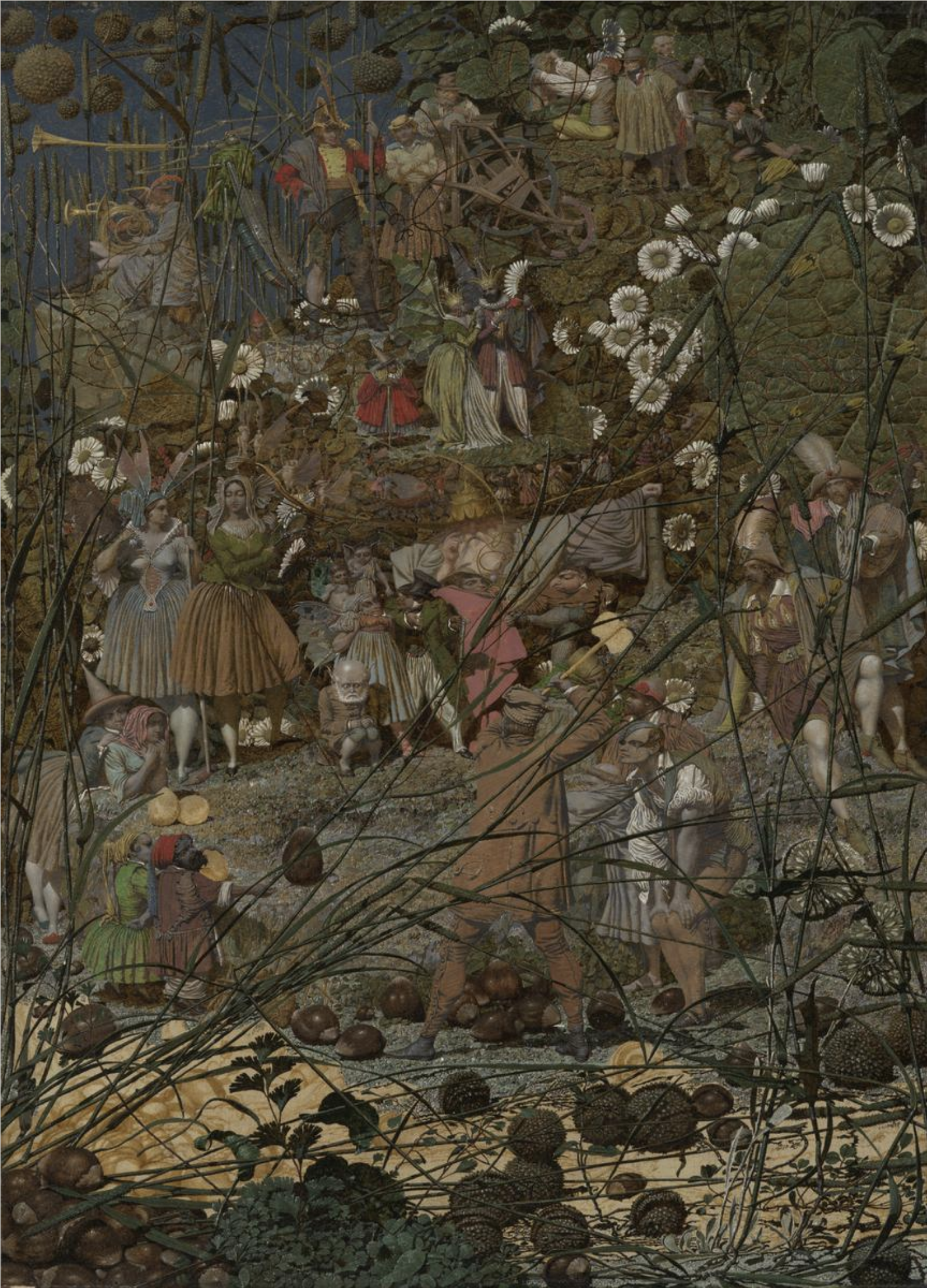
Richard Dadd - The Fairy Feller’s Master-Stroke 1855–64
I recently enjoyed a small exhibition of the art of Richard Dadd. (‘Beyond Bedlam’ is at the Royal Academy, London until 25 October.)
‘Perhaps the artist is himself the greatest victim of delusion – self delusion.’
Richard Dadd
Born in Chatham, Kent in 1817, the son of a chemist, Dadd studied at the Royal Academy Schools, where he was a member of a progressive group known as the Clique. Developing an interest in folklore and the uncanny, he was particularly inspired by Shakespeare’s ‘A Midsummer Night’s Dream.’
Queen Titania sleeps in a grotto, attended by dancing sylphs. Mischievous sprite Puck, a demonic mega-baby, sits cross-legged on a mushroom in a forest glade. A crouching fairy adorns her hair with flowers and regards us with a slight smile.
Dadd’s work is enigmatic and sensitive, exquisitely detailed and vibrantly coloured.
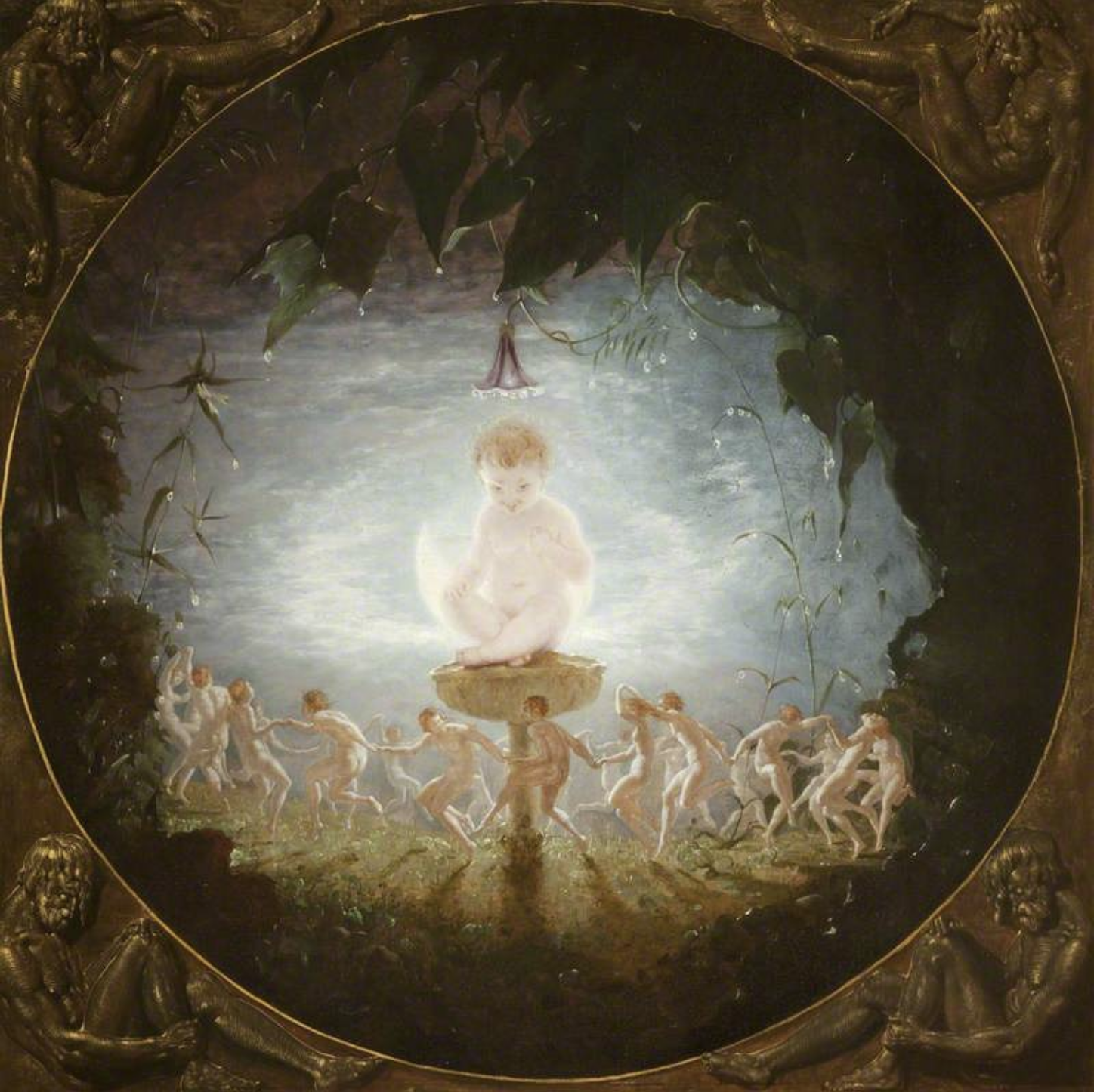
Richard Dadd - Puck 1841
In 1842 Dadd travelled to Turkey, Syria and Egypt. He filled his sketchbooks with intricate studies of camels, ruined monuments, mosques and markets. However, he began to experience delusions, became violent, and believed himself to be under the influence of the god Osiris. His condition was initially thought to be sunstroke. But in truth, his family had a history of mental illness, and he was probably suffering from paranoid schizophrenia. It has also been suggested that he’d consumed too much opium.
Back in England, Dadd withdrew to recuperate in the village of Cobham. On 28 August 1843, he took his father for an after-dinner walk and murdered him with a knife, believing him to be a devil. Fleeing to France, he tried to kill a stranger, and was subsequently apprehended and taken back to England.
Dadd was committed to Bethlem Hospital in Southwark (commonly known as Bedlam), an institution with a relatively enlightened regime. Encouraged by staff to continue painting, he created detailed works based on the sketches from his travels; portraits, literary scenes and landscapes. He also produced a series of watercolours to illustrate the intense, dark passions that drive human behaviour - including Grief, Ambition and Self-Contempt; Deceit, Jealousy and Agony-Raving Madness.
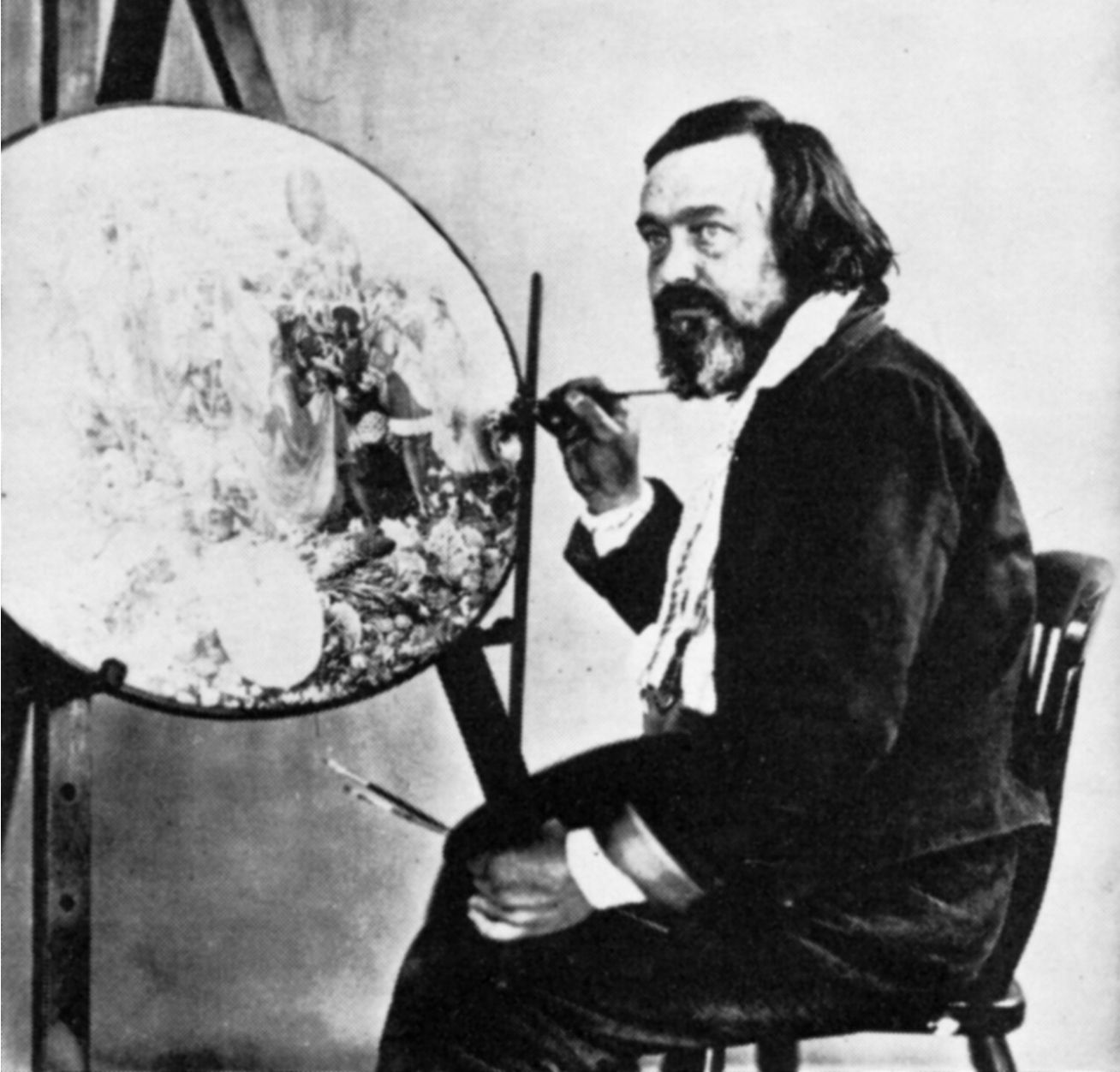
Henry Hering - Portrait of Richard Dadd, c. 1857
Photographic print. 20 x 15.5 cm. Courtesy of Bethlem Museum of the Mind. Alex Fox (Roy Fox Fine Art Photography)
Naturally Dadd returned to the enchanted worlds that had established his reputation. His most celebrated picture is ‘The Fairy Feller’s Master-Stroke.’ Painted over a nine-year period, it was inspired by Mercutio’s description in ‘Romeo and Juliet’ of Mab, the fairy queen who plants dreams in human heads at night.
‘Her chariot is an empty hazel-nut
Made by the joiner squirrel or old grub,
Time out o’ mind the fairies’ coachmakers.
And in this state she gallops night by night
Through lovers’ brains, and then they dream of love.’
William Shakespeare, ‘Romeo and Juliet’, Act I, scene 4
We peer through an undergrowth of wildflowers and weeds, to discover an axeman - intent on constructing Mab’s new fairy carriage - on the point of cleaving a chestnut in two. A bearded patriarchal figure wearing a gold papal crown stands nearby, and a crowd of peasants, soldiers and sprites look on. There, in the background, are Oberon and Titania, and a trumpet-playing crane fly. The image is intricate, ethereal, unsettling. Is the apothecary at the top right perhaps a reference to the artist’s murdered father? Is the adjacent child with an outstretched arm Dadd himself? Is that blood pouring from his fingers?
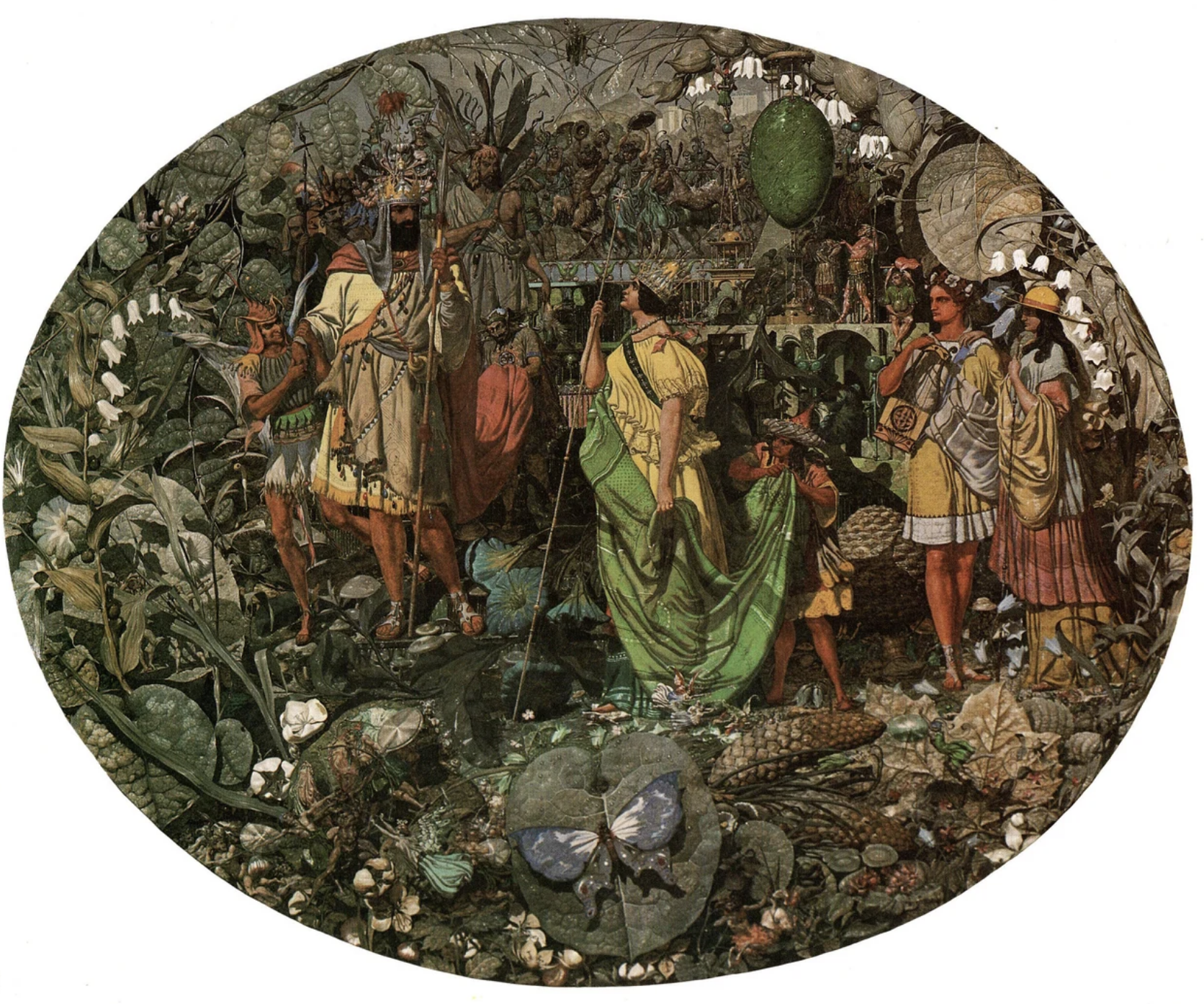
Richard Dadd - Contradiction. Oberon and Titania, 1854-58
Oil on canvas. 61 x 75.5 cm. Private Collection. Photo: David Parmiter
After 20 years in Bethlem, Dadd was moved to Broadmoor Hospital, near Reading, a newly built high-security facility. A few months after his arrival, his Case Notes observed:
‘Employs himself generally in painting and is at present engaged on a water colour fairy scene which he is executing with great care.’
Dadd remained in Broadmoor for the rest of his life, painting constantly. On one occasion, he seemed to reflect to a visitor on his artistic reputation.
‘Yes, some painters - the few, perhaps - achieve renown and substantial rewards; others lag behind.’
Dadd died of tuberculosis in 1886. He was largely forgotten until the 1960s, when his fantastical world of nymphs and goblins chimed with the culture of hippy psychedelia. On seeing Dadd’s work in the Tate Gallery, Freddie Mercury was inspired to write the 1974 Queen song ‘The Fairy Feller's Master-Stroke.’
Some have argued that Dadd’s fascination with sylphs and sprites derived from his mental illness. But the artist’s enthusiasm pre-dates his breakdown. I confess I’ve never been much taken with the mystical and occult. But his paintings prompted me to reflect on arcane traditions; the realm of dreams and fantasy; the surreal, subconscious and supernatural. Sometimes it’s healthy to set aside rationality, and let oneself go.
In a rhymed account of the ‘Fairy Feller’s’ origins and characters, Dadd explained that his picture was inspired by poetry, chance, and a kind of magic.
‘The fairies grow without / The reach of human ken or will.’
'He's a fairy feller.
The fairy folk have gathered 'round the new moon shine,
To see the feller crack a nut at night's noon time.
To swing his axe he swears, as he climbs he dares,
To deliver
The master stroke.’
Queen, 'The Fairy Feller's Master-Stroke’ (F Mercury)
No. 585