Anna Ancher: ‘Staying Mainly at Home’

Anna Archer - Interior With Red Poppies. 1905 Oil on Canvas

I recently saw an excellent exhibition of the work of Danish artist, Anna Ancher. (The Dulwich Picture Gallery, until 8 March).

Anna Brøndum was born in 1859 in Skagen, a fishing town at the top of the Jutland peninsula, the northern-most point in Denmark. Her father owned the Brøndums Hotel, whose guests included artists attracted to the area by its extraordinary light and seascapes. 

On the night Anna was born, the inn was visited by Hans Christian Andersen. Her mother took this as auspicious, and encouraged her daughter to pursue a creative career. Anna studied drawing in Copenhagen and Paris, and in 1880 she married fellow painter Michael Ancher. When she subsequently gave birth to a child, there was social pressure to devote herself to household duties, and her former art teacher advised her to ‘throw away her painting box.’ Nevertheless, she persisted.
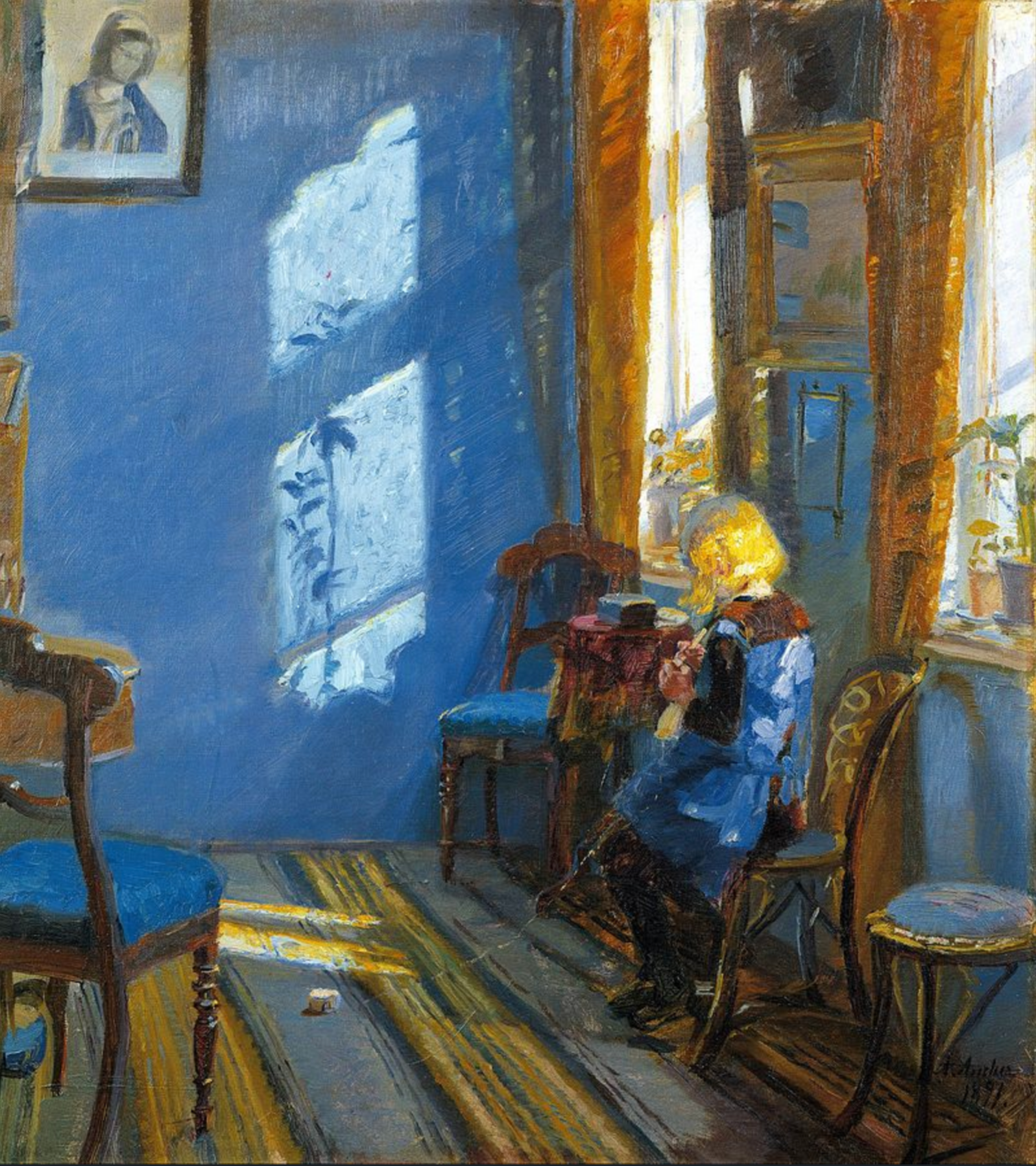
Anna Archer -Sunlight in the Blue Room. 1891. Oil on Canvas

Anna often depicted quiet domestic interiors. Her elderly mother, in white lace bonnet, is in repose - comfortably tucked in under a crimson blanket. Her sisters fall asleep at the table, exhausted after a hard day’s work managing the inn. A young woman is engrossed in her book, seated next to a vase of gorgeous red poppies. 

Anna was particularly skilled at capturing light - the golden glow of a lamp; the radiant flickers cast by the evening sun against the studio wall. Sunbeams fall across a blue room, as Anna’s blonde-bobbed daughter concentrates on her knitting. Light filters through a cream curtain, as a maid stands by the kitchen sink with her back to us. 

The hotel and the Ancher house became a vibrant hub for Skagen’s creative community. In the exhibition there are photos of them lunching in the garden, walking on the shore, enjoying a fancy dress party. Their portraits of one another still line the walls of the Brøndums dining room today, with Anna and Michael placed at the centre.
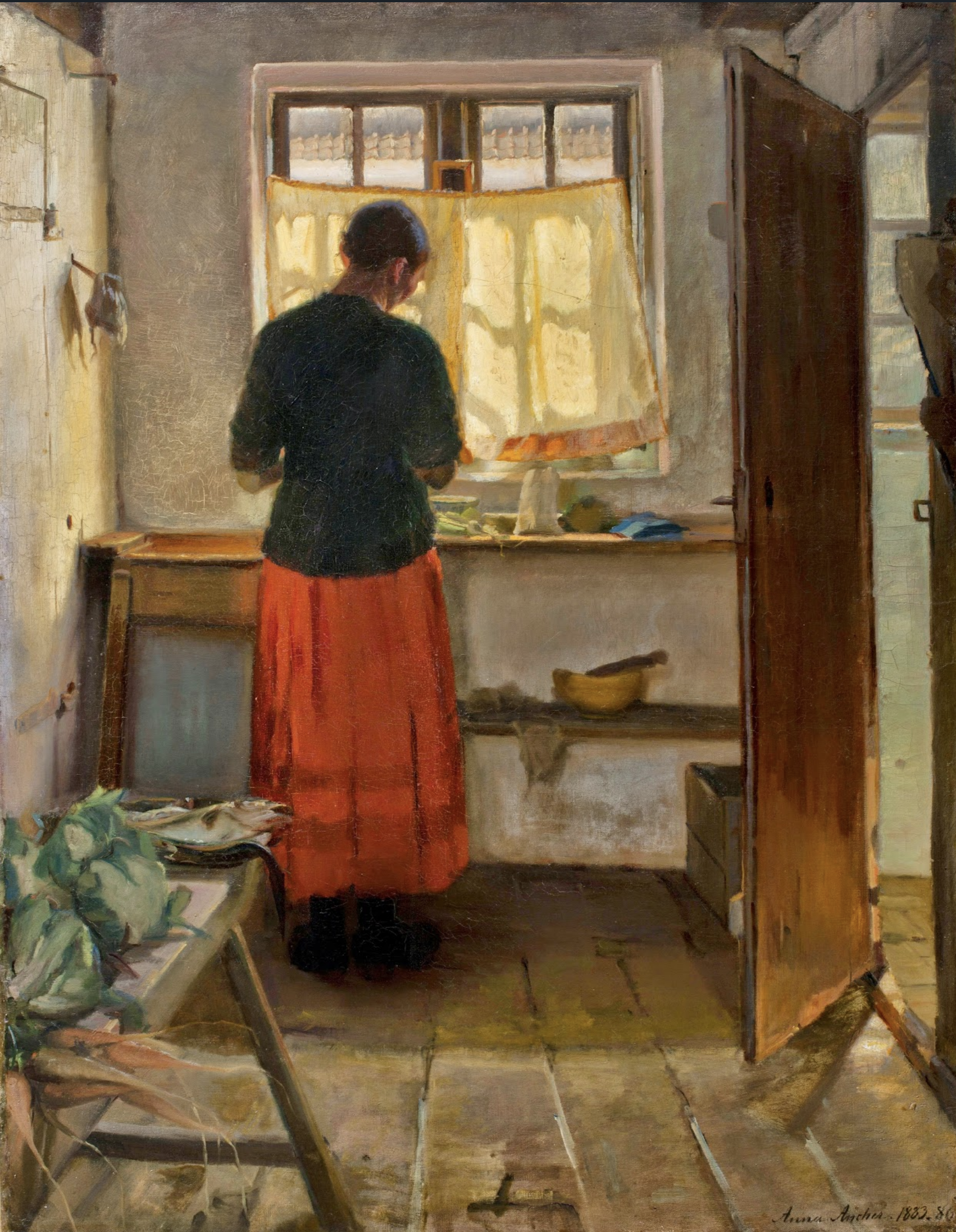
Anna Ancher - The Maid in the Kitchen. 1883 - 1886. Oil on Canvas

Anna also painted the dunes and heathland of this remote spot; the boats on the strand; children playing on the beach. She portrayed the poor local community hard at work. An old man whittles sticks. An elderly lady plucks a goose. A baker counts her coins. Scythe and rake at the ready, three farm labourers march across the field at harvest-time.

Although Anna travelled widely round Europe, visiting Germany, the Netherlands, Italy, Britain and France, nearly all her art depicts scenes around Skagen. There is gentle affection, mutual respect, quiet intimacy, in these portraits. As a local girl - the only local in the artists’ community - she was trusted by her sitters. 

‘I firmly believe that the very best thing is to go on small trips, but staying mainly at home and painting the people of one’s own country.’
Anna Ancher
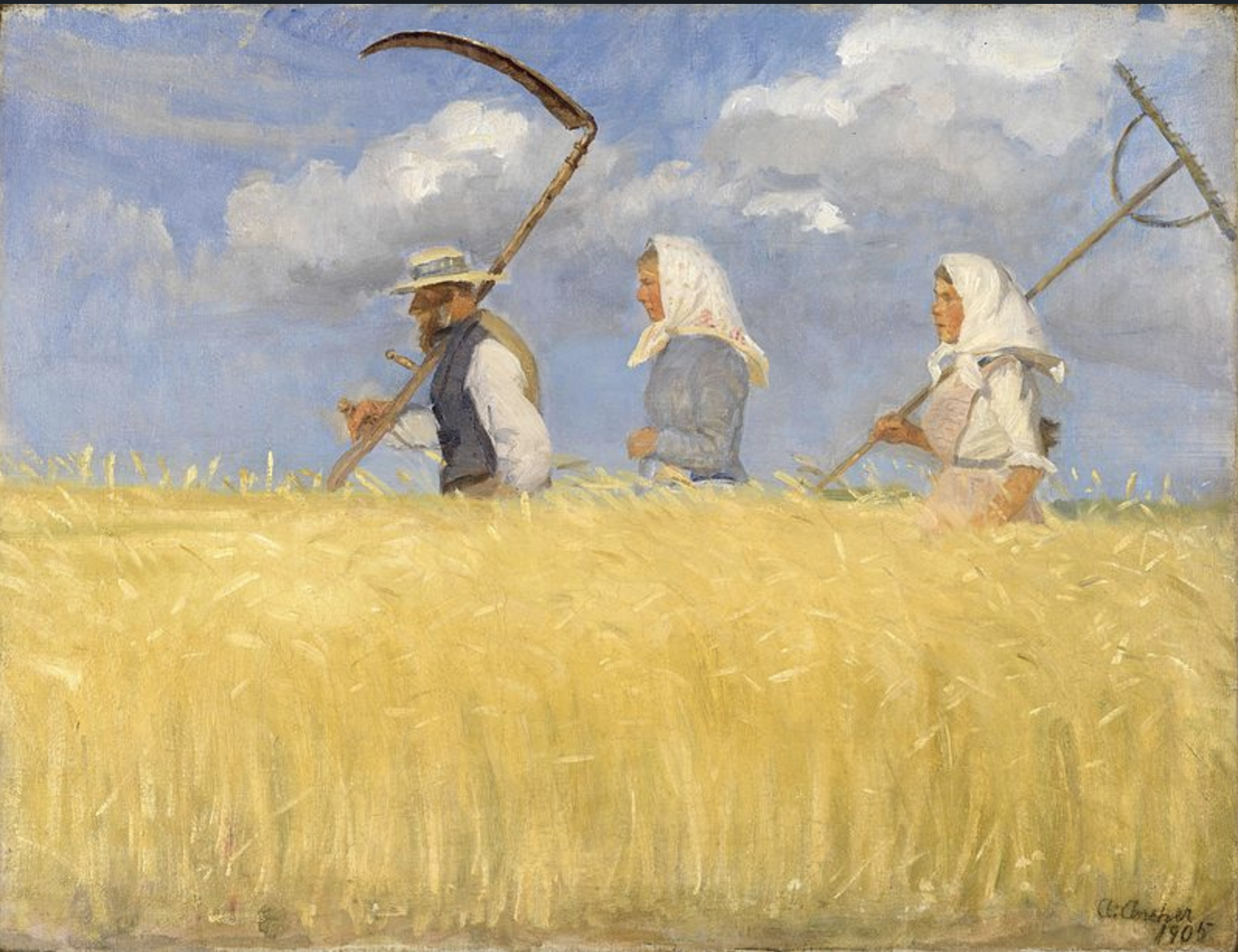
Anna Ancher - Harvesters. 1905. Oil on Canvas

Anna teaches us that we don’t have to go far to find inspiration. There is compelling material on our doorsteps – if we are willing to recognise and mine our unique understanding of home.

'Perhaps home is not a place, but simply an irrevocable condition.’
James Baldwin

Time for a festive break.
Have a restful Christmas. 
My next post will be on Thursday 8 January 2026.
If you’re missing me, there are lots of old articles to read in the Index.
See you on the other side, I hope.

'Sorry I'm not so merry,
But I feel like this yearly
Christmas time isn't my vibe,
Brings no joy into my life.
Watch the snow as it's falling,
And I don't feel a damn thing.
Only darken the tree lights,
Just another December night.
Sleigh bells ringing,
Still I feel sad.
It'll have you thinking
Of all the things
That you don't have.
But I know
If I'm feeling lonely,
I can't be the only one,
Drowning in my tears.
So somebody show me
How am I supposed to have fun
At the loneliest time of year?
The loneliest time of year.’

Mabel, ‘Loneliest Time of the Year’ (C Purcell / T Jean-marie / U Emenike / M Mcvey / N Nyassa)

No. 548

SUBSCRIBE

Afraid to Dance: Learning to Let Go As the Pressure Mounts

The dancing mania by Hendrik Hondius. Source: Wellcome Library, London

The dancing mania by Hendrik Hondius. Source: Wellcome Library, London

One day in July 1518 Frau Troffea stepped out onto the narrow streets of Strasbourg and began to dance. She swayed and shimmied, bobbed and boogied, with self-absorbed abandon. She danced for hours on end, not giving a thought to rest or sustenance. Hours turned to days. Within a week 30 or so others had joined in. Within a month there were 400 crazed dancers clogging the streets. The authorities were nonplussed. They laid on musicians to accompany the revellers, opened up halls and public spaces, in the belief that through encouragement they could drain the dance away. Inevitably many collapsed from exhaustion and some died of heart attacks.

The Strasbourg Dancing Plague was just one of a number of incidents of choreomania that were reported across Europe in the Middle Ages. Scholars have suggested that these were episodes of mass, stress-induced psychosis, brought on by the harsh conditions of medieval life. Some think that cult religions were involved. Others have speculated that fungus growing on local rye crops may have produced a psychoactive drug similar to LSD.

Whatever the specific cause, there’s no doubt that fear of dancing has a very particular grip on the popular imagination. In the late Middle Ages murals and woodcuts depicted Danses Macabres in which skeletons escorted people from all walks of life in a jaunty jig to the grave. In seventeenth century England Oliver Cromwell banned maypole dancing for its sinfulness and suggestion. The nineteenth century ballet Giselle features the Wilis, ghostly spirits of women betrayed by their lovers, who when they encounter men, dance them to death. In Hans Christian Andersen’s fairy tale, The Red Shoes, a pair of shoes refuses to let their occupants stop dancing.

What’s going on here? Of course we all love to dance. Well, most of us do. But maybe, at another level, we’re also afraid to dance. Dance represents succumbing to the sensual and emotional; a rejection of hierarchy and convention; a loss of control. Dance takes us back to our primitive roots. We danced before we could speak. It takes us to a world of instinct and intuition, of the euphoric and ecstatic. In dance we find release from our social shackles. We let go. And so as a culture we want to dance and yet we are afraid to dance.

In the creative industries we should recognise these contrary forces. We are forever managing the tension between the desire for freedom of expression and the need to take command of a situation. Creativity demands carte blanche; commerce demands control.

This tension is felt most acutely when the stakes are high: when the Clients are most expectant; when the prize is most exciting and the penalty is most disturbing; when time is running out. And it’s at precisely these times that the instinct to take control usually wins out. When we’re in a crisis we concentrate on cracking the idea at every moment of the day; we focus on finding the answer with every fibre of our bodies. The more arduous and important the undertaking, the more seriously we tend to take it.

But pressure can be counterproductive. By concentrating too intensely on a problem, we diminish our ability to solve it. We become cautious, conservative, blinkered and narrow minded.

In fact the creative’s best response to pressure should be to puncture it; release it. Because it’s only when we are at ease, when our minds are unfettered and free to wander, that we make random connections, have lateral thoughts and serendipitous encounters. At times of crisis we should learn to let go.

So as the tension mounts and the deadline looms, always remember to step outside. Go for a walk, go to the gym, go to sleep. Change the routine, change the subject, change the record. Look at the sky, read a book, call your mum. And don’t be afraid to dance.

‘Let’s groove tonight.
Share the spice of life.
Baby slice it right.
We’re gonna groove tonight.

Let this groove light up your fuse.
It’s alright (alright), oh, oh.’

Earth Wind & Fire, Let’s Groove (Maurice White, Wayne Vaughn)

No. 135

Subscribe