Rose Wylie: ‘Anything That Is Out of Control, I Like’
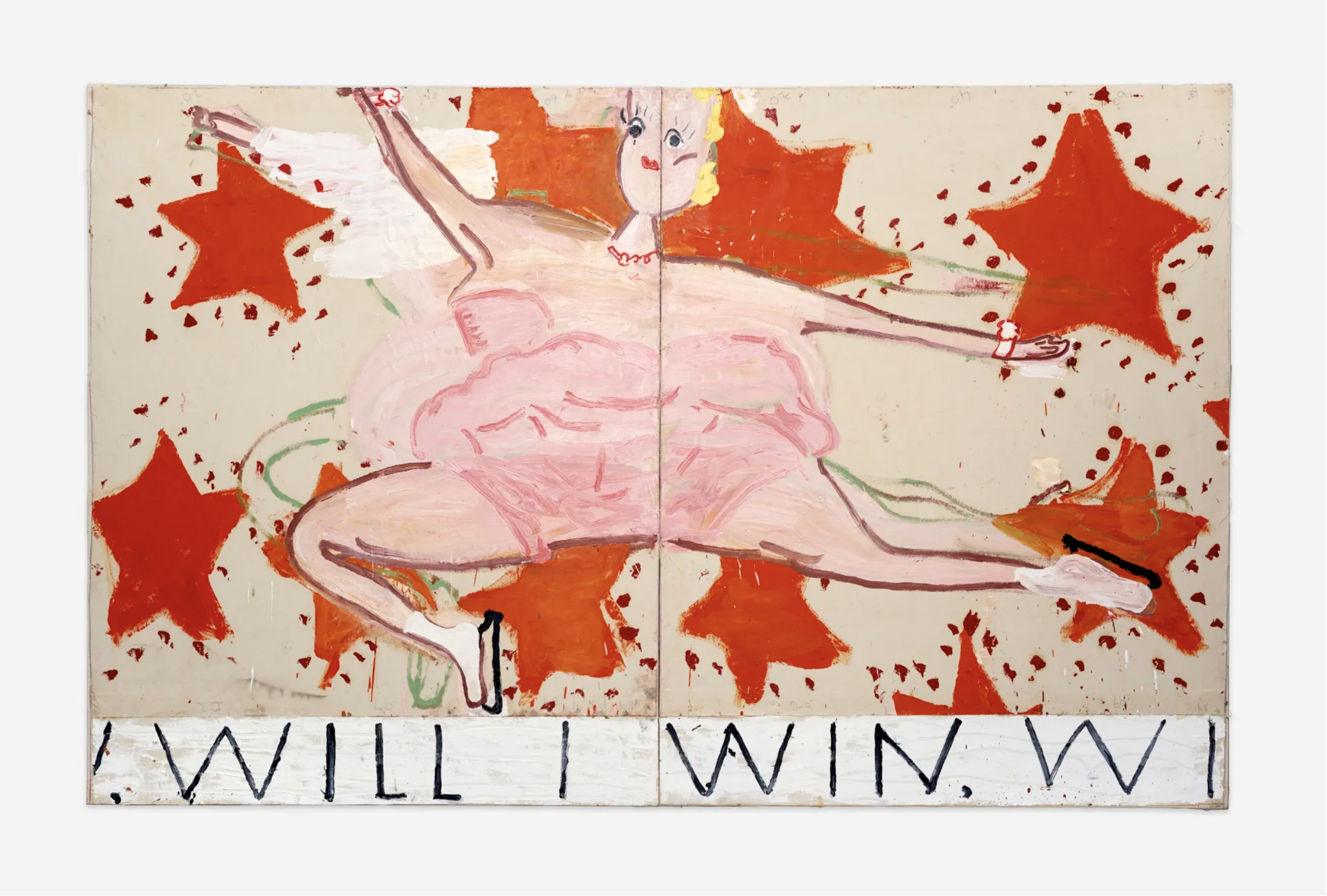
Rose Wylie - Pink Skater (Will I Win, Will I Win), 2015
Photograph courtesy Jari Lager: Soon-Hak Kwon © Rose Wylie)
I recently enjoyed an exhibition of the work of Rose Wylie - the first British female artist to occupy all of the Royal Academy’s main galleries. (‘The Picture Comes First’ is at the Royal Academy, London until 19 April.)
‘I love chance. It breaks through notions of control, of knowing what you were going to do before you do it.’
Rose Wylie
Born in Hythe in 1934, Wylie studied painting at Folkestone and Dover School of Art in the 1950s. Having taken an extended career break to raise three children, from the 1980s she devoted herself to her art, basing herself in a studio in her Kent cottage. She still works there today.
‘In painting I don’t like too much pernickety, precious fiddling about. Perhaps you’ve noticed.’
Wylie’s big canvases are painted in bold, bright colours, thickly applied, in a loose, spontaneous style. They integrate distant memories and recent experiences; animals, flora and fauna; references from history and mythology, from cinema, celebrity and popular culture.
‘It’s better to just get on… Just get on and do what you’re going to do. Thinking too much can wreck or inhibit ‘spontaneous.’’
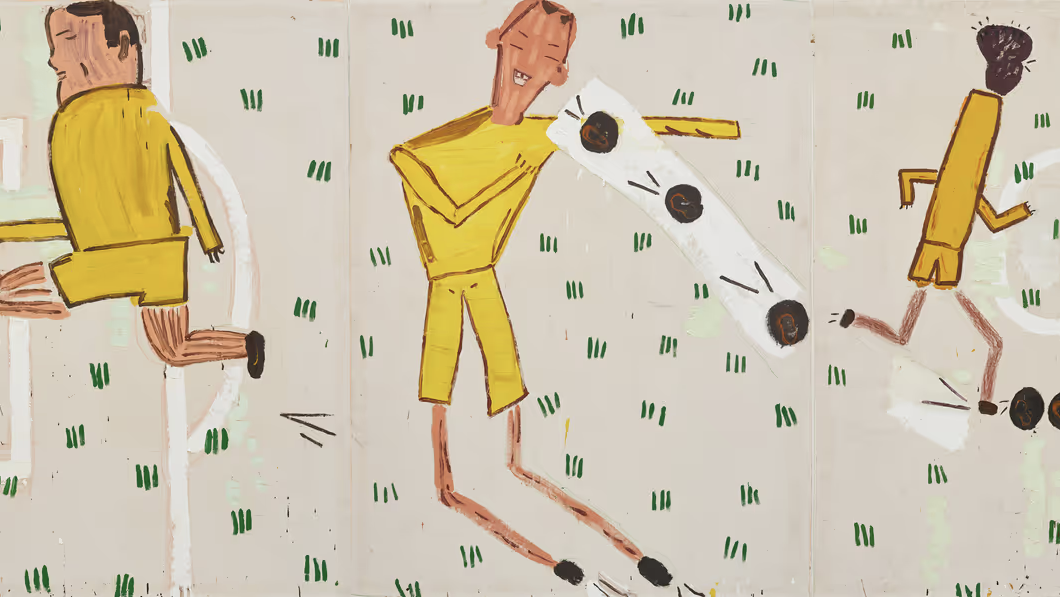
Rose Wylie - Yellow Strip
Here are birds, ducks and ack-ack fire. German planes fly overhead while dogs cavort in Kensington Gardens. (Wylie experienced the Blitz as a young girl.) Here are attentive cats, a big red elephant, an irreverent anatomical diagram of a horse. We see Premiership footballers and Olympic swimmers; Choco Leibniz, a well-cooked omelette and red lips licking a coffee spoon. Some friends take dinner outside on a summer evening. There’s a seating plan. And here’s Penelope Cruz on a bench, and Rita Tushingham with an axe.
Wylie is interested in the visual impact of images rather than the story they tell. Revelling in incongruous juxtapositions, her pictures are quirky, playful, joyful.
‘Usually I paint something I’ve seen, but I may fiddle with the scale, context and rules of gravity. I draw from observation, memory and with ‘conceptual projection.’’
Wylie clearly has a fondness for fashion. She paints her ‘50s-era bullet-bra, her favourite red lipstick and checked skirt, her dress with the padded shoulders. She paints cut-out paper dolls.
‘I like stuff that goes across time, through trans-temporality, or whatever you want to call it.’
Sometimes she adds text. Underneath a reclining female figure, she writes: ‘Bathing costume green. Glamour personified.’ Accompanying an ice skater in a pale pink dress: ‘Will I win.’ Alongside Snow White holding a duster: ‘Some day her prince will come.’
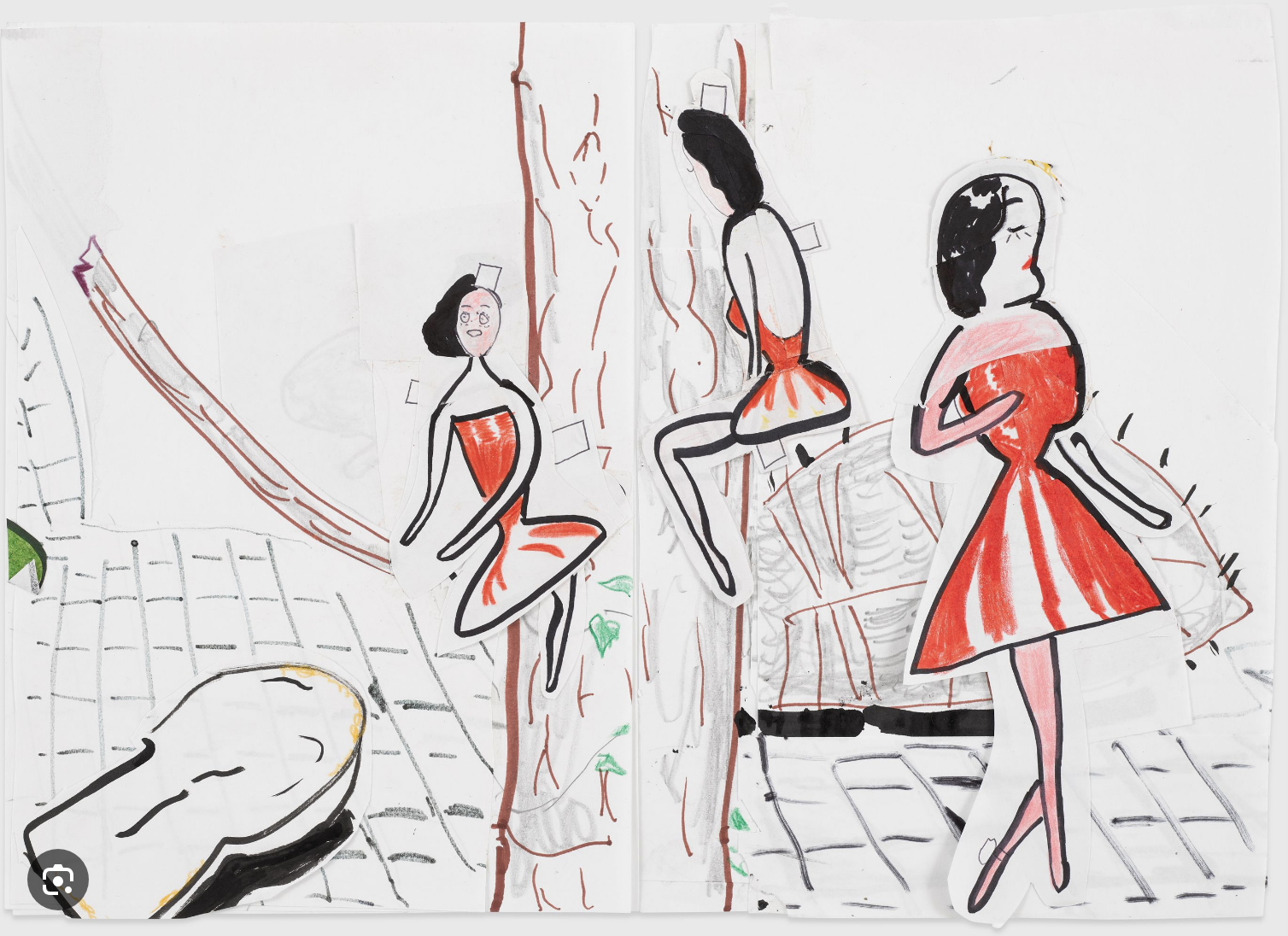
Rose Wylie - Study from Red Twink
Wylie draws every day in sketchbooks, on large sheets and scraps of paper. She has an insatiable curiosity, an avid interest in her immediate surroundings and in the world beyond. Her drawings form a memory bank, a treasure trove of ideas to which she constantly returns for inspiration. Her studio floor, covered with layers of newspapers, also acts as a source of stimulus.
‘Chance can bring in something totally new and unexpected…a cure for boredom… Chance is like the break in the dotted line. Anything that is out of control, I like.’
Wylie reminds us that, though we are endlessly trying to impose order, structure and logic on our thoughts, our mental processes are often erratic; coincidence causes fresh associations; and memories tend to be messy - jumbled, fluid, confusing.
‘It is the things I remember that I’m interested in. The memory may not be accurate, but if I have a fond memory of something, the work I make gives me a chance to relate the work to the memory.’
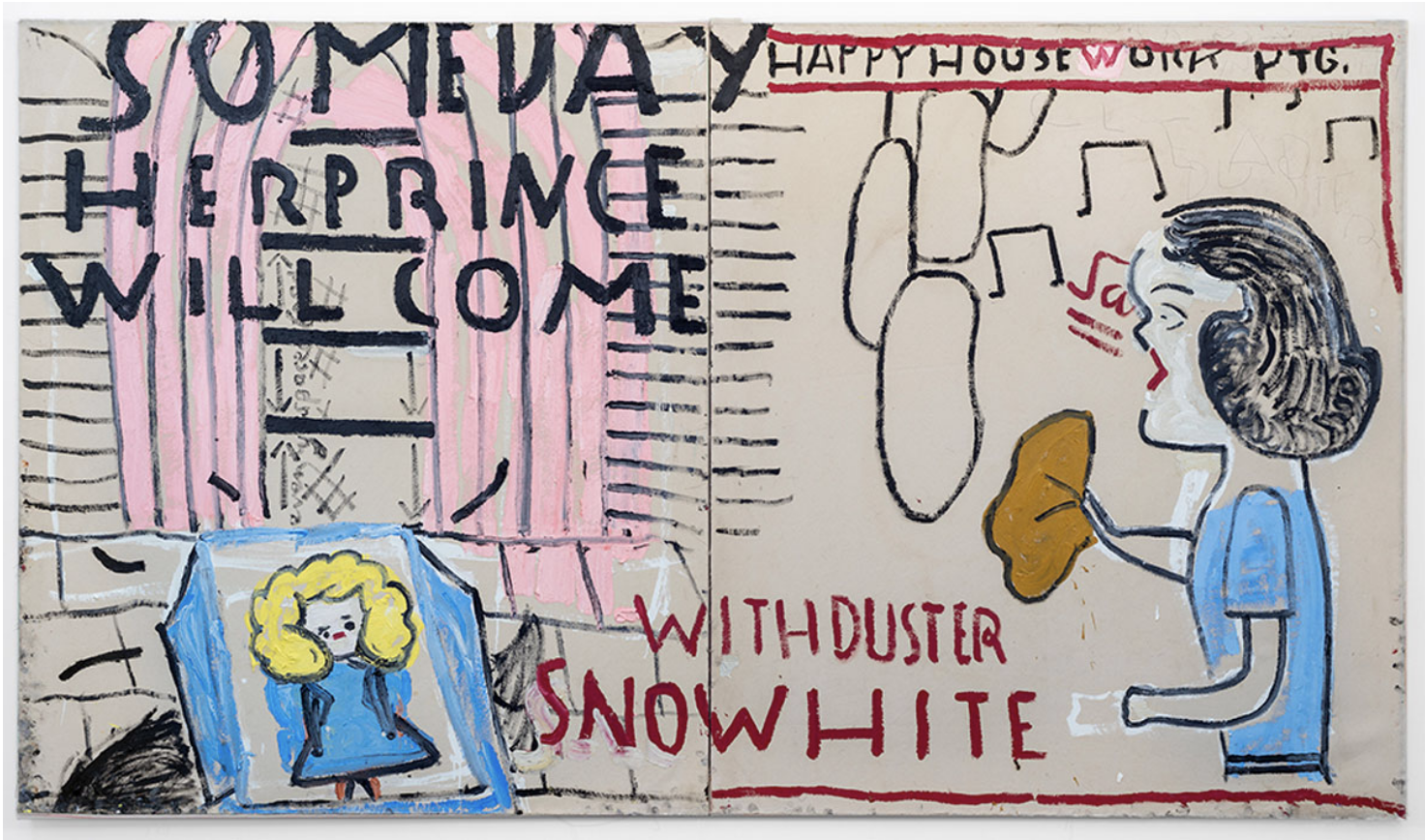
Rose Wylie - Snowwhite (3), with Duster
Wylie teaches creative people to liberate the imagination from classification and control; to be constantly curious, open to stimulus from all sorts of sources; to draw on recollections and experiences; to embrace the random, spontaneous and the incongruous; to make free associations. And, critically, to regard age as an advantage, not an adversary.
‘Age has more appeal [than youth]…There’s more ‘longer backwards’ to work with – and coincidences and connections have more time to happen.’
'Confusion in her eyes that says it all,
She's lost control.
And she's clinging to the nearest passerby,
She's lost control.
And she gave away the secrets of her past,
And said, "I've lost control again."
And of a voice that told her when and where to act.
She said, "I've lost control again.”'
Joy Division, ‘She’s Lost Control’ (B Sumner/ P Hook/ S Morris/ I Curtis)
No. 561