A Month in the Country: Lost in Lacemaking

Ivan Turgenev’s ‘A Month in the Country’ is set on a Russian country estate in the 1840s. The play explores the painful complexities of unrequited love - petty jealousies played out in a world of stifling ennui. (An excellent production of the Brian Friel version, directed by Lyndsey Turner, is running at the Donmar Warehouse, London until 3 October.)
Michel: It occurred to me a while ago that we regret most of the things we say and we regret even more all the things we don’t say; so that our lives just dribble away in remorse.
Natalya Petrovna, an intelligent, sophisticated woman in her late 20s, is bored by her marriage to Arkady, a rich landowner, seven years her senior, whose principal interests are weirs and winnowing machines.
Arkady: Yes, I always seem to be simultaneously very busy and very confused, don’t I?
Natalya sustains herself by spending time with debonair, attentive Michel, Arkady’s childhood friend.
Natalya: Don’t you know that nothing bores a woman more quickly than an excessive desire to please?
Though Natalya appreciates Michel’s devotion, she has never let their friendship develop into an affair.
Natalya: You know I love you. And the moment I say that, the moment I make that acknowledgement, I think… that man has never made me suffer; that man has never made me cry; and if I have never cried because of him, I can’t really love him, can I?
The equilibrium is disturbed by the arrival of Aleksey, the handsome 21-year-old tutor to Natalya’s son.
Natalya: He’s so unlike us: he’s so… unjaded.
Natalya falls in love with Aleksey. But so does Vera, her 17-year-old ward, precipitating rivalry, conspiracy and betrayal.
Natalya: I feel… unhinged…And dangerously irresponsible – giddy, heady, almost hysterical with irresponsibility.
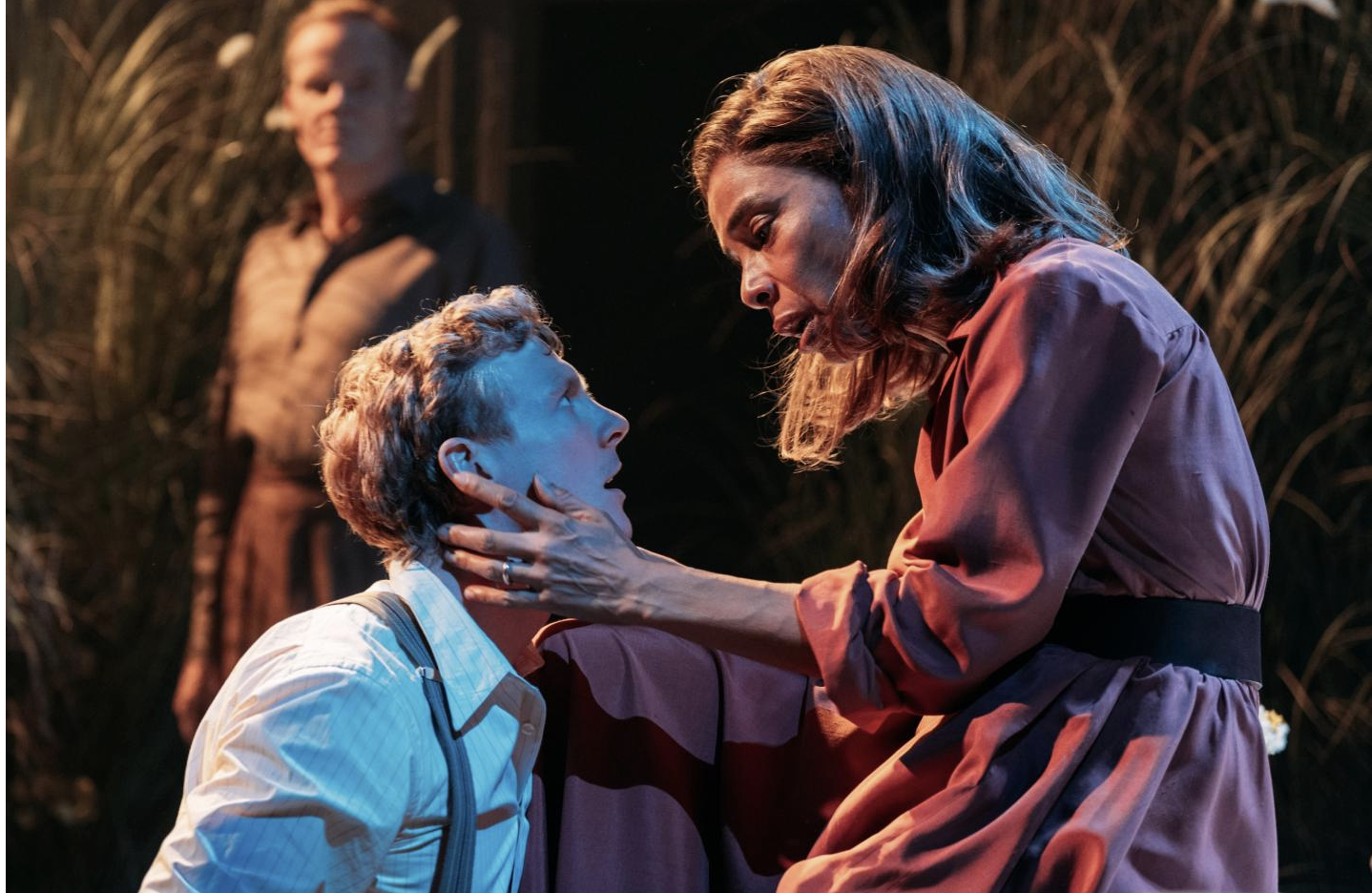
Patrick Gibson as Aleksy, Sophie Okonedo as Natalya, with Alistair Petrie as Michel looking on - Photo Helen Murray
Poor Aleksey finds it all very confusing.
Aleksey: I’m here a month and what happens? Arkady fights with Michel. Michel fights with Natalya. Natalya fights with you. Anna fights with Michel. And in some way I seem to be the cause of it all.
Amidst the romantic chaos, there is a strong sense that these listless, chattering aristocrats are not listening to each other.
Natalya: You are a kind man and a subtle man and a man of great delicacy. But there are times when I think you know nothing about me.
They are too caught up in their own immediate problems and their own private worlds.
Natalya: You’re not talking to me at all; you’re playing a private little game of your own. You’re like those lacemakers in those gloomy, airless rooms – each one totally isolated, totally concentrated on those minute, complex, subtle little stitches. As if nothing in the world mattered but those ridiculous little stitches.
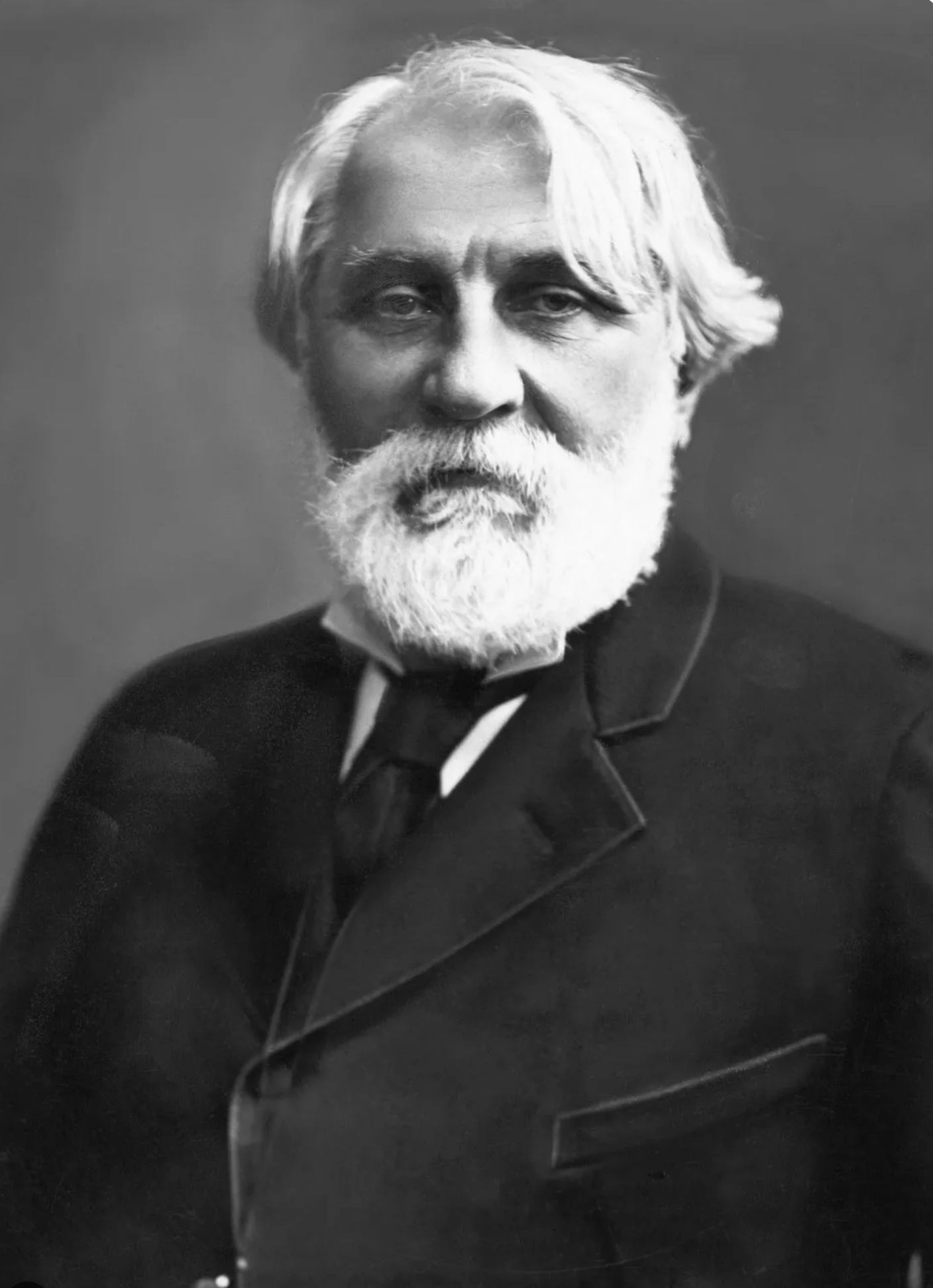
Ivan Turgenev
I found myself thinking that Natalya’s lacemaking analogy applies as much to the contemporary world of work as it does to rural life in pre-revolutionary Russia. Heads down, we labour to address our most pressing problems. We become absorbed in the detail, lost in the politics of the present. We begin to ignore our relationships; to abandon all sense of perspective and proportion.
We would do well to look up occasionally; to consider the broader picture and the longer term. We need to retain our vision.
Natalya: You gaze at me all the time, don’t you? You know every thought in my head – don’t you? You analyse everything I think, everything I do – don’t you?...Don’t tell me there’s a little portion of my mind that you haven’t invaded?
Written around 1850 and first published in 1855, ‘A Month in the Country’ was not staged until 1872, and then it was criticised for being ‘undramatic.’ It shares its character-driven narrative and melancholy tone with much of Anton Chekhov’s work, which it preceded by some forty years. It was only in the wake of Chekhov’s success - when in 1909 Konstantin Stanislavsky staged a production in Moscow - that Turgenev’s play was properly appreciated.
Vera: Esteem – affection – love; maybe you’re right; maybe they are synonymous; maybe they should be.
Inevitably the misaligned affections at the core of this splendid piece lead to disappointment, misery and heartache.
Michel: All love is a catastrophe. Look at me. An endless process of shame and desolation and despair when you are stripped – you strip yourself! – of every semblance of dignity and self-respect; when you grovel in the hope of a casual word or a sly smile or a secret squeeze of the hand.
Vera’s attempt at reassuring words falls on deaf ears.
Vera: Everything’ll soon be back to normal.
Natalya: For God’s sake, can’t you see that it’s the normal that’s deranging me, child?
As Natalya observes, life cannot be quietly managed, elegantly navigated. Survival and success require stronger, more robust decisions; bigger, bolder actions.
Natalya: You are so eloquent about ‘nature’, Michel; so sensitive, so responsive to it. ‘Nature’ must be flattered….But of course you’re wrong about ‘nature’. Nature is blunt and crude and relentless. Nature cares about nothing except itself – surviving and perpetuating itself. Your exquisite nature is a savage.
'When you looked into my eyes,
My heart never skipped a beat.
And when you touched my hand,
Didn't feel it down to my feet.
And when you kissed me so,
I didn't feel my body shaking.
And when you had to go,
Didn't feel my whole heart breaking.
It didn't mean much to me.
It didn't mean much to me.
And when you closed the door,
Didn't have to dry my eyes.
And when you didn't call no more,
I barely even realized.
I never listen for your voice,
Every time I pick up the phone.
'Cause you never even crossed my mind,
Until I had to sing this song.
It didn't mean much to me
It didn't mean much.’
The Womack Sisters, 'Didn’t Mean Much to Me’ (B Mann)
No. 586