Rose Wylie: ‘Anything That Is Out of Control, I Like’

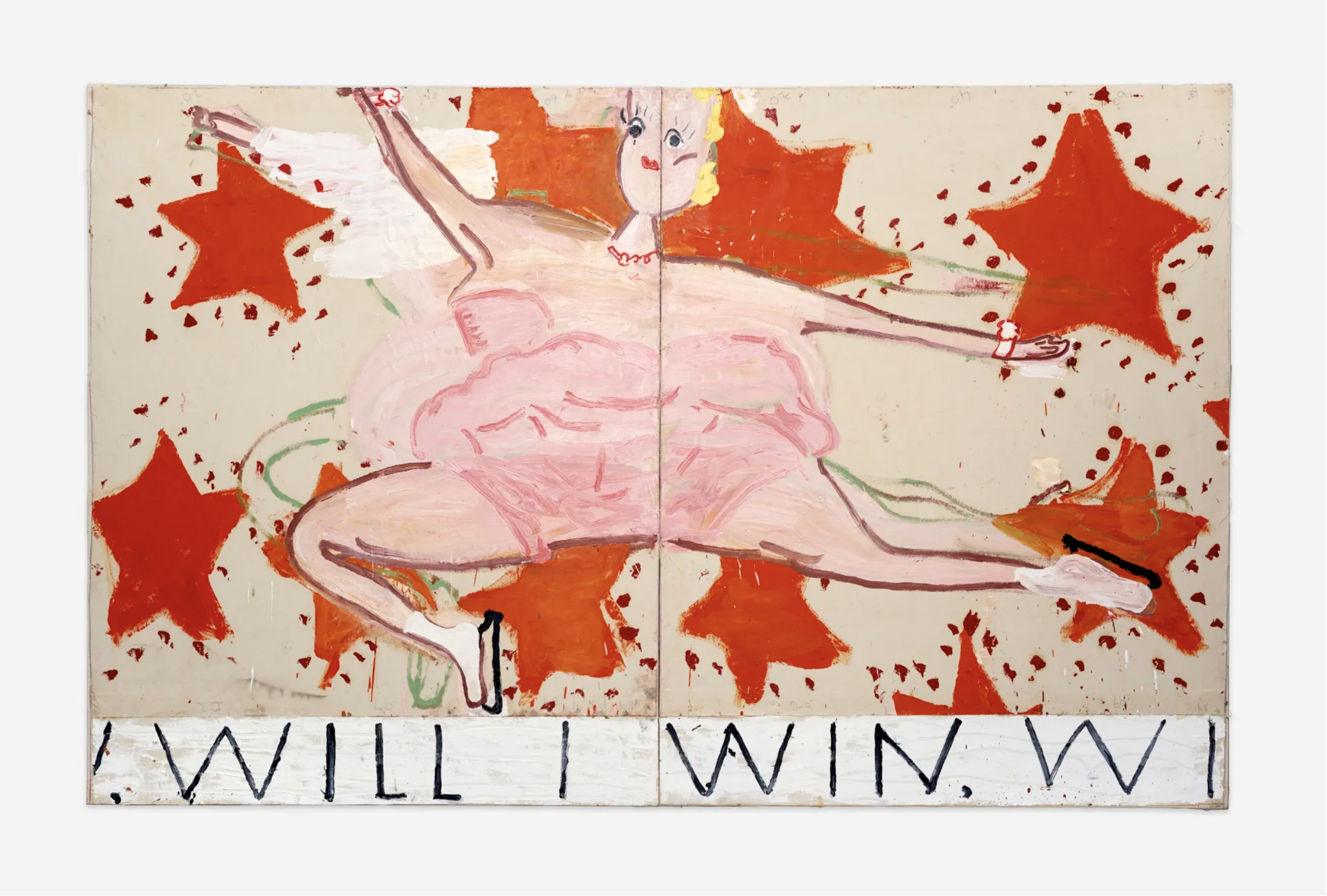
Rose Wylie - Pink Skater (Will I Win, Will I Win), 2015
Photograph courtesy Jari Lager: Soon-Hak Kwon © Rose Wylie)

I recently enjoyed an exhibition of the work of Rose Wylie - the first British female artist to occupy all of the Royal Academy’s main galleries. (‘The Picture Comes First’ is at the Royal Academy, London until 19 April.)

‘I love chance. It breaks through notions of control, of knowing what you were going to do before you do it.’
Rose Wylie

Born in Hythe in 1934, Wylie studied painting at Folkestone and Dover School of Art in the 1950s. Having taken an extended career break to raise three children, from the 1980s she devoted herself to her art, basing herself in a studio in her Kent cottage. She still works there today.

‘In painting I don’t like too much pernickety, precious fiddling about. Perhaps you’ve noticed.’

Wylie’s big canvases are painted in bold, bright colours, thickly applied, in a loose, spontaneous style. They integrate distant memories and recent experiences; animals, flora and fauna; references from history and mythology, from cinema, celebrity and popular culture. 

‘It’s better to just get on… Just get on and do what you’re going to do. Thinking too much can wreck or inhibit ‘spontaneous.’’

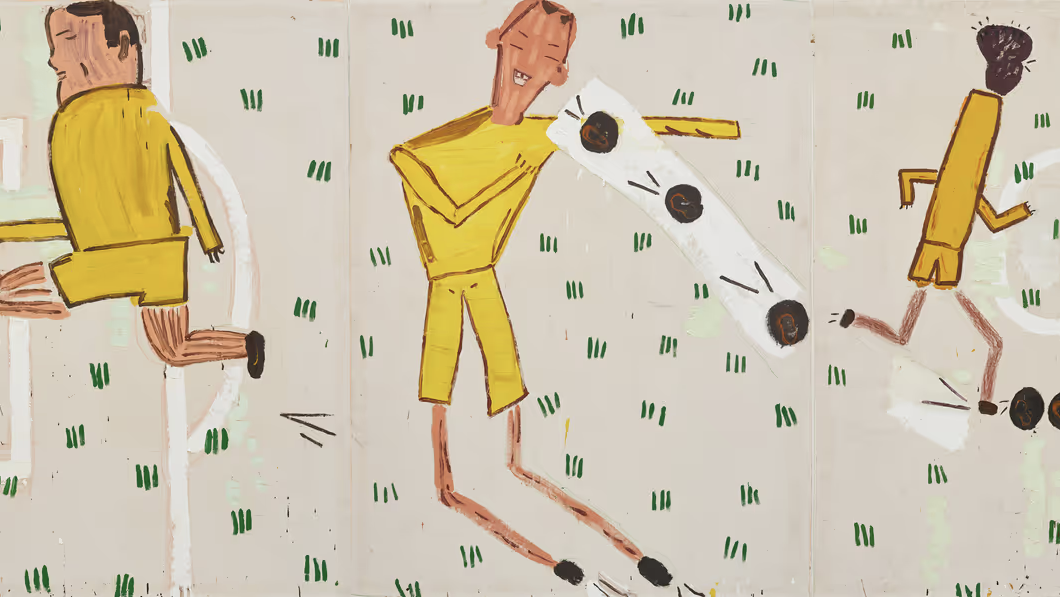
Rose Wylie - Yellow Strip

Here are birds, ducks and ack-ack fire. German planes fly overhead while dogs cavort in Kensington Gardens. (Wylie experienced the Blitz as a young girl.) Here are attentive cats, a big red elephant, an irreverent anatomical diagram of a horse. We see Premiership footballers and Olympic swimmers; Choco Leibniz, a well-cooked omelette and red lips licking a coffee spoon. Some friends take dinner outside on a summer evening. There’s a seating plan. And here’s Penelope Cruz on a bench, and Rita Tushingham with an axe.

Wylie is interested in the visual impact of images rather than the story they tell. Revelling in incongruous juxtapositions, her pictures are quirky, playful, joyful.

‘Usually I paint something I’ve seen, but I may fiddle with the scale, context and rules of gravity. I draw from observation, memory and with ‘conceptual projection.’’

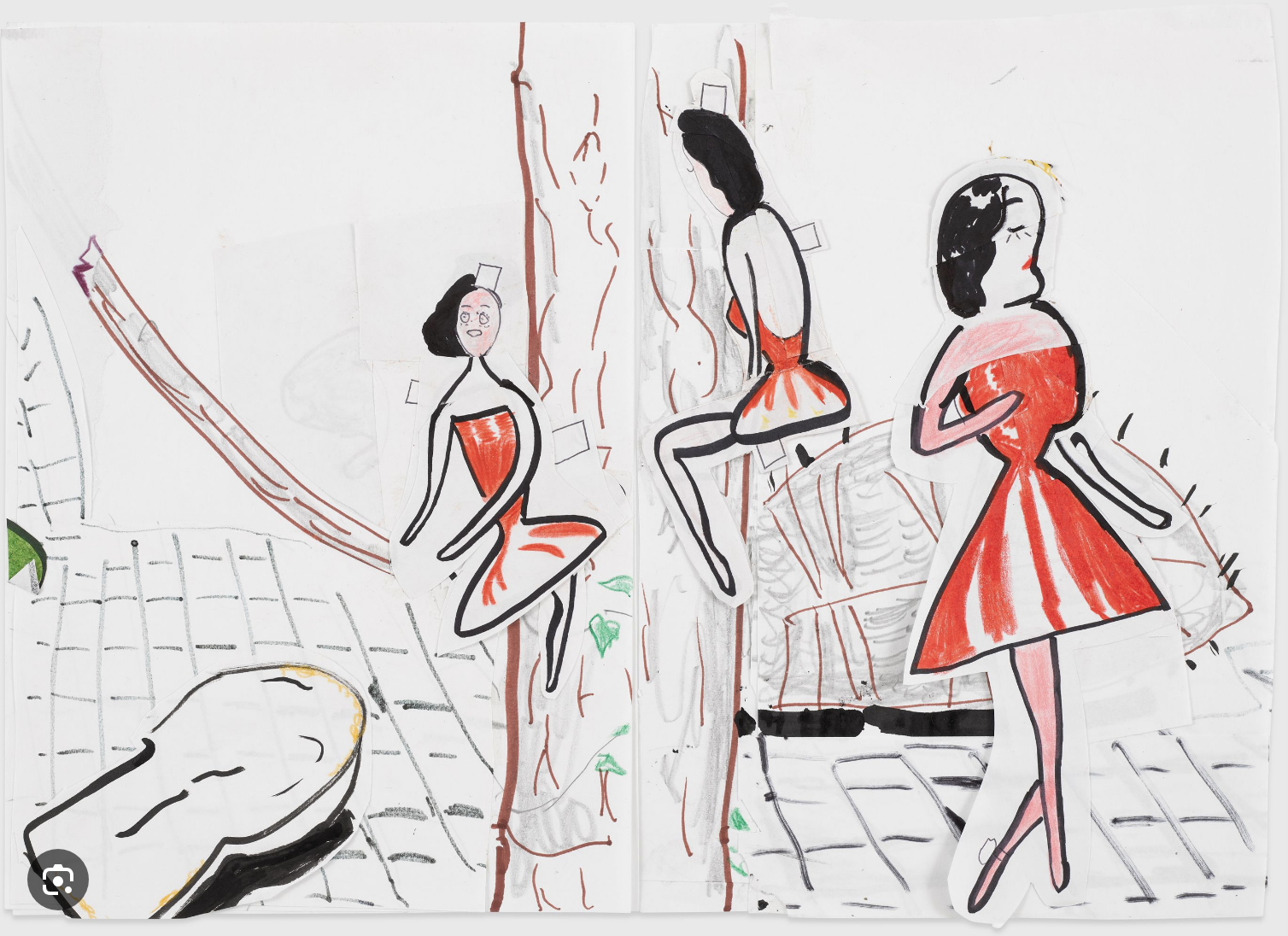
Wylie clearly has a fondness for fashion. She paints her ‘50s-era bullet-bra, her favourite red lipstick and checked skirt, her dress with the padded shoulders. She paints cut-out paper dolls. 

‘I like stuff that goes across time, through trans-temporality, or whatever you want to call it.’

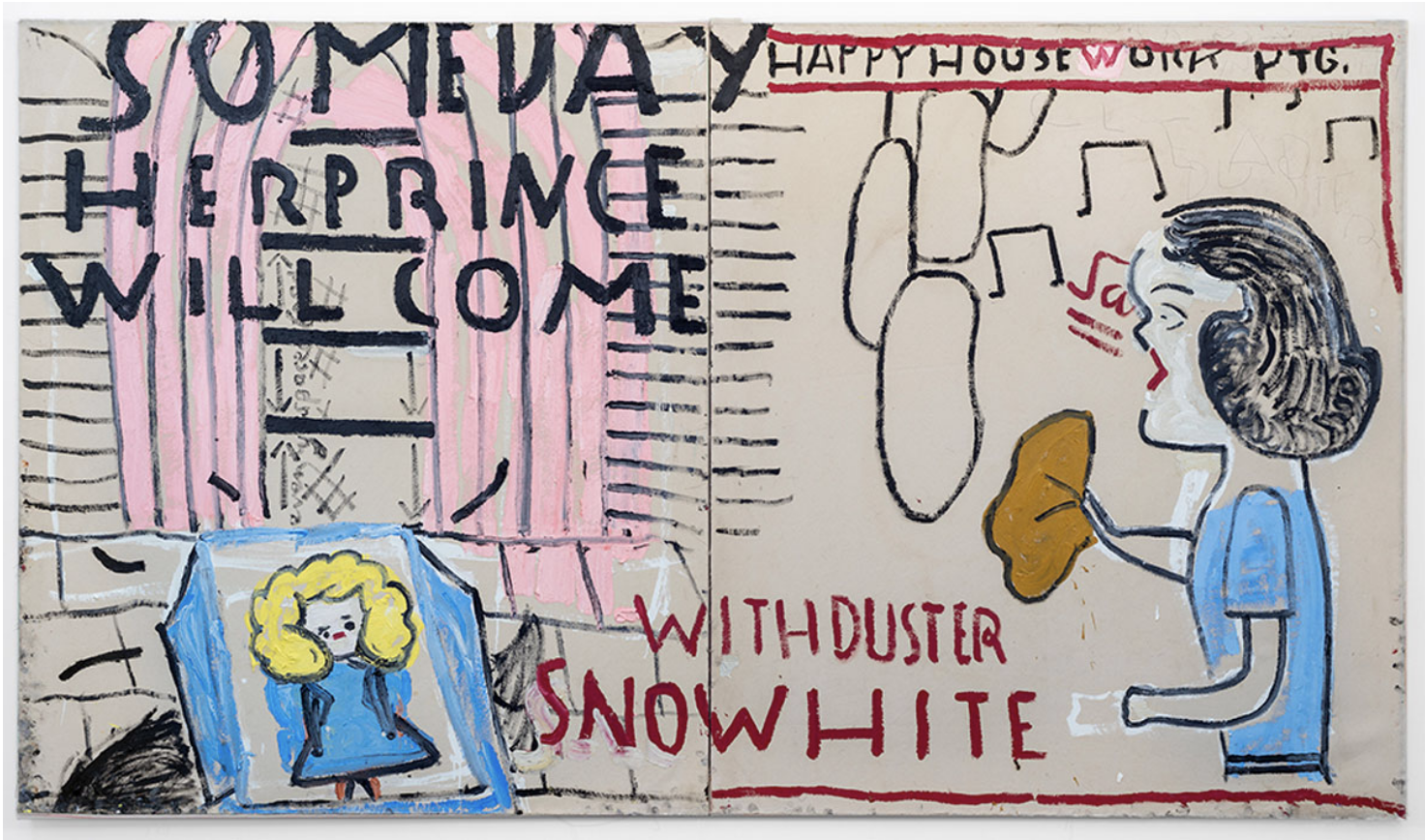
Sometimes she adds text. Underneath a reclining female figure, she writes: ‘Bathing costume green. Glamour personified.’ Accompanying an ice skater in a pale pink dress: ‘Will I win.’ Alongside Snow White holding a duster: ‘Some day her prince will come.’

Rose Wylie - Study from Red Twink

Wylie draws every day in sketchbooks, on large sheets and scraps of paper. She has an insatiable curiosity, an avid interest in her immediate surroundings and in the world beyond. Her drawings form a memory bank, a treasure trove of ideas to which she constantly returns for inspiration. Her studio floor, covered with layers of newspapers, also acts as a source of stimulus.

‘Chance can bring in something totally new and unexpected…a cure for boredom… Chance is like the break in the dotted line. Anything that is out of control, I like.’

Wylie reminds us that, though we are endlessly trying to impose order, structure and logic on our thoughts, our mental processes are often erratic; coincidence causes fresh associations; and memories tend to be messy - jumbled, fluid, confusing.

‘It is the things I remember that I’m interested in. The memory may not be accurate, but if I have a fond memory of something, the work I make gives me a chance to relate the work to the memory.’

Rose Wylie - Snowwhite (3), with Duster

Wylie teaches creative people to liberate the imagination from classification and control; to be constantly curious, open to stimulus from all sorts of sources; to draw on recollections and experiences; to embrace the random, spontaneous and the incongruous; to make free associations. And, critically, to regard age as an advantage, not an adversary.

‘Age has more appeal [than youth]…There’s more ‘longer backwards’ to work with – and coincidences and connections have more time to happen.’

'Confusion in her eyes that says it all,
She's lost control.
And she's clinging to the nearest passerby,
She's lost control.
And she gave away the secrets of her past,
And said, "I've lost control again."
And of a voice that told her when and where to act.
She said, "I've lost control again.”'

Joy Division, ‘She’s Lost Control’ (B Sumner/ P Hook/ S Morris/ I Curtis)

No. 561

The Unwelcome Feedback: Do You Want an Opinion or Affirmation?

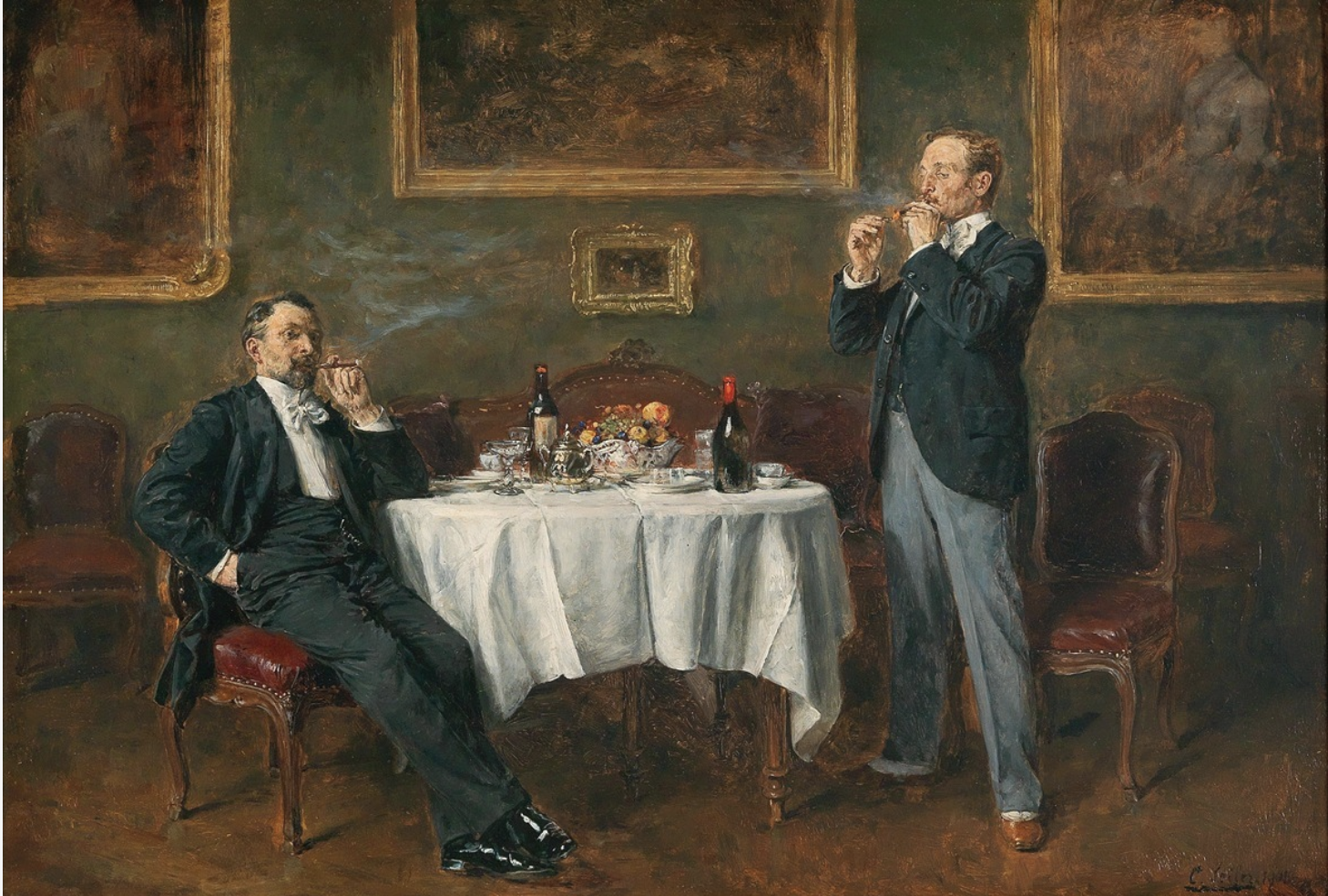
Carl Wilhelm Anton Seiler (1846–1921) - Cigars After Dinner (1901)

We’d been dining at a smart Islington restaurant. Perhaps a little too smart for my taste – somewhat formal, with reverential food presentation and only hushed conversation.

It was the end of the evening, and the chef-proprietor was circling the tables, exchanging a few pleasantries. Eventually he arrived before us, with a fixed smile and a satisfied demeanour.

‘Good evening, Monsieur, Madame. How did you find your meal?’

My wife was very happy to offer her point of view.

‘Well, the service was excellent and we enjoyed our dinner for the most part. Thank you. But I have to say, our vegetables were overcooked.’

Taken aback, the chef-proprietor adopted a rather hurt expression. He was not expecting this kind of response. My wife added:

‘And I think your kitchen is using too much salt.’

We may all recognise this uncomfortable exchange. Not just from restaurants. But from broader work and social settings. Feedback, though often invited, is not always welcome.

Sometimes people asking for an opinion, are really just seeking affirmation. 

I confess that, when I was younger, I regarded criticism as a personal affront. I was defensive, sensitive, easily hurt. But I gradually discovered, from observation of colleagues and the worlds of sport and culture, that ‘feedback is a gift.’ We can only improve our own performance if we embrace other people’s perspectives.

And, of course, feedback is just as hard to give as to receive.

I was taught to deliver constructive criticism by cushioning it between two positive statements. The ‘feedback sandwich,’ as it was inelegantly termed, involved praising a behaviour, raising an area for focus, and then reinforcing the key message with encouragement. Inevitably these sandwiches could still be hard to digest.

Next time you’re about to invite feedback, pause for a moment. Do I genuinely want to hear a perspective on my work? Am I prepared to reflect on what I hear, and if necessary act on it? Or am I really just looking for endorsement?

And if you’re volunteering an opinion on someone else’s contribution, remember: ‘tread softly because you tread on my dreams.’

We left the restaurant soon after our awkward encounter with the chef-proprietor. Never to return. To be fair, I doubt if he moderated his salt policy either. 

'Say it ain't so, Joe. 
Please say it ain't so.
That's not what I wanna hear, Joe, and I've got the right to know.
Say it ain't so, Joe.
Please say it ain't so.
I'm sure they're telling us lies ,Joe,
Please tell us it ain't so.
They told us that our hero has played his trump card.
He doesn't know how to go on.
We're clinging to his charm and determined smile,
But the good old days are gone.
Say it ain't so, Joe.
Please say it ain't so.’
Murray Head, '
Say It Ain't So, Joe'

No. 560

The Sisterhood of Mickalene Thomas: Create the Right Context, Then Focus and Celebrate

Mama Bush (Your Love Keeps Lifting Me) Higher and Higher

I recently enjoyed an exhibition of work by the African American artist Mickalene Thomas(‘All About Love’ is at the Hayward Gallery, London until 5 May.)

‘With painting you can manipulate time, shaping how it’s perceived. It’s about exploring fantasy, illusion and the creation of desire.’
Mickalene Thomas

Thomas creates paintings, photographs, collages and installations that celebrate her family, friends and lovers. Her portraits are big, bold, colourful and confident. Conveying a very human presence with intimacy and intensity, they stop us in our tracks, hold us in their gaze.

‘To see yourself, and for others to see you, is a form of validation. I’m interested in that very mysterious and mystical way we relate to each other in the world.’

Born in 1971, in Camden, New Jersey, Thomas was raised by her mother, a former fashion model, who enrolled her in after-school art lessons at the Newark Museum. 

‘It all began as a young child, when I recognised beauty and desire by the way the world responded to my mother’s beauty. My understanding of the complexity of desire began with how I perceived myself in relation to my mother. I became mindful of a desire to be the woman that she hoped I would be.’

As a teenager, Thomas moved to Portland, Oregon, and she subsequently studied at the Pratt Institute and Yale School of Art. She developed a particular interest in creating large-scale depictions of Black women. 

‘I grew up with a lot of brothers, and I don’t have any sisters, so for me it’s really important to develop my sisterhood. It’s something I’ve always coveted.’

Painting in oil, acrylic and enamel, sometimes employing collaged black and white photos to add a touch of realism, Thomas inlays her work with multi-coloured rhinestones. Her subjects, dressed in vibrant, glamorous clothes and located in bright domestic contexts, are in repose, relaxed, at leisure. They regard us directly, with assured stares, seeming both self-possessed and vulnerable.

‘The love we make in community stays with us wherever we go.’

Often the poses and compositions echo the works of historical European painters - Ingres, Courbet, Manet, Monet – as Thomas seeks to reclaim art from its traditional white male perspective.

‘My work is rooted in self-discovery, celebration, joy, sensuality, and a need to see positive images of Black women in the world.’

Mickalene Thomas, Afro Goddess Looking Forward, 2015,
Rhinestones, acrylic, and oil on wood panel, 60 x 96 in (152.4 x 243.8 cm)

I was impressed by Thomas’ process. 

She first photographs her subjects in bespoke sets built in her Brooklyn studio. These interiors, draped with vividly patterned textiles, suggest warmth, security, the comfort of home. 

‘I created domestic settings primarily for fellow Black women – my muses – to spend time and have new experiences in familiar surroundings, perhaps resembling their mother’s or grandmother’s living rooms.’

At the exhibition you can see a couple of Thomas’ living room installations, recalled from her own childhood: mirror walls, thick carpet, Tiffany lamp and pot plants; Donna Summer and Diana Ross LPs leaning against the music centre. She seems to be suggesting that our identity is shaped by the spaces we inhabit, the clothes we wear, the music we listen to.

Having put her sitters at their ease, Thomas then finds deeply personal connections with them. She focuses on who they truly are, celebrates them, elevates them. 

‘Beauty has always been an element of discussion for Black women, whether or not we’re the ones having the conversation.’

In the world of commercial communication, we may recognise this approach: settle on the right environment; create an appropriate context; locate the brand in its own world. Then focus on, and amplify, its truth.

‘I define my work as a feminist act and a political act because I’m Black and a woman. You don’t necessarily have to claim that, but the act of making art itself is a political and feminist act when you’re a woman.’

There’s much to see at the exhibition beyond Thomas’ portraiture. I was particularly taken with a video piece inspired by Eartha Kitt’s 1953 song, ‘Angelitos Negros.’ The artist reimagines original footage of Kitt singing, combining it with images of herself. The lyrics ask why religious painters of the past filled the heavens exclusively with white figures. 

It’s an absence Thomas seeks to address. She paints her own Black angels. 

'Painters painting saints in church,
How do you know that God is white?
Painter, if you paint with love,
Paint me some Black angels now.
For good Blacks in Heaven,
Painter, show us that you care.
Paint me some Black angels now.
Paint me some Black angels now.’

Eartha Kitt, 'Angelitos Negros’ (Translation) (M Maciste, A Blanco)

No. 507

Now You See Us: Buried Treasure and Hidden Gems

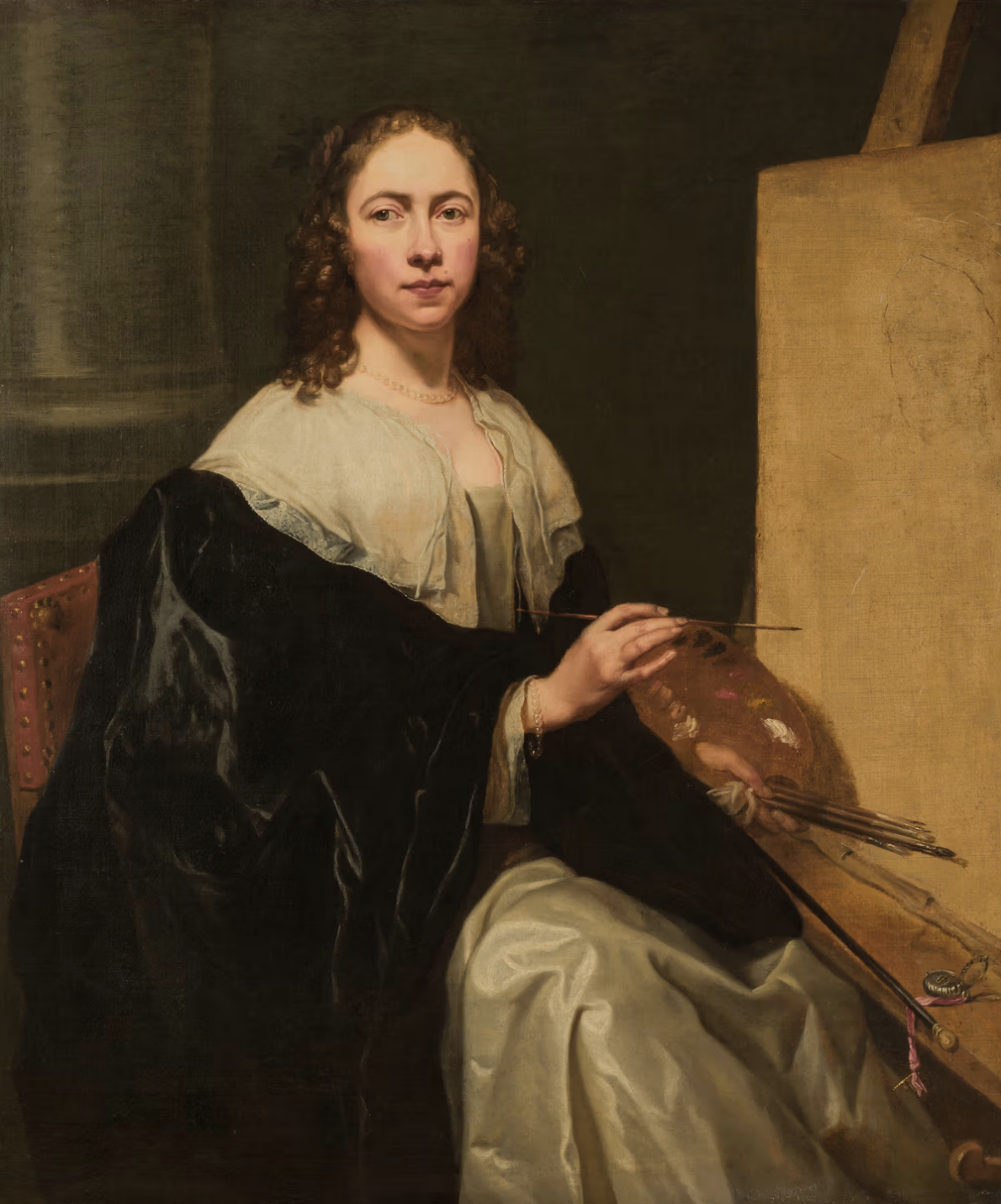
Mary Grace - Self portrait 1760’s . Oil on canvas

'Now You See Us’ at the Tate Britain, London (until 13 October) celebrates over 100 women artists who worked in Britain between 1520 and 1920. The exhibition presents paintings, pastels, needlework, photography and sculpture, that for the most part have been little known and rarely seen.

Here you’ll find Mary Beale’s glamorous depictions of 18th century society ladies, and a rather tender sketch that she made of her young son, his curly tresses tumbling to his shoulders. And there’s Mary Grace, whose only surviving painting is a self-portrait. In a fine primrose silk dress, she sits bolt upright, a palette resting on one arm, and regards us with stern authority.

Through the Looking-Glass, by Louise Jopling, 1875, acquired by the Tate. Photograph: Tate

In the 19th century rooms, Rosa Bonheur takes us to the Highlands, to mournful sheep grazing under a stormy sky. Elizabeth Forbes presents a naturalistic image of a farm labourer, head turned to the floor, in quiet conversation with a young woman at the edge of the woods - terribly romantic. And with its bold brushstrokes and flat appearance, Louise Jopling’s self-portrait suggests a Mancunian Manet.

There’s a good deal of buried treasure here, and many hidden gems.

Elizabeth Forbes - The Edge of the Woods

As we progress through the galleries, we also learn of the many hurdles women artists had to overcome.

For the most part, they were subject, first to their fathers, and then their husbands, limited to the domestic sphere. Having no access to apprenticeships, art was a private, amateur pursuit, one that was only available to the higher social orders, or those related to male artists. Their lives and work were poorly documented.

In 1768 Angelica Kauffman and Mary Moser became founding members of the Royal Academy (along with 32 men). However, when Johann Zoffany memorialised the new institution with a group picture of the Academicians at a life class, Kauffman and Moser were reduced to two indistinct portraits on the back wall - women were barred from life classes on the grounds of propriety. It would take more than 150 years for the next woman to be elected to membership.

Johan Zoffany - The Academicians of the Royal Academy, 1771-1772

There was a commonly held view that women were best suited to ‘imitation’ rather than invention. Miniatures, pastels and watercolours, sectors in which women thrived, were treated dismissively as ‘lower arts’ by the establishment. In 1770, the Royal Academy banned from its exhibitions ‘needle-work, artificial flowers, cut paper, shell-work, or any such baubles’. Joshua Reynolds, the Academy’s President, remarked that working in pastel was ‘just what ladies do when they paint for their own amusement.’

Nevertheless, they persisted. Between 1760 and 1830 some 900 women exhibited at public shows.

Flower painting was considered an appropriate artform for women. Mary Gartside created sublime floral watercolours, whilst at the same time pioneering colour theory. Mary Delany’s collages of spider lilies and flowering raspberry - made with coloured paper placed on black backgrounds (what she called her ‘paper mosaicks’) - are exquisite.

Mary Delany Rubus Odoratus 1772-1782 The British Museum

Gradually in the Victorian era women artists found new galleries, exhibition spaces and events that were less conservative than the Royal Academy. At the same time, they campaigned for access to training, governance and awards. Florence Claxton’s ‘Woman’s Work’ of 1861 shows some women fawning at the feet of a pompous man who sits under a false idol. Other women meanwhile are confined behind ‘the ancient wall of Custom and Prejudice,’ and the door to the medical profession is locked. Only one female artist, Rosa Bonheur, has climbed a ladder to view the ‘forbidden fruit’ beyond.

Florence Claxton, Women's Work, 1861

Founded in 1871, the Slade School of Fine Art in London offered women an education on equal terms with men, and, at last, access to life classes. Soon women students outnumbered men by three to one.

As we enter the 20th century rooms, and the progress towards broader freedoms, we see work from artists who have become more familiar to us: Gwen John, Laura Knight, Vanessa Bell, Nina Hamnet, Helen Saunders. Still, some of these magnificent painters have taken a century to receive proper recognition.

Leaving the exhibition, one can’t help thinking about wasted talent. So many remarkable artists unseen and unacknowledged. So many great works neglected and ignored.We may also be prompted to reflect on the world of work. Are our biases blinding us to untapped abilities and underutilised expertise? Are we failing to realise the true potential of the human capital at our disposal? Are we still missing out on buried treasure and hidden gems?

'I believe talent is like electricity. We don’t understand electricity. We use it. Electricity makes no judgment. You can plug into it and light up a lamp, keep a heart pump going, light a cathedral, or you can electrocute a person with it. Electricity will do all that. It makes no judgment. I think talent is like that. I believe every person is born with talent.'
Maya Angelou


'The most as you'll ever go
Is back where you used to know.
If grown-ups could laugh this slow
Where as you watch the hour snow,
Years may go by.
So hold on to your special friend.
Here, you'll need something to keep her in:
"Now you stay inside this foolish grin"
Though any day your secrets end.
Then again,
Years may go by.’

Rickie Lee Jones, 'On Saturday Afternoons In 1963’

No. 475

‘Will It Paint?’: John Singer Sargent and the Semiotics of Style

John Singer Sargent - Lord Ribblesdale

I recently visited an exhibition considering the importance of clothes and costume in the portraits of John Singer Sargent. (‘Sargent and Fashion’ is at the Tate Britain, London until 7 July.)

The show is a celebration of sensuous silks and satins; of long buttoned bodices and pleated organza skirts; of Chesterfield coats, velvet jackets and crimson dressing gowns. Sargent captures the play of light and shadow across garments, their undulating creases and folds. He revels in the detail of a black tulle dress, a scarlet cape and a mauve sash; the elegance of a Chantilly fan, an antique lace collar and a Kashmiri shawl.

The exhibition prompts us to reflect on the coded language of fashion, the semiotics of style.

Sargent was born to American parents in Florence in 1856. As a child he lived in several European countries, before training and establishing his artistic reputation in Paris.

In 1882 Sargent was so taken with fellow American-in-Paris, the beautiful Virginie Gautreau, that he convinced her to pose for a life-size portrait without a commission. He presented her in a long black evening gown with a plunging neckline, her arms and neck bare, her face turned to one side in a classical pose – and with one of the jewelled dress straps slipping from her shoulder.

French society was scandalised by the ‘indecency,’ and both Sargent and his sitter were stung by the criticism. The artist repainted the strap in an upright position and left Paris soon afterwards. He kept the painting, subsequently called ‘Madame X’, until after Gautreau’s death.

‘I suppose it is the best thing I have done.’

John Singer Sargent - Madame X (with a vintage photo of the original portrait)

In 1886 Sargent settled in London, joining a social circle of actors, artists, composers and writers. His studio on Tite Street in Chelsea had previously been home to the painter James McNeill Whistler, and Oscar Wilde lived opposite. 

Although Sargent painted a number of British aristocrats, for the most part his clientele was international new money. Their wealth derived from finance, commerce and industry, and they were set on securing social status – by buying grand houses and estates; by keeping the right company, hosting magnificent parties and making appropriate marriages. The clothes they wore and the portraits they commissioned all contributed to the process of assimilation. A striking portrait would attract large crowds at exhibition. It would be much discussed and broadly reproduced. And a full-length Sargent could cost around $120,000 in today’s money. The exhibition curators term this phenomenon the ‘economy of images’.

Almost half of Sargent’s female sitters wore black gowns. While black retained its association with mourning, in the late 19th century it became fashionable for women of all ages, not least because new synthetic aniline dyes enabled an intense pure depth of colour. When, on a visit to his friend Claude Monet, Sargent discovered that there was no black paint to be found, he declared that he simply couldn’t work.

John Singer Sargent - Lady Sassoon

This period also saw the rise of haute couture. Name brands like Paquin or Doucet provided their clients with what novelist Edith Wharton described as ‘social armour.’ Many of Sargent’s sitters wore outfits from Charles Worth, an English designer who dominated Parisian fashion, and catered particularly to British and American customers. A Worth gown would cost between $10,000 and $30,000 today.

‘I have Delacroix’s sense of colour and I compose. A toilette [a complete ensemble, from the French word toile, cloth] is as good as a painting.'
Charles Worth

In the exhibition, Sargent’s work is displayed alongside examples of period fashion, including several original garments featured in his paintings. Although the artist claimed that ‘I only paint what I see,’ throughout the gallery we can observe where he has adjusted a strap here, removed a bow there. He clearly styled his sitters, pinning, draping, tucking and folding their gowns to create new shapes and textures. For his portrait of Lady Sassoon, he pinned her black silk taffeta opera cloak, so that the bright lining was more visible, creating a dramatic river of pink.

Foreshadowing today’s Instagram culture, one French critic noted, ‘there is now a class who dress after pictures, and when they buy a gown ask ‘will it paint?’’

Sargent was just as interested in painting fashionable men as women.

The surgeon Samuel Pozzi stands proud in a red dressing gown and Turkish slippers, one hand on heart and the other toying with the cord of his robe.

John Singer Sargent - Dr Pozzi at Home

The debonair Lord Ribblesdale looks rather superior in a long dark velvet-collared coat, buff breeches and polished black boots. Sporting grey kid gloves and a hunting whip, the elegant outfit is completed with a top hat and flamboyant silk muffler tied to one side. It was said of Ribblesdale that ‘he never stepped out of his picture frame.’

Sargent painted the young illustrator and designer W Graham Robertson holding a jade-topped walking stick and wearing a long, black wool Chesterfield overcoat. Robertson recalled that, during the sittings, the artist would ‘pull and drag the unfortunate coat more and more closely around me until it might have been draping a lamp-post.’ Sargent subsequently declared:

‘The coat is the picture.’

John Singer Sargent - W Graham Robertson

All in all, it’s a splendid exhibition, full of glamour, performance and personality.

Whilst marvelling at the flamboyance of the fashions featured in Sargent’s portraits, we may imagine that the sartorial codes and social values of late 19th century high society are a million miles away from our own. Surely we live in a more liberated, egalitarian world of informal attitudes and casualised style.

But clothes continue to signal something about our individual identity and sense of belonging. 
In the first half of my career, I dressed casually for work. Until my clients donned trainers, chinos and Ralph Lauren Polo shirts. I promptly switched to city suits, keen to create some distance and differentiation. I was amused to learn that Sargent played a similar game. While painting his clientele in their elegant finery, he himself tended to wear a sober business suit.

On encountering the artist in 1899, the poet Wilfred Scawen Blunt described him as ‘a rather good-looking fellow in a pot hat, whom at my first sight I took to be a superior mechanic.’

Whether we like it or not, we are constantly judging and being judged.


'When you wear your high-heeled boots with your hip-hugger suit,
It's all right, you're outta sight.
And you wear that cute mini-skirt with your brother's sloppy shirt,
I admit it, girl, that I can dig it.

When you wear your bell bottom pants,
I just stand there in a trance.
I can't move, you're in the groove.
Would you believe, little girl, that I am crazy about you?

When you wear those big earrings, long hair and things,
You got style, girl, that sure is wild.
And you wear that cute trench coat and you're standing and posing,
You got soul, you got too much soul.’

Brenton Wood, '
The Oogum Boogum Song’ (A Smith)

No. 474

John Craxton: The Heroic Hedonist

Still Life Sailors (1980-85) Estate of John Craxton

I recently took the train to Chichester to see an excellent exhibition of the art of John Craxton. (Pallant House Gallery, until 21 April 2024)

Though born and raised in England, Craxton produced much of his work in Greece. There he portrayed an Arcadia of ordinary folk living under a hot sun, amongst olive trees and asphodels, wild cats and frolicking goats. He painted young men smoking in the morning, sleeping in the afternoon and dancing into the night. His art is full of colour, light and movement. It is a joyous celebration of life, and prompts us to consider our own attitudes to work and play.

‘As a child I enjoyed a happy, near-Bohemian home life in a large family.’

Craxton was born in London in 1922. When his father, a pianist and composer, scored his only hit - ‘Mavis,’ sung by the legendary Irish tenor John McCormack - he took his wife and six children down to Selsey on the south coast and bought a shack above the beach.

Craxton had an idyllic childhood.

‘In what now seems like a succession of endless, if not cloudless, summer days, I ran barefoot, rode ponies, shrimped at low tide, collected fossils from the Bracklesham Beds, went to the movies, carried milk from the farm (which still had a working windmill) and had family picnics on the beach.’

Craxton decided as a young boy that all he wanted was to be an artist. He attended various schools, but emerged with no qualifications. A naturally independent spirit, he didn’t fancy the discipline of formal creative training either. And so he was largely self-taught, occasionally dropping into art schools to pick up equipment and a little drawing tuition.

Boy on a Blue Chair, 1946 John Craxton

Having failed an army medical, Craxton was excused war service. Always rather charming, witty and spontaneous, he fell in with various sponsors, lovers and artists, and one patron funded a studio in St John’s Wood that he shared with Lucian Freud.

His early work featured quiet country lanes, twisted trees and dead animals; solitary souls in melancholy, menacing landscapes. During the war years he was given his first solo exhibitions in London, and was commissioned to produce book designs – a line of work that served him well for much of his life.

But Craxton was keen to get away from Britain. As a teenager he had been enchanted by the ancient Greek figurines and pottery he encountered at the Pitt-Rivers Museum in Dorset. He aspired to a Mediterranean idyll.

‘The willow trees are nice and amazing here, but I would prefer an olive tree growing out of a Greek ruin.’

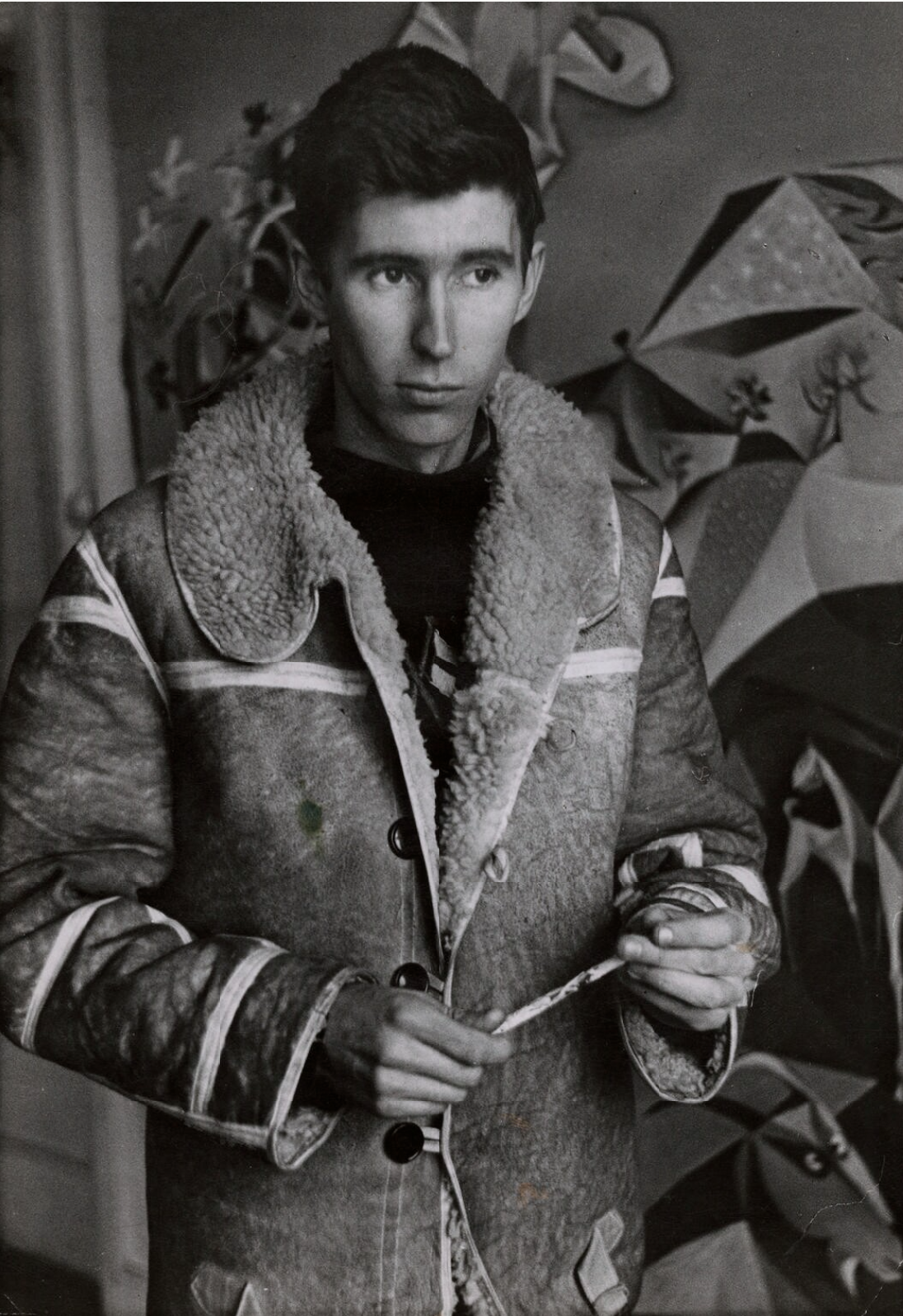
John Craxton by Felix H. Man
bromide print, 1940s© estate of Felix H. Man / National Portrait Gallery, London

Immediately after the hostilities ended, there were still strict restrictions on travel. So Craxton and Freud embarked on a painting expedition to the Scilly Isles, and then stowed away on a Breton fishing boat bound for France. They only got as far as Penzance. 

The following year Craxton made it to Zurich, where he met the wife of a British ambassador at dinner. She offered him a lift to Athens in a bomber she had borrowed for a curtain-buying trip. 

And so, aged 23, Craxton arrived in Greece and immediately fell under its spell. He settled first in Poros, and then Crete, and he would stay there, on and off, for the rest of his life.

‘It’s possible to be a real person – real people, real elements, real windows – real sun above all. In a life of reality my imagination really works. I feel like an émigré in London and squashed flat.’

In Greece Craxton created romantic landscapes populated by shepherds, peasants and a pipe-playing Pan. He painted the azure sea and cyan sky; bare footed young men in white cotton trousers and striped tee shirts - working, relaxing, dancing arm-in-arm. His art has vibrant colours and a gentle cubism. And by contrast with his previous work, there’s an exultant spirit, a dreamy languor, a warm conviviality. We meet a rugged herdsman, a smoking butcher, a grey-bearded octopus fisherman. Here are moustached mariners tucking into a meal of seafood and salad at the local taverna. A sign on the wall behind them warns against breaking plates.

‘The most wonderful sound in the world is of people talking over a good meal.’

Craxton was fond of saying that 'Life is more important than art.’ He relished the freedom he had on the Greek islands - to ride his Triumph Trophy motorcycle along dirt roads and mountain tracks; to talk and laugh at the dockside bars, as he drank ouzo and feasted on cuttlefish and calamari; to lead an openly gay life. 

At the time Greece was a more tolerant place than Britain - although Craxton's interest in young men in uniform did prompt the authorities to suspect he was spying. When homosexuality was decriminalised in the UK in 1967, he sent the Home Secretary, Roy Jenkins, a picture.

As well as painting, Craxton designed book jackets for the travel writer Paddy Leigh Fermor; and created stage sets for Frederick Ashton at the Royal Ballet. But he was not particularly industrious. His friends joked that he suffered from ‘procraxtonation.’

Pastoral for PW John Craxton

Craxton suggests that a creative life need not be fuelled by anxiety and pain. It doesn’t have to be all about struggle and denial. Rather we can choose to follow our dreams; pursue our passions; seek out the sun. 

Craxton, who was made a British honorary consul in Crete, was never concerned by artistic fashion or the opinions of the establishment. He carried on painting in his own individual style into his later years, and he rode his motorbike until nearly 80. When he died aged 87, his ashes were scattered in Chania harbour. 

His biographer Ian Collins described him as ‘a heroic hedonist.’

 
'My life, my life, my life, my life in the sunshine.
Everybody loves the sunshine.
Sunshine, everybody loves the sunshine.
Sunshine, folks get down in the sunshine.
Sunshine, folks get 'round in the sunshine.
Just bees and things and flowers.
My life, my life, my life, my life in the sunshine.
Everybody loves the sunshine.
Feel, what I feel, when I feel, what I feel,
When I'm feeling, in the sunshine.
Do what I do, when I do, what I do,
When I'm doing, in the sunshine.
Sunshine, everybody loves the sunshine.'

Roy Ayers, '
Everybody Loves The Sunshine

No. 453

Philip Guston’s Art of Anxiety: Not Inventing, But Revealing

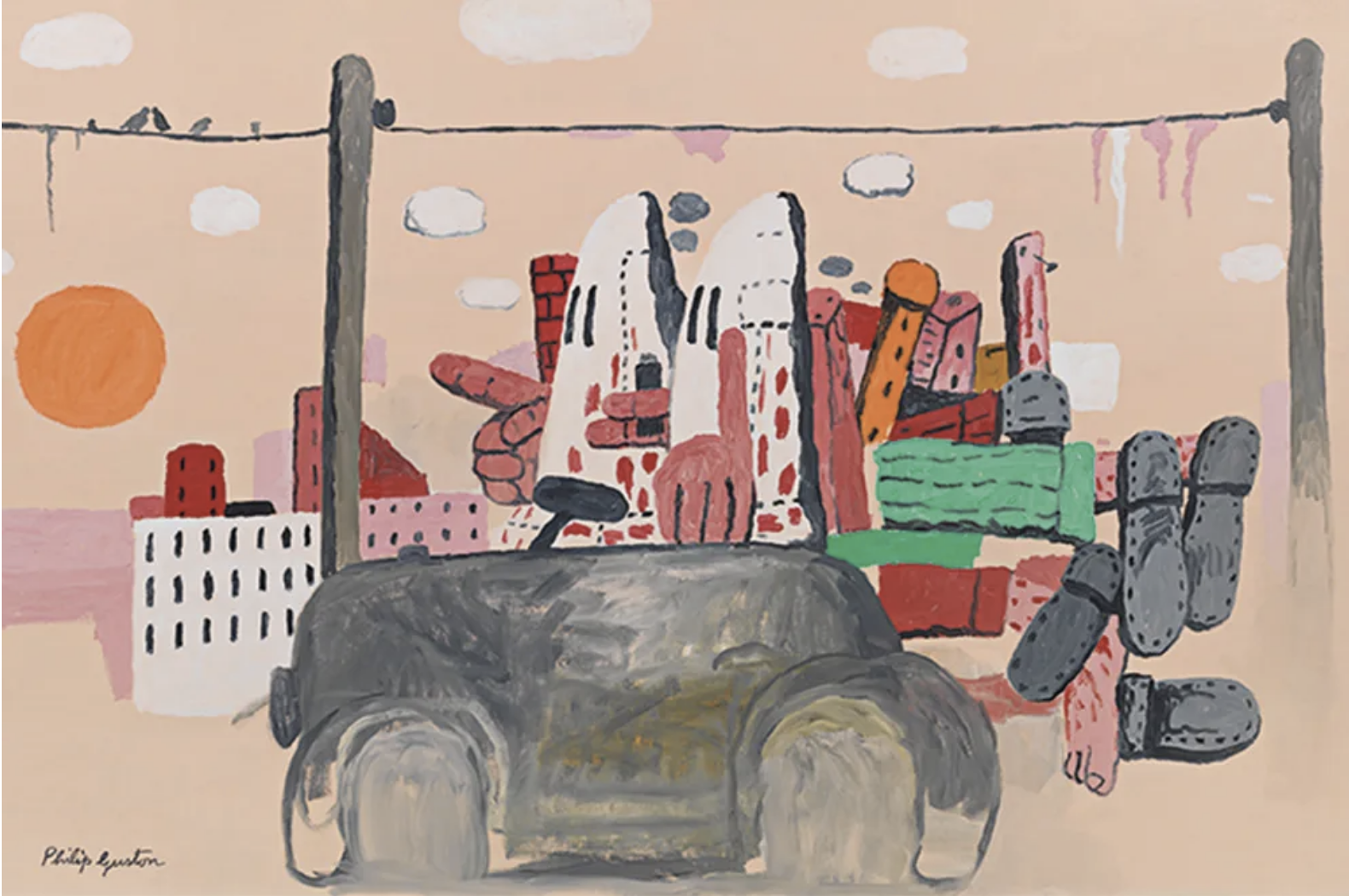
Dawn (1970), Philip Guston, oil on canvas. Glenstone Museum, Maryland

‘Well, it could be all of us. We’re all hoods.’
Philip Guston

I recently visited a fine exhibition of the work of Philip Guston. (Tate Modern, London, until 25 February)

Guston was a fiercely political artist, raging at injustices he saw all around him. He articulated his anger and anxiety through narrative murals and allegorical paintings, through abstract works and depictions of dark cartoonish nightmares. He was a restless soul who believed the role of the artist was not to invent fictions, but to reveal truths. He pleads with us to care, and prompts us to reflect on the enemy within – within our society and within ourselves.

‘I feel that I have not invented so much as revealed in a coded way, something that already existed.’

He was born Phillip Goldstein in Montreal in 1913, the youngest of seven children. His Jewish parents had fled persecution in present-day Ukraine. In 1922 the family moved to Los Angeles, where, struggling to make ends meet, his father, a scrap collector, hanged himself in the shed - and 10 year old Phillip found the body. 

Philip Guston in New York, in 1952 Martha Holmes/The LIFE Images Collection, via Getty Images

As a child Goldstein was interested in cartoons and Renaissance art. At 14 he began painting, and enrolled in the Los Angeles Manual Arts High School where he met Jackson Pollock, who became a life-long friend.

‘I grew up politically in the thirties and I was actively involved in militant movements and so on, as a lot of artists were… I think there was a sense of being part of a change, or possible change.’

Goldstein became politically active as the United States saw the rise of racism and antisemitism; and the resurgence of the Ku Klux Klan. He joined a group of artists creating large-scale narrative murals supporting workers’ rights and resistance to fascism and oppression. 

'Frustration is one of the great things in art. Satisfaction is nothing.’

In 1935, at 22, Goldstein moved to New York where, concerned about the climate of antisemitism, he changed his name to Philip Guston. He was deeply affected by the war in Europe and the Holocaust. And so he turned to his easel and painted the bombing of Guernica; children playing and fighting in ruined townscapes; haunted camp inmates.

‘That’s the only reason to be an artist… to bear witness.’

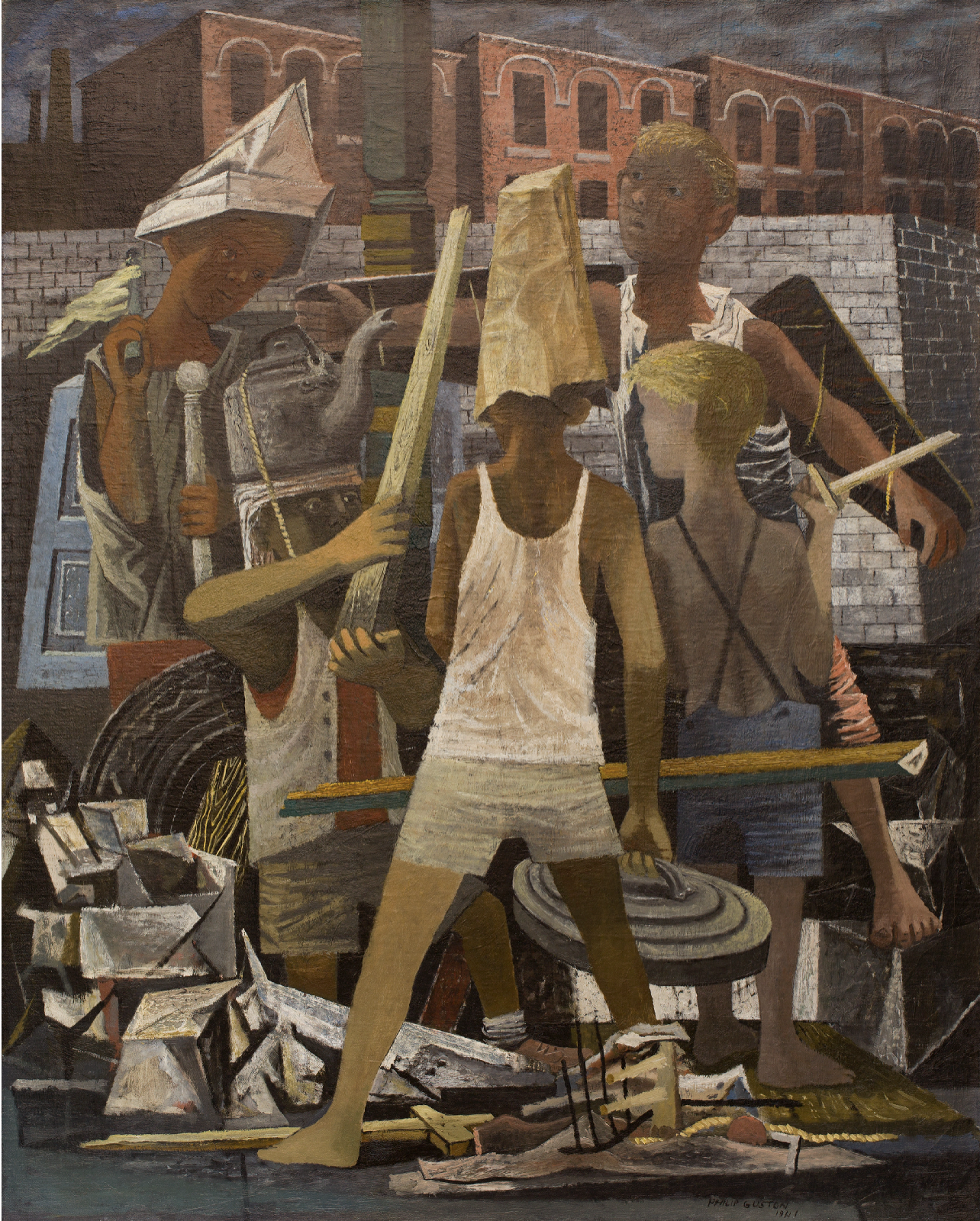
Martial Memory Philip Guston, 1941, Oil on Canvas

In the late 1940s, suffering a crisis of confidence, Guston destroyed everything he’d been working on. Perhaps he felt figurative painting could not do justice to the horrors that had so recently taken place.  

‘I began to feel that I could really learn, investigate, by losing a lot of what I knew.’

He decided to change course, and immersed himself in New York’s emerging Abstract Expressionist scene, hanging out with Rothko, de Kooning and Kline. 

‘The trouble with recognisable art is that it excludes too much. I want my work to include more. And ‘more’ also comprises one’s doubts about the object, plus the problem, the dilemma, of recognising it.’

Standing close to the canvas, Guston painted forms coming into existence – perhaps you can detect a body or a head - using gentle, complementary colours. Critics dubbed him an ‘abstract impressionist.’ His favourite shade was cadmium red, and it would continue to feature strongly in his work for the rest of his career. 

‘I like pastrami. I just like it. I couldn’t tell you why.’

Beggar's joys, Philip Guston, 1954–1955 oil on canvas

In the late ‘60s Guston was deeply moved by the Vietnam War and the political upheaval in the United States. 

‘The war, what was happening to America, the brutality of the world. What kind of man am I, sitting at home reading magazines, going into a frustrated fury about everything – and then going into my studio to adjust a red to a blue?’

Feeling that his art had to make more overt political statements, Guston made a dramatic return to figurative work.

‘The hell with it. I just wanted to draw solid stuff.’

He had always liked comics, and his new images drew on George Herriman’s Krazy Kat. He painted cartoonish, blood-spattered Klan figures driving around town in a childish car, pointing at the sights, the legs of a man projecting from the boot. He depicted similar hoods relaxing at home with a cigarette by the window; in the courtroom, at the office and drawn on blackboards - suggesting they were part of the curriculum.

'Look at any inspired painting. It's like a gong sounding; it puts you in a state of reverberation.’

Where previously Guston had shown Klansmen conspiring, in the act of racial assault, here they were engaged in the mundane activities of everyday life. It was as if he was saying: evil is all around us; it is institutional, systemic - in our courts and schools and on our streets; it is hiding in plain sight.

‘My attempt was really not… to do pictures of the KKK, as I had done earlier. The idea of evil fascinated me… I almost tried to imagine that I was living with the Klan. What would it be like to be evil? To plan and plot?’

Most striking among these works was a picture of a hooded artist at work in the studio, painting himself. 

‘I perceive myself behind the hood.’

The Studio, Philip Guston, 1969 Oil on canvas

Guston implies that we are all complicit in the injustices we see around us. We carry with us our own prejudices and partialities; our unconscious biases; our inertia and failure to act. We should turn our critical faculties on ourselves.

'There is another man within me that’s angry with me.’
Thomas Browne

Guston presented his startling new work at the Marlborough Gallery in New York in 1970. But the show was not a success and he only sold one painting. Critics were hugely disappointed that he had deserted the abstract cause, and he lost friends as a result. 

‘There is nothing to do now, but paint my life; my dreams, surroundings, predicament, desperation, [my wife] Musa – love, need.’

Depressed at the response, Guston turned to painting strange dreamscapes populated by objects that meant something to him – mental junk that he called ‘crapola.’ Repeatedly he depicted cigarettes, irons, clocks and steaming kettles; clocks, blinds and bare bulbs; sinister dangling light-pulls. And everywhere there were old shoes and severed legs - echoes of the Holocaust.

'The canvas is a court where the artist is prosecutor, defendant, jury and judge. Art without a trial disappears at a glance.’

In 1973 Guston painted himself: pastrami-pink, indolent, smoking in bed with a plate of ketchupped chips on his chest and a stack of shoes at his side. There’s a bare light bulb and a light-pull. His paintbrushes sit unused. It’s a desolate image. 

Interviewer: Do you think of yourself as kind of pessimistic?

Guston: I don’t think it’s pessimistic. I think it’s doomed.

In 1980 Guston died of a heart attack, in Woodstock, New York. He was 66.

Smoking, Eating . Philip Guston (1973). Stedelijk Museum Amsterdam/The Estate of Philip Guston

Guston was clearly a melancholy figure. But he demonstrated that, even at our lowest ebb, we can find some solace in art. He teaches us to be restless; to embrace radical change when we’re running out of steam; to see the enemy within; and to turn our critical judgement on ourselves. 

‘Probably the only thing one can really learn, the only technique to learn, is the capacity to be able to change.’

'People just ain't no good,
I think that's well understood.
You can see it everywhere you look,
People just ain't no good.

It ain't that in their hearts they're bad.
They can comfort you, some even try.
They nurse you when you're ill of health,
They bury you when you go and die.
It ain't that in their hearts they're bad.
They'll stick by you if they could.
Ah, but that's just bullshit, baby.
People just ain't no good.

People they ain't no good.
People they ain't no good at all.’

Nick Cave and the Bad Seeds,'People Ain't No Good’ (N Cave)

No. 445

Manet, Baudelaire and the Flaneur Strategist

Manet, ‘Music in the Tuileries’ 

‘Modernity is the transitory, the fugitive, the contingent - that half of art of which the other is eternal and immutable.’
Charles Baudelaire

Édouard Manet painted the vibrant modern world that was emerging around him in mid-nineteenth century Paris. Working in his own simple, direct style he created a bridge between Realism and Impressionism, and he is considered by many to have been the first modern artist. Some also think he was an archetype for Baudelaire’s ‘flaneur’: a debonair, detached onlooker, wandering the metropolis making acute observations on contemporary life.

Manet prompts us to reflect on our own engagement with change, culture and the city.

'Every new painting is like throwing myself into the water without knowing how to swim.’
Édouard Manet

Manet was born in Paris in 1832, into an affluent middle-class family. His father Auguste, a judge, wanted his son to follow him into the law. Then, when the young Édouard struggled at school, he suggested a maritime career. But a voyage to Rio de Janeiro culminated in failed Navy exams. Finally Auguste relented and allowed his son to pursue his long-held ambition to train as an artist. 

Whilst Manet was a great admirer of the Old Masters, particularly the Spanish School, he was not fond of the Romantic art that dominated French painting at his time. Religious, historical and moral themes seemed less relevant to him than the Realism recently pioneered by Gustave Courbet.

Manet’s inclination towards Realism may have been inspired by the phenomenal structural and social change that was going on around him in his home town. France had been in constant upheaval since the revolution of 1789. When in 1848 Napoleon III became Emperor, he set out to transform Paris from a cramped medieval city into a vibrant modern capital. The Emperor commissioned Georges-Eugène Haussmann to carry out a massive urban renewal programme - demolishing existing streets to create space for a network of interconnecting boulevards, lined with cafes, restaurants and theatres; for new parks and railway stations; for gaslight and improved sanitation.

'I paint what I see and not what others like to see.’

Édouard Manet

Portrait of Charles Baudelaire in Profile by Edouard Manet

Around 1855 Manet became close friends with the poet and critic Charles Baudelaire. Each day they would stroll together through the new boulevards and parks of Paris, discussing the emerging industrial age, the thrill of modern city life and the responsibility of the artist to depict it.

In his essay ‘The Painter of Modern Life’ (published in Le Figaro in 1863) Baudelaire celebrated the work of Constantin Guys, the  war correspondent, water colourist and illustrator. In particular he drew attention to Guys’ mastery of the fleeting moment; of passing fashion; of the here and now.

'He has sought, everywhere, the passing beauty of present-day life, the fleeting character of that which the reader has allowed us to term modernity. Often bizarre, violent, excessive, but always poetic, he has succeeded in concentrating, in his drawings, the flavour, be it bitter or heady, of the wine of Life.'
Charles Baudelaire

In the same essay Baudelaire also described the flâneur, the artist-poet of the modern metropolis.

'The crowd is his element, as the air is that of birds and water of fishes. His passion and his profession are to become one flesh with the crowd. For the perfect flâneur, for the passionate spectator, it is an immense joy to set up house in the heart of the multitude, amid the ebb and flow of movement, in the midst of the fugitive and the infinite. To be away from home and yet to feel oneself everywhere at home; to see the world, to be at the centre of the world, and yet to remain hidden from the world... The spectator is a prince who everywhere rejoices in his incognito. The lover of life makes the whole world his family…The lover of universal life enters into the crowd as though it were an immense reservoir of electrical energy. Or we might liken him to a mirror as vast as the crowd itself; or to a kaleidoscope gifted with consciousness, responding to each one of its movements and reproducing the multiplicity of life and the flickering grace of all the elements of life.'
Charles Baudelaire

Manet shared Baudelaire’s enthusiasm for realism, modernity and the city (though he articulated his passion with fewer words).

'One must be of one's time and paint what one sees.’
Édouard Manet

His 1862 work ‘Music in the Tuileries’ presented contemporary Paris at leisure. We see a crowd of smartly dressed dignitaries, intellectuals and socialites, seated, standing and promenading under the chestnut trees. They rejoice in their fashionable clothing, in seeing and being seen. 

We must assume from the title that a concert is taking place, but we can see no orchestra. Manet painted the assembly with loose strokes of the brush, distributing the figures across the picture as if in a frieze, with no obvious focal point. Most of the faces are just a blur. This is a brief passing moment; a story half told. 

In amongst the throng in ‘Music in the Tuileries’ we can identify the painter’s brother Eugène, along with other family members and friends - including the musician Jacques Offenbach, the artist Henri Fantin-Latour and Baudelaire. Manet himself stands at the far left of the picture, impeccably dressed and holding a cane, a participant in the scene, but also slightly detached from it. 

Edouard Manet - Le Chemin de fer (The Railway)

'It is not enough to know your craft - you have to have feeling. Science is all very well, but for us imagination is worth far more.’
Édouard Manet

Baudelaire’s description of the flaneur and Manet’s evocation of it may still resonate with us today. 

We can imagine the Flaneur Strategist: a wandering observer, immersed in contemporary urban life. Someone who engages in culture and change; celebrates the new, the innovative and the fashionable. And yet also stands to one side – watching, witnessing, taking notes – alone in the crowd. 

But the concept of the Flaneur Strategist also poses a challenge. With new technology we increasingly hide behind screens, pods, buds and beats. With maturity and success there is a tendency to withdraw; to cocoon ourselves in comforts. We retreat to the country, to bigger houses and better cars; to our own private bubbles. 

If we want to sustain our careers over the longer term, we would do well to stay in touch with ordinary people; with the rhythm of the city, the clamour of the crowd, the commotion of change – participating in culture, reviewing it from the inside, not the outside.

‘Genius is childhood recovered at will.’
Charles Baudelaire

When it was first exhibited ‘Music in the Tuileries’ was poorly received – by both journalists and the general public. They were uncomfortable with Manet’s contemporary subject matter, his unusual composition and loose technique. Although the artist was fiercely independent, he was always sensitive to criticism.

Édouard Manet - Un bar aux Folies Bergère

'The attacks of which I have been the object have broken the spring of life in me... People don't realize what it feels like to be constantly insulted.’
Édouard Manet

Nonetheless, Manet persevered. ‘Music in the Tuileries’ was followed by more masterpieces: 'Le Déjeuner sur l’Herbe', ‘Olympia’, 'A Bar at the Folies-Bergère;' by vital pictures of social events, and street and café scenes; by enigmatic portraits of fashionable people. He became the quintessential artist of the contemporary city; and something of a father figure to the Impressionists - socialising with them in city cafes and offering advice.

What we do not know is whether Baudelaire approved of Manet’s work. The writer remained curiously silent about his friend’s output. Perhaps Manet was not quite ‘The Painter of Modern Life’ that he had in mind.

 
'Some time,
Great times,
Troubled time.
Fire for the times,
Ringing out footsteps,
Calling out steel-heels.
Promised land.
Great times in commotion.
Here comes every day,
It only lasts an hour,
Unhappy the land that has no heroes,
No! Unhappy the land that needs heroes.’

Simple Minds, '20th Century Promised Land' (B Mcgee / C Burchill / D Forbes / J Kerr / M Macneil)

No. 441

Edward Hopper: The Lonely City

Edward Hopper - Automat (1927)

'All I ever wanted to do was to paint sunlight on the side of a house.’
Edward Hopper

I recently watched an insightful documentary about the artist Edward Hopper. (‘Hopper: An American Love Story’ (2022) by Phil Grabsky)

Hopper painted beguiling pictures of ordinary folk and everyday lives - individuals lost in thought; groups of people, each isolated and remote; private dramas played out in public places. He created a brooding world of alienation and ennui, and distilled a truth about the modern urban experience: that we can be living and working in a vibrant, bustling city, surrounded by entertainment, community and opportunity – and yet still feel terribly empty and alone.

'In every artist’s development, the germ for the later work is always found in the earlier. What he once was, he always is, with slight modifications.'

Hopper was born in 1882 in Nyack, New York, the son of a dry-goods merchant. He grew up in an affluent, intellectual Baptist household, and from an early age he was encouraged to draw by his mother. Having enrolled at the New York School of Art and Design, he subsequently took up a career in commercial illustration, a job he detested.

‘Well, illustration really didn’t interest me. I was forced into it by an effort to make some money, that’s all.’ 

Edward Hopper - Office At Night (1940)

In his early 20s Hopper made three trips to Paris, where he pursued his studies in literature, language, architecture and art. Naturally conservative, while in the French capital he avoided the avant-garde. He was a tall, shy, awkward young man, whose first romantic encounters were overwrought and frustrating. In 1910 he returned to the United States, and thereafter never left.

'I am very much interested in light, and particularly sunlight, trying to paint sunlight without eliminating the form under it, if I can.'

From the outset Hopper was fascinated by light and shadow, and he often painted urban and architectural scenes - stairways and window frames; porticos and pavements; turrets, towers and mansard roofs. His city pictures were sparsely populated, or devoid of people entirely. They had an eerie stillness.

Hopper’s early work was poorly received, rarely exhibited and seldom sold.  He remained on the margins for many years. This was all to change in 1923, when, on a summer painting trip in Gloucester, Massachusetts, the 41 year old encountered Josephine Nivison, whom he had known at art school. She was his opposite - short, talkative and sociable - and she set about taking this intense, introverted man in hand.

Nivison persuaded the Brooklyn Museum to include some of Hopper’s work alongside her own in a forthcoming show. One picture was purchased by the museum for $100, and from that point on he was set fair. 

Hopper and Nivison married in 1924 and settled into his Washington Square apartment in Greenwich Village, where they resided for the rest of their days. He was at last able to give up his job as an illustrator.

'The only real influence I've ever had is myself.’

Edward Hopper - Room in New York, 1932.

Hopper’s most celebrated paintings present seemingly mundane moments in the lives of ordinary people. They have a voyeuristic feel and sometimes their subjects are as if spied from a distance. (In his youth Hopper had enjoyed observing life in the streets, offices and residential buildings as he travelled by train into New York.) The viewer is invited to speculate: Who are these characters? What are they thinking about? What is really going on here? 

A bald fellow in a white shirt with sleeve garters sits on the sidewalk smoking a cigar, absorbed in his own private world. A middle-aged man methodically rakes the lawn of the garden adjoining his clapboard house. It’s 11-00AM and a woman with long dark hair leans forward in her armchair to stare out of the apartment window. She is naked but for a pair of flats. At the automat a lady in a cloche hat and jade green coat concentrates on her coffee. A woman in a pink slip perches on her bed and soaks up the morning sun. A pensive female usher, in smart blue uniform, leans against the wall of the movie theatre, her blond hair illuminated by a side lamp. 

There’s a cinematic quality to Hopper’s work. No surprise perhaps as he and Nivison often took trips out together to the movies or the theatre.

'When I don't feel in the mood for painting I go to the movies for a week or more. I go on a regular movie binge!'

When Hopper paints more than one subject, the characters rarely interact, touch or look at each other. We see them assembling in the hotel lobby, dining at the restaurant, reading on a train. They are together, but apart. An executive works at his desk, while nearby his assistant silently gets on with her filing. Three customers sit at the cherry-wood counter of a diner. Drinking coffee, eating a sandwich, smoking a cigarette. Each seems preoccupied. A smartly dressed couple relax at home. He reads the paper intently, she half-heartedly plays a few notes on the piano. 

There’s a melancholy sense of disappointment in these images; of boredom and bewilderment. What has happened? How did I get here? Is this it?

'Great art is the outward expression of an inner life in the artist, and this inner life will result in his personal vision of the world.’

Edward Hopper - Self-Portrait (1925–1930)

In the mid-1930s Hopper and Nivison built a summer-house in South Truro on Cape Cod and they went on field trips for fresh material in their 1925 Dodge. They had a troubled, but enduring marriage. She subordinated her career to his, managing his appointments and sharing his reclusive life-style. He was generally withdrawn and aloof, and was rather dismissive of her art. He nonetheless used her as the model for all his female characters - just changing the faces.

Hopper was a slow, meticulous painter and he made many compositional sketches before he was comfortable with a scenario. His output could be as low as two pictures a year.

‘One good picture is worth a thousand inferior ones.’

He didn’t like interviews and he avoided explaining his work.

‘The whole answer is there on the canvas. If you could say it in words, there would be no reason to paint.’

Once, when asked what his artistic objective was, he simply replied:

‘I’m after me.’

It’s hard to avoid the conclusion that this silent, secretive, introspective man was presenting us with his own sense of alienation and isolation; his own interior sadness.

'So much of every art is an expression of the subconscious that it seems to me most of all the important qualities are put there unconsciously, and little of importance by the conscious intellect. But these are things for the psychologist to untangle.'

Edward Hopper - New York Movie (1939)

It struck me that in the world of work we make many assumptions about our colleagues’ wellbeing and state of mind. We imagine that - because ours is a youthful, vigorous, convivial industry; because the city is such a dynamic, inspiring, populous place – our fellow employees are fulfilled and satisfied, content and connected. We put on parties, inductions and talks to fuel their enthusiasms. We send upbeat missives and promote unifying values. We celebrate success. But we too often fail to understand that many of our colleagues feel remote and detached. They are lost in the lonely city.

'I have tried to present my sensations in what is the most congenial and impressive form possible to me.'

Hopper died in his Washington Square studio in 1967. Nivison passed away ten months later. One of his last paintings simply presented sunlight and shadow falling across an empty room.


'Mother, I tried, please believe me.
I'm doing the best that I can.
I'm ashamed of the things I've been put through,
I'm ashamed of the person I am.
Isolation, isolation, isolation.’
Joy Division, ‘
Isolation’ (S Morris / I Curtis / B Sumner / P Hook)

No. 435

Gwen John’s Interior Lives: Seeing People As They Are, Not As We Would Want Them To Be

Gwen John, The Convalescent 1920-23

'If it isn’t right, take it out!’

I recently visited an excellent exhibition of the work of artist Gwen John. (‘Art and Life in London and Paris’ is at the Pallant House Gallery, Chichester until 8 October.)

John painted pensive women in austere rooms, in soft light and closely related colours. Her portraits have a haunting stillness. They capture her sitters somber, at ease, in repose. Perhaps we see something of their true selves, their interior lives.

‘I may never have anything to express, except this desire for a more interior life.'

Born in Haverfordwest, Wales in 1876, and raised in Tenby, John was the daughter of a dour solicitor and a frail, artistic mother who died when Gwen was 8. Educated by governesses, she studied at the Slade in London, the only art school in Britain that accepted female students at the time.

In 1904 John settled in Paris, finding work as an artist’s model and falling in love with the sculptor Auguste Rodin. Six years later she moved to the suburb of Meudon to be close to him. She would remain there for the rest of her life. 

'Decide on the subject, before sleeping, for the unconscious mind.'

Young Woman in a Red Shawl. Gwen John (1876–1939)

John’s women look contained and self-possessed. Often they sit with their hands on their lap and a slight tilt of the head; with dropped shoulders and a blank expression. A young brunette holding a black cat stares into the distance. A convalescent in a plain blue dress examines a letter, a pot of tea at her side. A woman reads a book by a gingham-curtained window, relishing the seclusion. 

John created moods of quiet isolation, of fragile presence, her sitters almost blending into their surroundings. Sometimes she added chalk to her paint to enhance the muted effect.

‘People are like shadows to me and I am like a shadow.’

When, after a decade, John’s affair with Rodin ended, she turned to Catholicism. She painted a series of portraits of the nuns at the local convent in Meudon, including a commissioned series of the order’s founder, Mère Marie Poussepin. These works perhaps provided the ultimate test of her art. The sitters’ habits and wimples suppress their individuality, but their personalities shine through in their eyes and expressions.  

Gwen John, Mère Poussepin 
© The Henry Barber Trust, The Barber Institute of Fine Arts, Univeristy of Birmingham

‘In talking, shyness and timidity distort the very meaning of my words. I don't pretend to know anybody well.’ 

From what we know of John, she was sociable and given to intense, passionate attachments, to both men and women. But she also clearly treasured solitude, as a subject for her art and as a precondition for her creative process.

‘A beautiful life is one led, perhaps, in the shadow, but ordered and regular, harmonious. I must stay in solitude to do my work.’

John began one notebook of 1912:

'Rules to Keep the World Away
Do not listen to people (more than is necessary)
Do not look at people (ditto)
Have as little intercourse with people as possible
When you have to come into contact with people, talk as little as possible
Do not look in shop windows’

For much of her life John was overshadowed by her flamboyant younger brother and fellow artist Augustus. In the exhibition there are two portraits, side-by-side, of Dorelia McNeil, Gwen’s friend and Augustus’ lover. Augustus painted her at the outset of their relationship, in 1903, with flushed cheeks and sensuous gaze, a yellow posy in her hands. In Gwen’s portrait from later that year, Dorelia, arms folded and wearing a simple black dress, looks straight at us with an expression of silent strength. 

We get a sense that, while Augustus painted the woman he wanted to see, Gwen portrayed her as she was.

There is a lesson for us all here. We carry around with us impressions of our friends and colleagues. We regard them through the prism of our own tastes, preferences, experiences and expectations. But often our assumptions do not tally with reality, and this can lead to misunderstanding, resentment and disappointment. Perhaps we should endeavour to regard our acquaintances and associates as subjects, not objects; to see people as they are, not as we would want them to be.

'I cannot imagine why my vision will have some value in the world. And yet I know it will. I think I will count because I am patient and recueilli (contemplative) in some degree.’

For much of John’s career her sole patron was an American lawyer and art collector, John Quinn. After he died in 1924 she struggled financially and her work tailed off. She stopped painting entirely around 1933 and took to gardening. 

In September 1939, as war descended on Europe, John wrote her will and travelled without any luggage to Dieppe, a town she had visited a number of times before. She collapsed in the street and died in hospital 8 days later. She was 63.

 
'Wish you gave me your number.
Wish I could call you today, just to hear a voice.
I got a long way to go,
I'm getting further away.

If I didn't know the difference, living alone would probably be OK.
It wouldn't be lonely.
I got a long way to go,
I'm getting further away.

A lot of hours to occupy, it was easy when I didn't know you yet.
Things I'd have to forget.
But I better be quiet now.
I'm tired of wasting my breath,
Carrying on and getting upset.'

Elliott Smith, 'Better Be Quiet Now'

No.431